
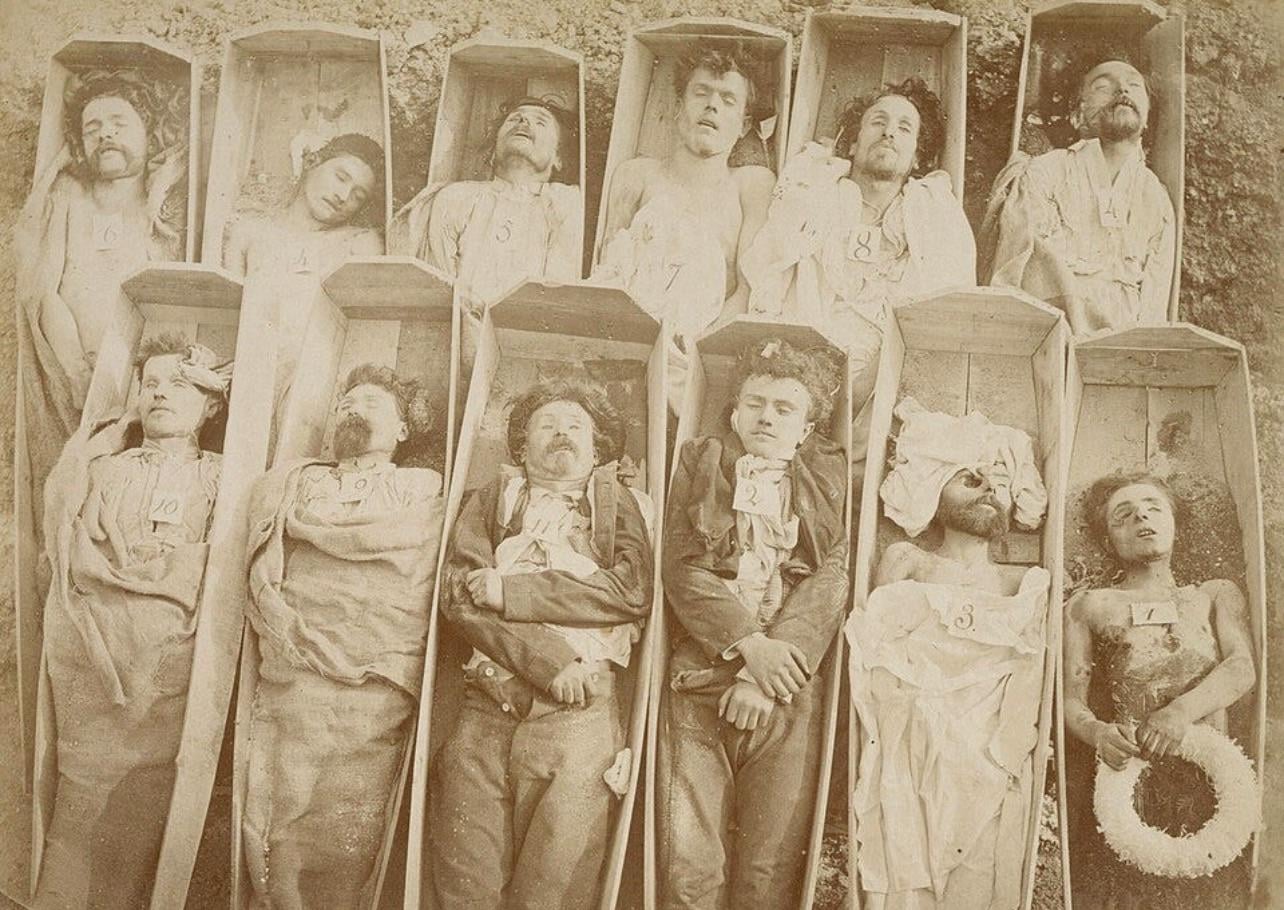
The Paris Commune was a radical, short-lived socialist government that controlled Paris from March 18 to May 28, 1871. It emerged following the collapse of the Second French Empire and during the Franco-Prussian War, when the city was under siege and facing severe shortages of food and supplies. The immediate trigger was a confrontation over cannons held by the National Guard in Montmartre, which escalated into an uprising against the provisional Third Republic government in Versailles.
The Commune established a municipal council through elections and implemented a series of reforms. These included the separation of church and state, the suspension of conscription and rent payments, the abolition of night work and the death penalty, and the promotion of local governance through neighborhood councils. However, it faced stark internal divisions between moderate elected officials and more radical factions, including the Blanquists and members of the socialist First International. While the Commune enacted reforms and attempted a decentralized governance structure, it lacked coordination with the rest of France, leaving it militarily vulnerable.
In response, the French government reorganized its army and advanced on Paris. The resulting conflict, known as the Semaine Sanglante (“Bloody Week”), involved street-by-street fighting, executions of armed Communards, killing of priests and the destruction of key buildings. Estimates suggest that 10,000 to 20,000 participants were killed, with tens of thousands more imprisoned or exiled.
Despite its short duration, the Paris Commune had a lasting influence on socialist and revolutionary movements worldwide. Karl Marx and Friedrich Engels praised it as a practical example of workers’ governance, though they also criticized its shortcomings. Later figures such as Vladimir Lenin and Mao Zedong studied it as a model. In France, the Commune remains a contested historical event, symbolizing both radical social experimentation and the challenges of revolutionary governance.
If you’re interested, I write more about the Commune here: https://open.substack.com/pub/aid2000/p/hare-brained-history-vol-77-the-paris?r=4mmzre&utm\\\\\\\_medium=ios
by aid2000iscool
9 Comments
More like commutards, amirite?!
[https://en.wikipedia.org/wiki/Paris_Commune](https://en.wikipedia.org/wiki/Paris_Commune)
Workers of the world unite, you have nothing to lose but your chains
Can anyone recommend any good books on the Paris Commune?
They were terrible people and it’s a shame they were not repressed even harder.
It’s even more a shame they’re romanticised now by wannabe-communists.
Reading history, it’s impressive how hardcore people were. Poverty and desperation fueled an enormous amount of death and bloodshed.
The language of your description is quite interesting. You deftly avoid noting *how* the Commune “emerged following the collapse of the Second French Empire.”
Specifically, it was a violent insurrection against the legitimate democratic government of the country, was it not?
The Franco-Prussian war was absolutely insane. France completely instigated the conflict, basically insisting that Germany would preemptively not try to put a Hapsburg monarch on the Spanish throne. The Germans demurred, France invaded. Meanwhile the Spanish went with an Italian, who was unaligned.
Still France invaded with Napoleon the 3rd at the head of the army and they were defeated so badly the majority of the army was captured or killed in a single battle. In two days the Germans captured 104,000 out of 120,000 French soldiers. Possibly the single worst defeat in modern military history.
The defeat was so catastrophic that it ended monarchy in France for good. However France wa occupied and Paris was besieged for 4 months. Thousands starved to death, hundreds of thousands died of disease.
The provisional war minister escaped Paris in a hot air balloon, and established a “government”. Eventually the French sued for peace in January 71.
In March the Parisian workers rose up and established the Commune. In order to put it down the Germans released the French army from captivity. In May they signed a treaty for territory and also founded Germany.
There’s a good case to make that the Paris Commune represents the true end of France’s distinct Revolutionary Era: between technological advances, the modernisation of the administrative state and critical ideological developments; for the first time since the 1780s taking control of Paris and dislodging the national government there wasn’t enough to affect full control over France.
Communication advances meant the rest of the country learned of events within hours and could involve themselves within days, not weeks and months like even 1848, the previous successful overthrow of a government. Perhaps even more critically, within a century the liberals of France had gone from being the radical revolutionaries to being the people the radicals wanted gone. The balance was already shifting by 1848, but by 1878 the government was a fresh liberal democracy, not a monarchy, destroying any cross-ideological alliance of revolution.