
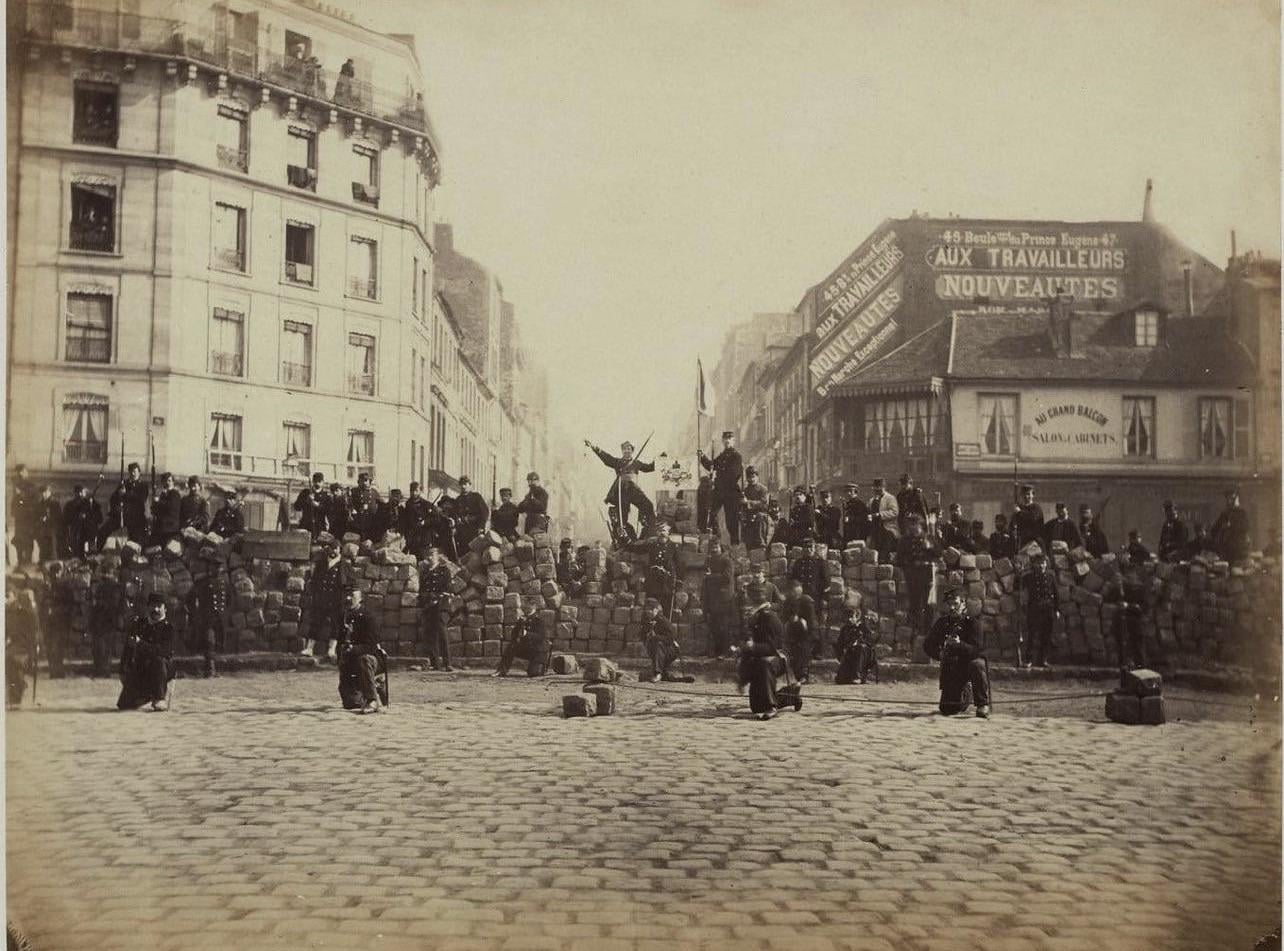
The Paris Commune was a radical, short-lived socialist government that controlled Paris from March 18 to May 28, 1871. It emerged following the collapse of the Second French Empire and during the Franco-Prussian War, when the city was under siege and facing severe shortages of food and supplies. The immediate trigger was a confrontation over cannons held by the National Guard in Montmartre, which escalated into an uprising against the provisional Third Republic government in Versailles.
The Commune established a municipal council through elections and implemented a series of reforms. These included the separation of church and state, the suspension of conscription and rent payments, the abolition of night work and the death penalty, and the promotion of local governance through neighborhood councils. However, it faced stark internal divisions between moderate elected officials and more radical factions, including the Blanquists and members of the socialist First International. While the Commune enacted reforms and attempted a decentralized governance structure, it lacked coordination with the rest of France, leaving it militarily vulnerable.
In response, the French government reorganized its army and advanced on Paris. The resulting conflict, known as the Semaine Sanglante (“Bloody Week”), involved street-by-street fighting, executions of armed Communards, killing of priests and the destruction of key buildings. Estimates suggest that 10,000 to 20,000 participants were killed, with tens of thousands more imprisoned or exiled.
Despite its short duration, the Paris Commune had a lasting influence on socialist and revolutionary movements worldwide. Karl Marx and Friedrich Engels praised it as a practical example of workers’ governance, though they also criticized its shortcomings. Later figures such as Vladimir Lenin and Mao Zedong studied it as a model. In France, the Commune remains a contested historical event, symbolizing both radical social experimentation and the challenges of revolutionary governance.
If you’re interested, I write more about the Commune here: https://open.substack.com/pub/aid2000/p/hare-brained-history-vol-77-the-paris?r=4mmzre&utm\_medium=ios
by aid2000iscool
2 Comments
The Revolutions podcast did a great season on the commune. Fascinating to think what could have been if it had survived longer.
Is this one of the corridors widened by Napoleon III? It looks way to wide to effectively barricade, like they did in previous decades.