
Data Source:
Job postings from Google, Apple, Meta, Microsoft, and Netflix extracted from BigQuery jobs database. Compares equivalent ~75-day periods year-over-year (same calendar window in 2025 vs 2026). Only includes positions with salaries ≥$80,000 to focus on professional/technical roles.
Full data / live dashboard at https://mobius-analytics-v2-83371012433.us-west1.run.app/
Tools Used:
- Recharts (React) for grouped bar chart visualization
- BigQuery for data aggregation and YoY comparison queries
- Material UI for styling with percentage change chips
Methodology:
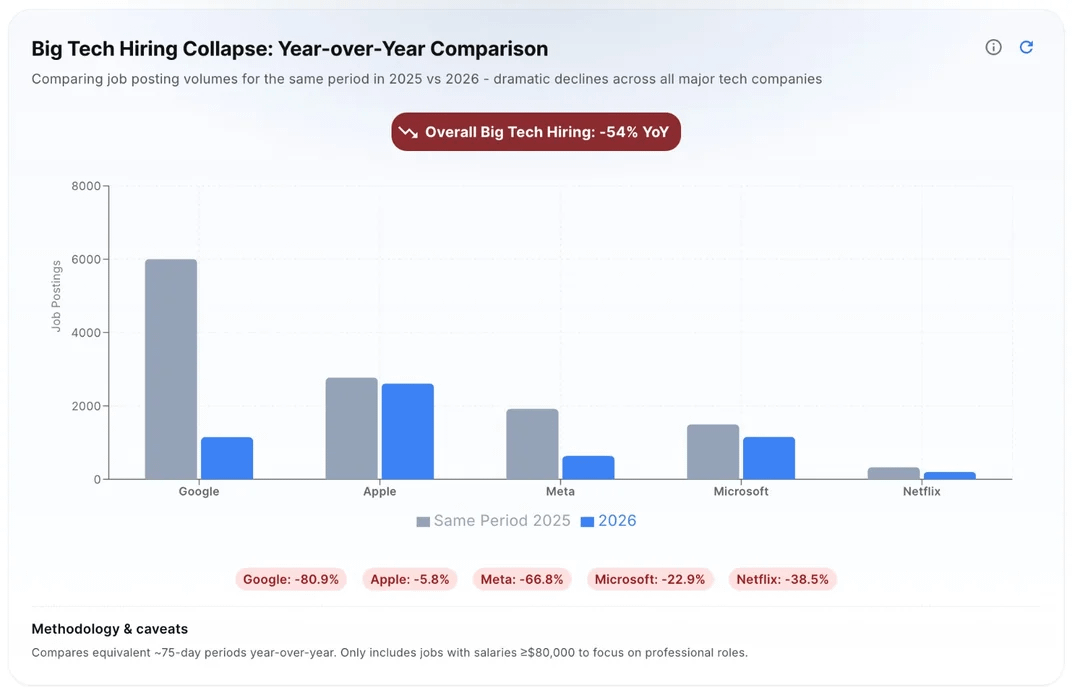
- Each bar represents total job postings during the comparison window
- Gray bars = 2025 baseline period, Blue bars = 2026 same period
- Percentage change calculated as ((2026 – 2025) / 2025) × 100
- Salary floor of $80K filters out hourly/retail positions to isolate tech hiring
Key Insights:
- Google's dramatic pullback: -80.9% decline (6,000 → 1,100 postings) — the steepest cut among FAANG
- Meta's continued contraction: -66.8% drop reflects ongoing "Year of Efficiency" restructuring
- Apple's relative stability: Only -5.8% decline — notably resilient compared to peers
- Microsoft holding steadier: -22.9% decrease despite AI investment announcements
- Netflix trimming: -38.5% reduction in a smaller but significant hiring footprint
- Overall FAANG hiring down 54% — suggests structural shift, not seasonal fluctuation
What This Might Mean:
The data suggests Big Tech has moved from "growth at all costs" to sustainable headcount. Google's 81% drop is particularly striking given their AI race positioning. Apple's resilience may reflect hardware product cycles vs. software-heavy peers.
by aaghashm
1 Comment
What is also interesting here is that many big tech companies will keep phantom jobs posted with no intention of filling them, because they know people are watching their posting activity.