
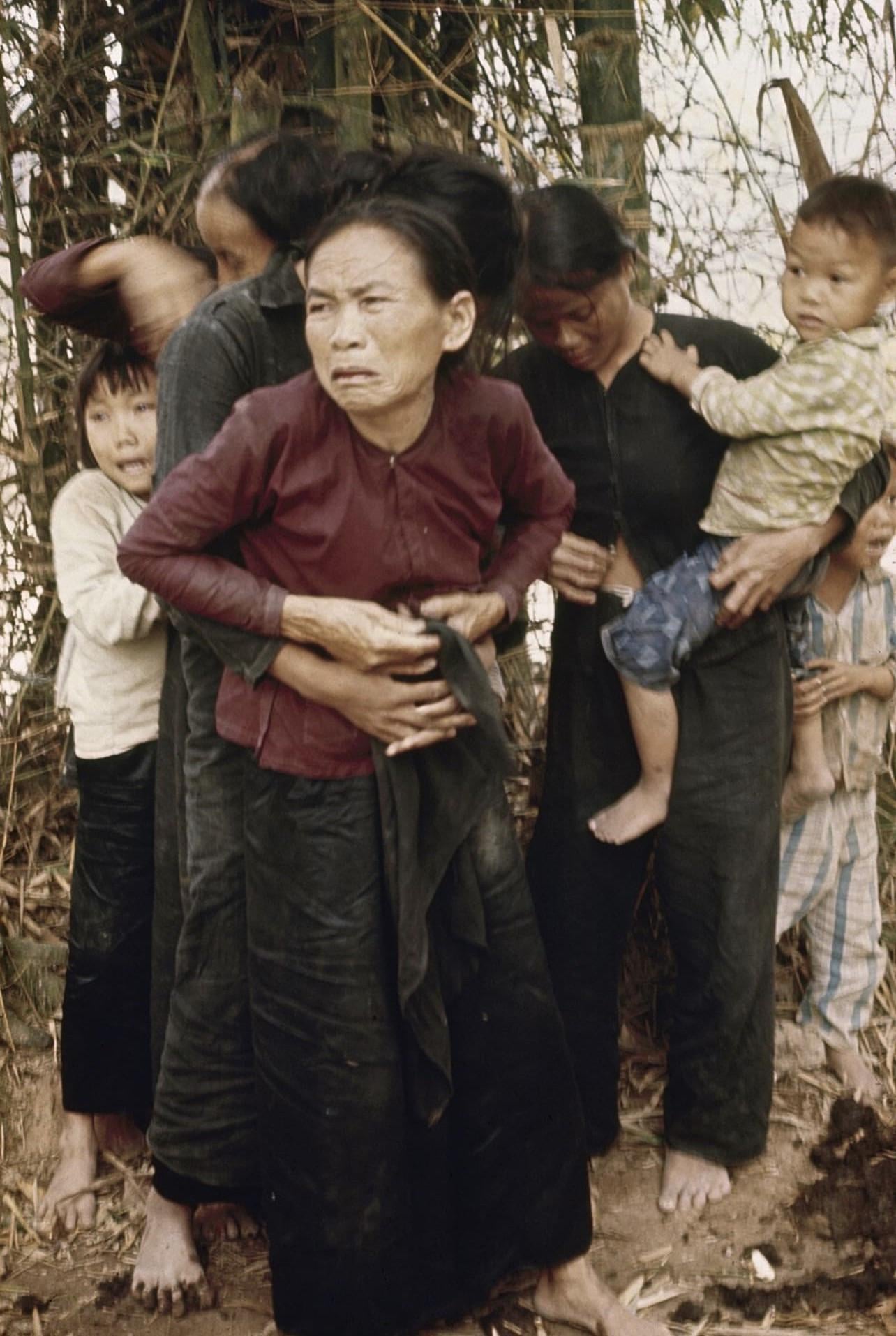
On March 16, 1968, American soldiers entered the village of Sơn Mỹ in Quảng Ngãi Province, searching for Viet Cong during the ongoing Tet Offensive. Intelligence had suggested several coastal hamlets were sheltering guerrillas.
Soldiers had been briefed by Colonel Oran Henderson to “go in there aggressively, close with the enemy, and wipe them out for good.”
Captain Ernest Medina of Charlie Company, 1st Battalion, 20th Infantry Regiment, 11th Brigade, 23rd Infantry Division reportedly told his men of the villagers: “They’re all VC. Now go and get them.”
Some soldiers later recalled being ordered to destroy anything “walking, crawling, or growling,” while another remembered: “We were told to leave nothing standing.”
At roughly 8:00 AM, the 1st Platoon led by First Lieutenant William Calley and the 2nd Platoon led by Stephen Brooksentered the hamlet of Tu Cung. Instead of encountering Viet Cong, they found villagers preparing breakfast and getting ready for market. What followed was the My Lai Massacre.
Hundreds of unarmed civilians, elderly people, women, children, and infants, were killed. The U.S. Army later estimated 347 deaths, while the Vietnamese government lists 504 victims.
Soldiers fired into groups of civilians and into homes. Dennis Konti later testified:
“A lot of women had thrown themselves on top of the children to protect them… The children who were old enough to walk got up and Calley began to shoot the children.”
Army photographer Ronald L. Haeberle documented the massacre with his camera. He captured the scene in the photograph above. Haeberle later recalled, “They started stripping her, taking her top off, and the mother, if that was her mother, was trying to protect her. The GIs were punching her around, and one of them kicked her,” before they were all shot.
Above the village, a helicopter crew, pilot Hugh Thompson Jr., Glenn Andreotta, and Lawrence Colburn, began noticing bodies everywhere.
Thompson later recalled:
“Everywhere we'd look, we'd see bodies. These were infants, two-, three-, four-, five-year-olds, women, very old men. No draft-age people whatsoever.”
At first the crew believed the casualties were caused by artillery. After landing and seeing the killings firsthand, Thompson confronted Calley:
Thompson: “What’s going on here, Lieutenant?”
Calley: “This is my business.”
Thompson: “But these are human beings, unarmed civilians.”
Calley: “Look, Thompson, this is my show. It ain’t your concern.”
Thompson: “You ain’t heard the last of this.”
Thompson and his crew then intervened, evacuating civilians and at one point positioning their helicopter between soldiers and fleeing villagers. Thompson reportedly ordered his crew to fire on American troops if they continued attacking civilians.
Around 11:00 AM, the killings finally stopped. Soldiers paused for lunch.
That evening, the official press briefing reported:
“In an action today, Americal Division forces killed 128 enemy near Quang Ngai City.”
What followed was a massive cover-up. When the truth eventually emerged, only Calley was convicted, and he was later pardoned.
If interested, I wrote a full breakdown of the massacre, its aftermath, and the broader context of the war here: https://open.substack.com/pub/aid2000/p/hare-brained-history-vol-76-the-my?r=4mmzre&utm\_medium=ios
by aid2000iscool
14 Comments
Who are the terrorists again?
I remember the first time I read about this and saw the photos, I was physically ill for a while. There is one photo in particular featuring the corpses of naked dead infants on the side of the road that I can’t seem to get out of my head.
It’s infuriating that the guy behind the massacre was given a presidential pardon and is now chilling in Florida.
For those who are not Vietnamese, please allow me to explain the truth hidden in plain sight:
Mỹ Lai, a South Vietnamese village and pro-America, was taken over by American soldiers. They tortured, raped women & children then killed and blowtorched the **entire** Village to cover up their atrocities. The original name of this village was Mỹ Sơn (literal translation of “Mỹ” is beatiful and “Sơn” is paint – so “Picturesque Village”). When American soldiers entered the war the word Mỹ became synonymous to “Americans” as in “người Mỹ” (beautiful people).
The village changed its name to “Mỹ Lai” likely after the massacre (“Lai” means Lie/Deceipt). No longer the “Picturesque Village” but simple truth: Americans Lied.
The united states has done many terrible things and made many mistakes.
To acknowledge this simple fact is not anti-american and never will be, no matter what brain-washed nationalists tell you.
Absolutely fucked, peaceful people living out their lives and those animals turn up
utterly disgraceful
Why did OP leave out the gang rape and sexual violence towards of Vietnamese women ?
These women and girls were also r*ped before this photo was taken.
This photo was taken both moments after all but one two of the people in this photo were raped by uniformed members of the us army and every single one of these people would by murdered by uniformed members of the us army.
Poor Ted Turner colorization distracting and unnecessary.
Yet those same people would have done the exact same thing in a heartbeat if they weren’t unarmed. Vietnam got smashed and just didn’t wanna admit defeat. RiPiss
I have seen this picture a dozen times, but the horror and despair on her face always gives me the chills. So sad.
And those criminals will be honoured as heroes in America.
Shit like this was common practice in the Vietnam War. There was another massacre in My Khe just a few miles away at the same time as My Lai.