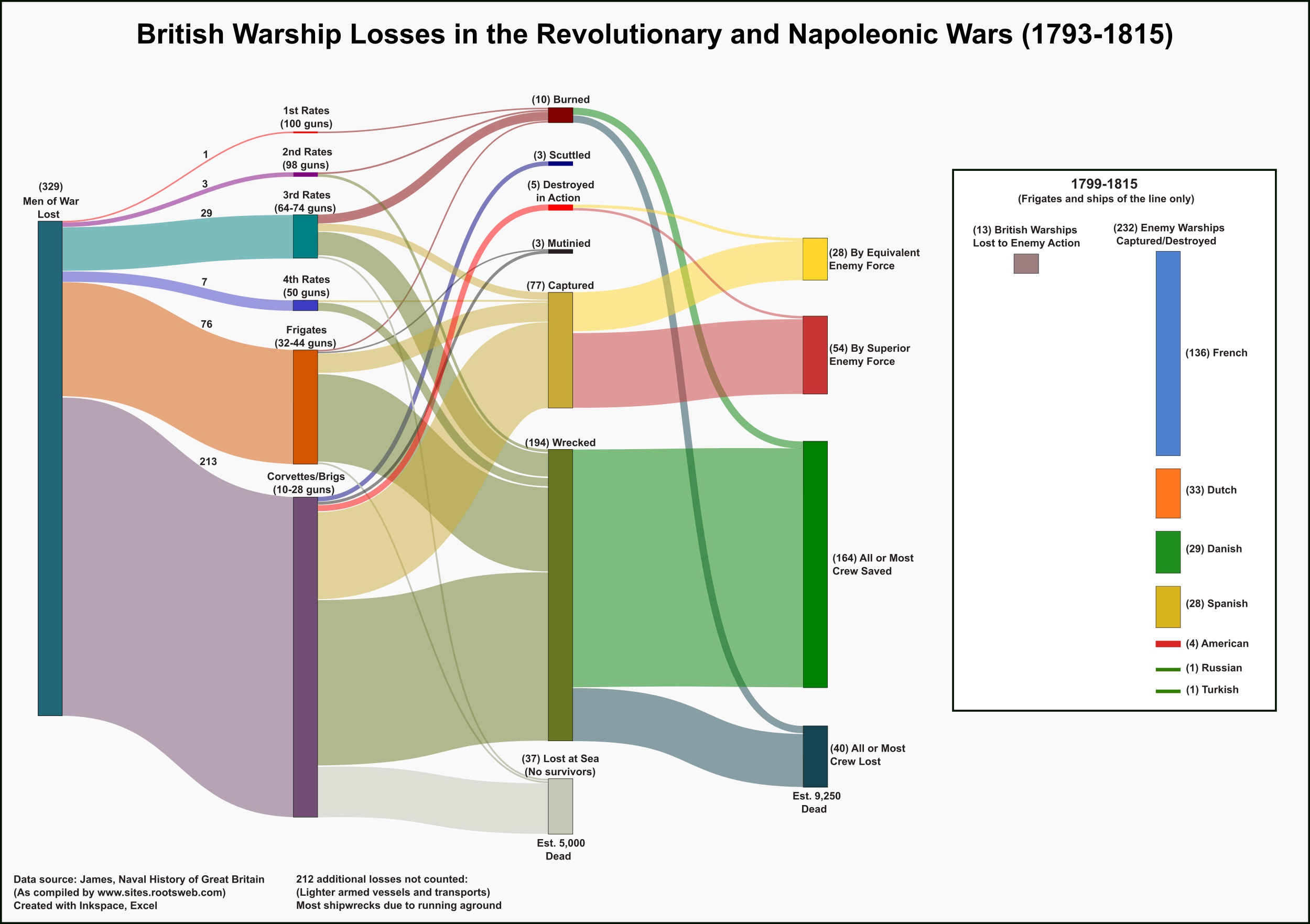
[OC] The British Navy lost 329 significant warships during the French Revolutionary and Napoleonic Wars, mostly due to navigation errors and storms. In actual combat involving large warships, ~18 enemy vessels were taken or destroyed for each British ship lost.
by ppitm

1 Comment
Key takeaways from this data are the oppressively lopsided outcomes of combat between British and foreign warships. Combat losses of large warships were exceedingly rare, typically in unequal engagements. The earlier parts of the 18th Century saw other European navies put up a better fight, generally speaking.
The true enemy was the ocean, as accidental groundings accounted for a plurality of losses. The demand for global operations and close blockades of the dangerous French coast made this inevitable. With around 15,000 deaths due to accidents and the elements, combat casualties cannot begin to compare. For 54 of 77 captures of British vessels by superior enemy forces, surrender would often come rapidly, with little bloodshed. For British combat losses in evenly-matched engagements, the Americans account for more than their fair share.
The lower cutoff for the data is determined by size, and is a bit messy. The 329 vessels in the sample size are meant to include most square-rigged men of war, although around 20 ship-rigged sloops may have been omitted, as have miscellaneous combatants such as bomb vessels, fire ships, hired vessels, cutters, schooners, troop ships and store ships.
Another compelling correlation here is between size and vulnerability to being lost at sea with all hands. Virtually all of those casualties were smaller ships and brigs. Stability increases rapidly with tonnage, and as a general rule a vessel can be capsized by a breaking wave equal in height to the width of its hull. So there is a big difference between a 20′ wide brig and a 30′ wide frigate. The large warships seldom vanished without a trace, except in major hurricanes. But everyone was equally vulnerable to striking hidden reefs or being blown ashore in a gale.
Data source: https://sites.rootsweb.com/~pbtyc/Naval_History/Reports/Index.html
Tools used: Inkspace, Excel