
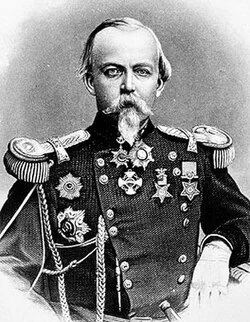
In 1863 in Egypt came the rule of Khedive Ismael Pasha الخديوي إسماعيل باشا and Between 1869 and 1878, Ismael recruited about 49 American officers to help modernize the Egyptian army. Interestingly, some of them had served in the Union army while others had fought for the Confederacy during the Civil War. Yet in Egypt they worked together !
Stone Pasha in the Citadel
At the Battle of Ball's Bluff in October 1861, where a reckless attack led to the death of a sitting U.S. Senator and the slaughter of Union troops, there was a need for a scapegoat. Charles P. Stone, the overall commander in the area but not present at the battle, was that scapegoat.
Powerful political enemies, including the radical abolitionist Senator Charles Sumner, saw to it that Stone was arrested and thrown into Fort Lafayette in New York Harbor. For 189 days, he was held without charge, without trial, in a prison meant for traitors and spies. He was later released in August 1862, a broken man.
After the war, Stone worked as a mining engineer in Virginia, but the stain on his honor never faded. So, when an opportunity arose in 1869 to join a unique military mission to Egypt, he joined immediately. For Stone, it was a chance to rebuild not just an army, but his own shattered self-esteem. Khedive Ismael welcomed him with open arms and he was appointed as Chief of Staff of the Egyptian Army with the rank of Fariq فريق (Lieutenant General).
Stone served in Egypt for 13 full years, longer than any other American officer. Throughout this period, his office was in a solemn site : Saladin Citadel قلعة صلاح الدين in Cairo. The Egyptian troops called him "Stone Pasha ستون باشا", and this was a great honor at the time. The reason was that he was different from the rest of American officers: he was not adventurous and did not just need money. He wanted to build a real institution for the Egyptian army.
For the next thirteen years, from 1870 to 1883, Stone Pasha would serve two Khedives, Ismael إسماعيل and his son Tawfiq توفيق.
He built a modern general staff, established technical schools for officers and soldiers, and began the colossal task of surveying the Khedive's vast dominions.
This survey was perhaps Stone's greatest contribution. He took charge of the "Survey of Egypt," a project of immense strategic importance. He and his team of American and Egyptian officers became the Khedive's cartographers, meticulously mapping not only Egypt but also the Sudan, Uganda, and the frontiers of Ethiopia.
One of his officers, Samuel H. Lockett, a brilliant engineer who had designed the famous Confederate defenses at Vicksburg, would go on to produce the "Great Map of Africa" under Stone's direction, a true cartographic masterpiece.
Stone's vision extended beyond the purely military. In 1875, he was instrumental in founding the Khedivial Geographical Society in Cairo, one of the first scientific institutions of its kind in Africa.
At last In 1881-82, former war minister Ahmed Urabi-Arabi أحمد عرابي (whose name was given to a district, Arabi, Louisiana near New Orleans, , as he was inspiring to all anti-colonialists and revolutionist movements in the world and always appeared on British and American Newspapers at the time).
Urabi led a nationalist revolt against Khedive Tawfiq and the growing European intervention in Egypt. The crisis escalated in July 1982, when the British fleet bombarded the city of Alexandria الأسكندرية.
As shells rained down on the city, Stone Pasha made a choice. He stayed by the side of the Khedive Tawfiq, and had taken refuge in the still-burning city, refusing to abandon his post even as his own wife and daughters were trapped and isolated in Cairo.
The British bombardment was the prelude to their full-scale invasion and occupation of Egypt. Urabi was defeated in September 1882 at the Battle of Tell El Kebir معركة التل الكبير, and was captured, imprisoned and ultimately exiled in Island of Ceylon (Present-day Sri Lanka).
Frustrated and with his life's work undone, Stone Pasha finally resigned in 1883 and returned with his family to the United States.
He was appointed chief engineer for the Liberty statue's pedestal in New York. He died on January 24, 1887.
by ismaeil-de-paynes
1 Comment
I recommend you to read my 2 posts about the Civil War :
**The Anecdotes of Egypt and The American Civil War**
[https://www.reddit.com/r/CIVILWAR/comments/1rpb9q3/the_anecdotes_of_egypt_and_the_american_civil_war/](https://www.reddit.com/r/CIVILWAR/comments/1rpb9q3/the_anecdotes_of_egypt_and_the_american_civil_war/)
**The Anecdotes of Ex Confederate – Union Officers in Egypt**
[https://www.reddit.com/r/CIVILWAR/comments/1rtxtt9/the_anecdotes_of_ex_confederate_union_officers_in/](https://www.reddit.com/r/CIVILWAR/comments/1rtxtt9/the_anecdotes_of_ex_confederate_union_officers_in/)