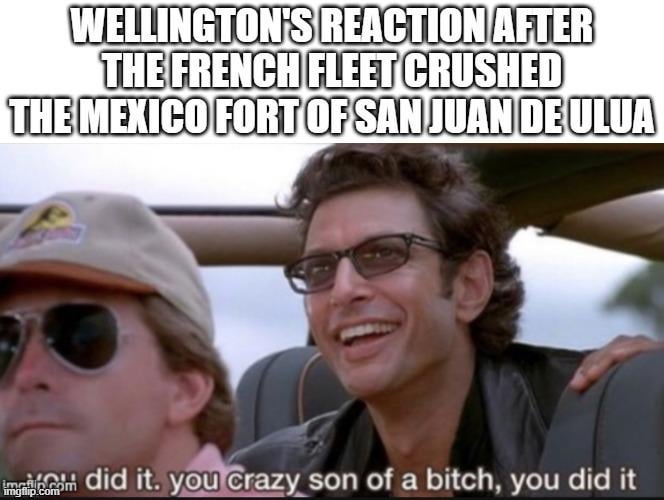
>[The fall of San Juan de Ulua came as a surprise to the world. Neutral observers, notably from HMS Satellite, under Captain Robb, and USS Levant, reported the effect of the French bombardment. Lord Wellington is often reported to have stated in the House that the incident was the only recorded example of a strong fort overwhelmed entirely by a naval squadron.](https://en.wikipedia.org/wiki/Battle_of_Veracruz_(1838))
Despite mostly forgotten today, this event is notable in the history of naval development in that it shifted the assumed balance of power between warships and forts (which up to that point beforehand conventional military wisdom assumed that forts have the upper hand by default). This shift come about with the usage of explosive shells and steam power, both of which would also transform naval warfare for the next century and beyond.

1 Comment
To quote Wikipedia:
>[The fall of San Juan de Ulua came as a surprise to the world. Neutral observers, notably from HMS Satellite, under Captain Robb, and USS Levant, reported the effect of the French bombardment. Lord Wellington is often reported to have stated in the House that the incident was the only recorded example of a strong fort overwhelmed entirely by a naval squadron.](https://en.wikipedia.org/wiki/Battle_of_Veracruz_(1838))
Despite mostly forgotten today, this event is notable in the history of naval development in that it shifted the assumed balance of power between warships and forts (which up to that point beforehand conventional military wisdom assumed that forts have the upper hand by default). This shift come about with the usage of explosive shells and steam power, both of which would also transform naval warfare for the next century and beyond.