
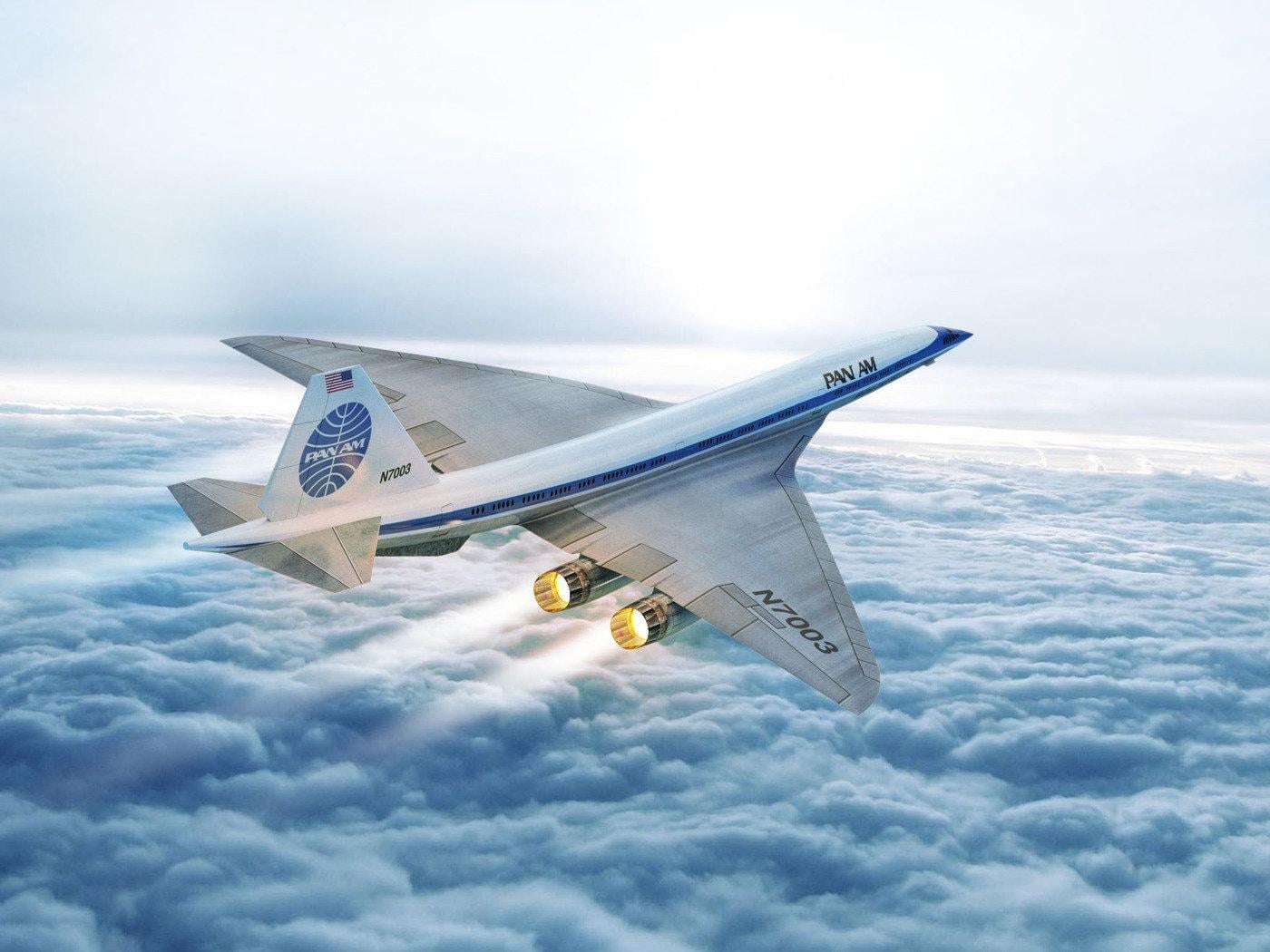
An actual concept for an American supersonic airliner that made it all the way to full-scale mock-up, including cabin design. Original design had swept wings like the B-1 Lancer, but evolved into a shape similar to the Concorde (though much larger).
This is art by Miroslav Dorotcin – he has quite a few more concepts in this Pan Am livery here: https://www.coroflot.com/MiroslavDorotcin/Aircraft-Design
by OrwellianChild
4 Comments
Specs ?
It’s was never realised …. So unfortunate.
On that train all graphite and glitter
Undersea by rail
Ninety minutes from New York to Paris
Well by ’76 we’ll be A-OK
It would have been a monster. Up to 300 feet long, because that’s the only way to pack 250 passengers into a supersonic airframe. Mach 2.7 because that’s the only way to make enough USA – Europe – USA transatlantic rotations within a single day (a 747 does a single rotation, Concorde made two, Mach 2.7 allows three). That was the one and only way a SST could breakeven a) transatlantic airway b) lots of daily rotations c) much more than 200 passengers. Mach 2.2 Concorde with max 140 pax was economically doomed long before the 1973 oil shock.
Transpacific (Tokyo – Los Angeles) would have been better but it simply wasn’t feasible technology wise to fly 10 000 km supersonically without a stop in Hawaii. Max range was 7000 km -something. The only way to get better range would have been a supersonic L/D of 9 rather than 7, but the SCAT-15F aerodynamic shape would have needed digital FBW to control its nasty stall characteristics, not doable in the 1960s.
Titanium airframe as aluminum couldn’t stand Mach 2.7 while steel would be too heavy. Up to 700 000 pounds in weight at takeoff, with each GE4 turbojet almost 30 tons of thrust.
If you think the SR-71 and XB-70 are big: the former is 100 ft long the other 200 ft but the SST would have been 300 ft long – longer than any 747, A380 or An-225.