
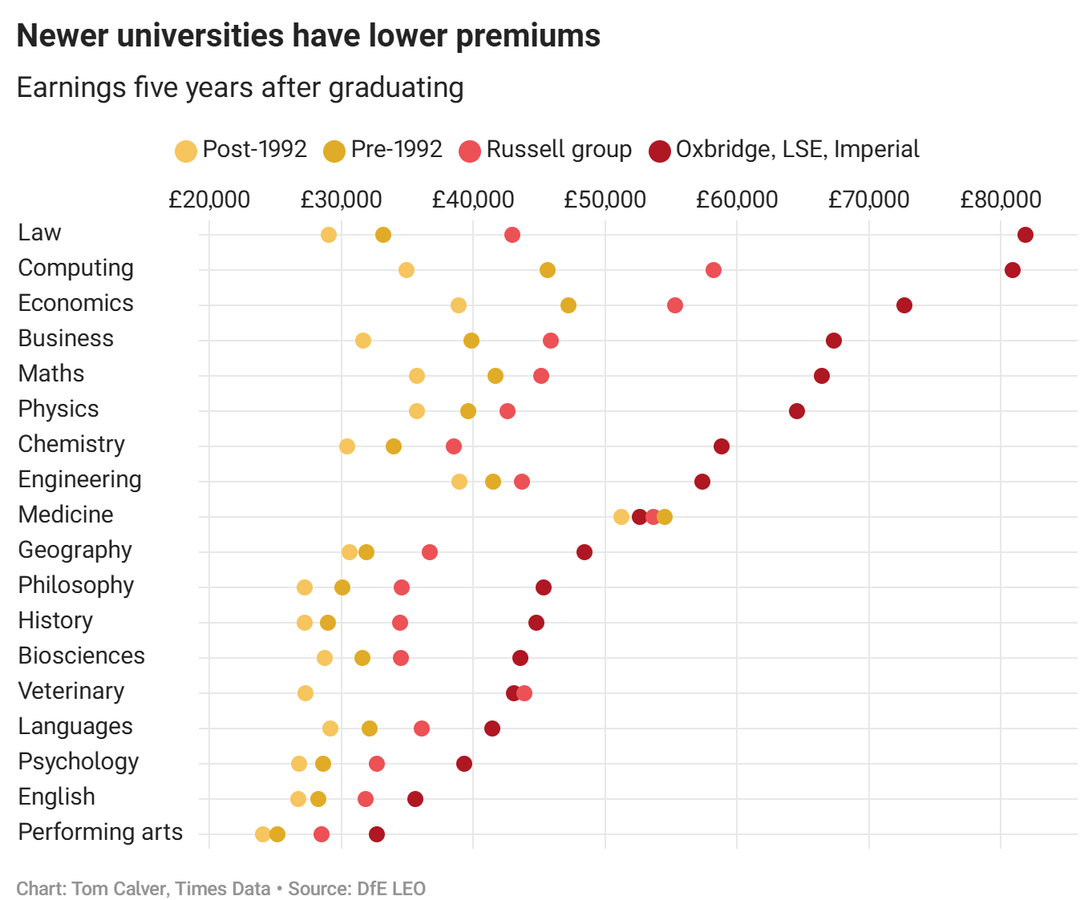
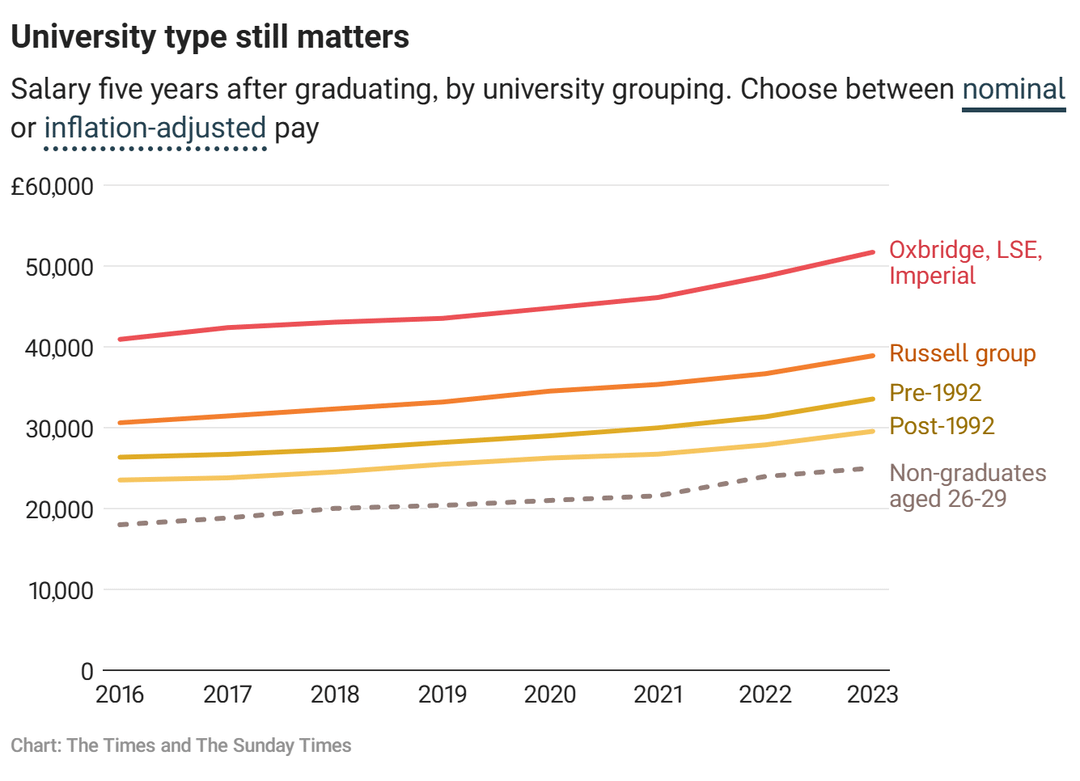
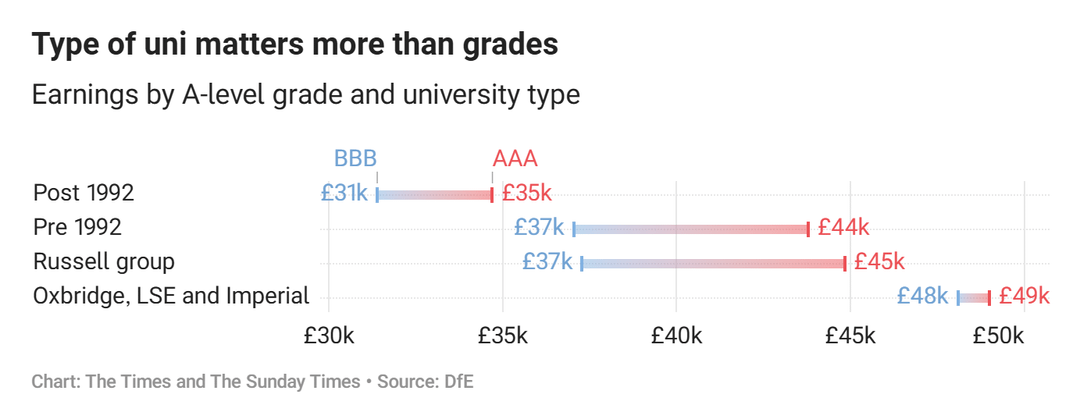
Explainer of the groups if you're unfamiliar:
- The first category includes Oxford, Cambridge, London School of Economics, and Imperial College London. These are generally seen as the best universities in the UK.
- Russell Group is a group of 24 reputable large research universities, minus the first four. These are generally seen as the next best tier.
- Pre-1992 refers to the rest of the universities in the UK outside of the Russell Group that were chartered as universities before the Further and Higher Education Act 1992
- The Further and Higher Education Act 1992 upgraded the polytechnics into full universities, and the post-1992 group refers to this group.
by Uptons_BJs
4 Comments
How does this correlate to global rankings for the universities? My guess is that the older the university, the higher ranked it is, thus it results in a higher wage premium?
Largely proving it’s networking and the UK class system rather than skill levels, right?
Medicine really jumps out here. Is this related to how the NHS standardizes doctors’ wages?
I suspect we’re not seeing the real determining variable here, which is where the high-paying firms recruit from. Rather than the jobs being differentiated within the firms, tilting towards Oxbridge, it is certain firms that pay a lot more for every job they hire for.
My guess is that high paying firms in law and finance are overwhelmingly biased towards Oxbridge recruitment. Your magic circle law firms, investment banks, prop trading firms, high-level consultants, and the tech giants.
If we could see the actual distributions of incomes, it would probably be highly skewed due to a few mega salary employers who tend to recruit at the prestigious universities.
If you look at a few of these jobs you will find eg a lawyer at magic circle making six figures, vs an ordinary high street lawyer making a lot less. A software guy at google makes a lot more than the same guy at another firm.