> In the Punjab, the Sikh princes crucially helped the British by providing both soldiers and support. The large princely states, Hyderabad, Mysore, Travancore, and Kashmir, as well as the smaller ones of Rajputana, did not join the rebellion, serving the British, in the Governor-General Lord Canning’s words, as “breakwaters in a storm”.
mathdhruv on
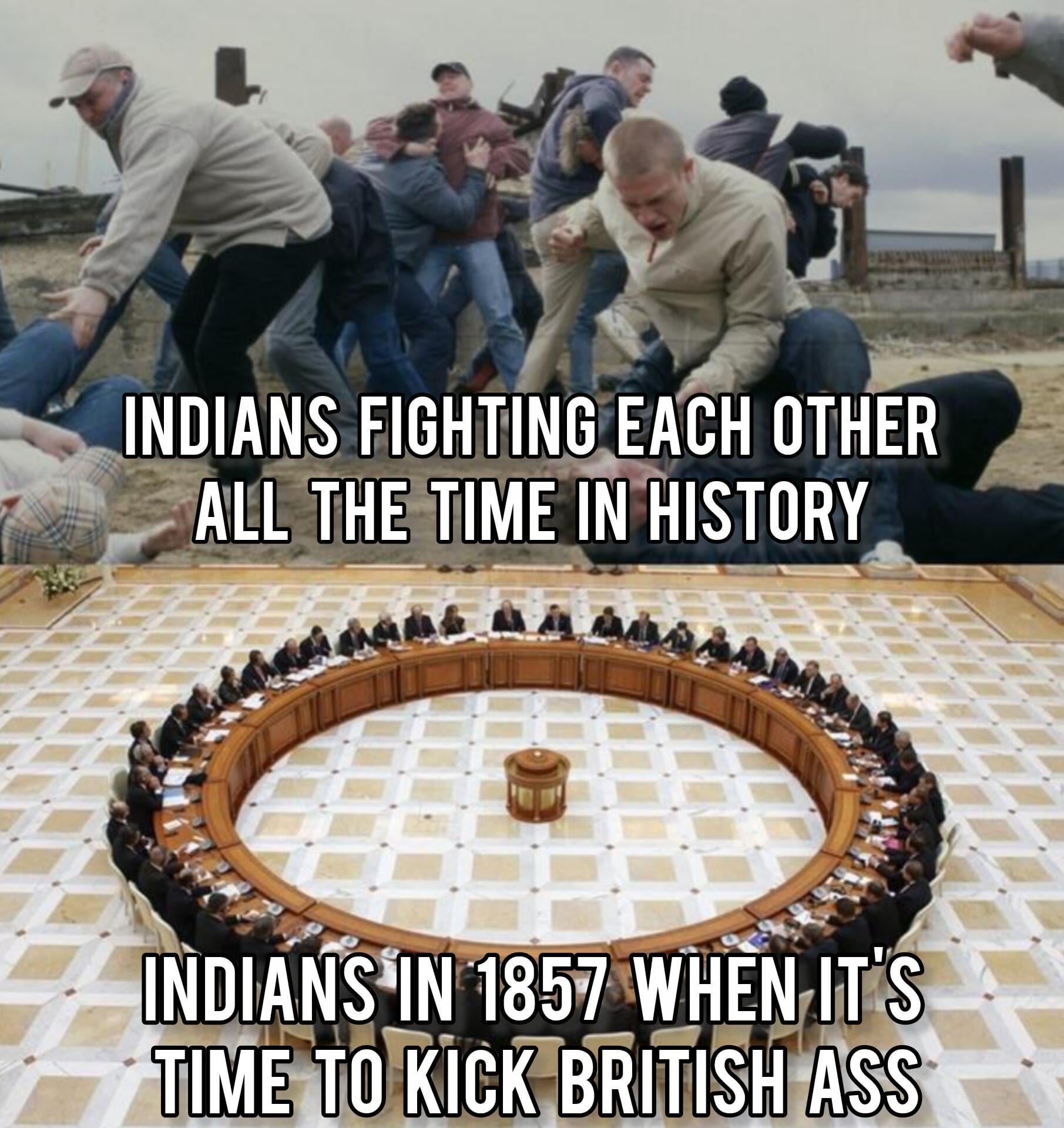
Yeah they kicked such good British ass that *checks notes* the British Raj’s territories grew, and British Rule over the subcontinent lasted another 90 years.
mossmanstonebutt on
The image should be the same,the reason it was so damnably easy to take India in comparison to say, Afghanistan,is because all you had to do was say “I’ll help you kill X if you agree to vassalage”
SatynMalanaphy on
Lol nope. That was a set of localized uprisings that only became bestowed with a unifying sheen after the Republic of India became a thing and needed to build a suitable narrative to tell to unite this fundamentally disunited subcontinent. A majority of the big players, including the important kingdoms (princely states, if you must), did not participate or condone the revolt, and the instigators themselves barely coordinated among themselves, if at all.
ThinBobcat4047 on
Not really, a bunch of Indian princes sided with the Brits, and the company used Indian troops from Punjab to crush the uprising in Delhi.
Acrobatic-Rip-4362 on
They did such a good job… I guess that’s why India wasn’t independent until 1947
45000BC on
No they didn’t. That’s part of why they lost.
FatherofWorkers on
Another historically illiterate post. Britain quelled the rebellions with ”volunteer” Indian troops. So they sold their country for money.
Schwiftness on
…and then India went back to racial violence, not long afterwards. How else do you end up with someone like modi today?
pinespplepizza on
The only path to modern Indian military dominance is bringing back war elephants
Rollover__Hazard on
Another low effort and just blatantly wrong meme.
What happened to this sub?
PositiveMaster8236 on
Err no!, there were still multiple factions that didn’t side with the anti East India Company Faction, it one of the reasons why there were self governing kingdoms that lasted until 1947, when ironically the Indian state post 1947 annexed them
Crismisterica on
I think you fell for the Indian narrative that tried to build a national identity off scraps. The EIC was removed however the British Raj remained and grew even stronger for 90 more years and expanded to the entire subcontinent. The Rebellion was a failure.
Not only that but many Indian, Sikh and muslim kingdoms within the EIC fought against the rebellion which included thousands of Indians.
Though 6000 British were killed that is absolutely nothing compared to the 800,000 Indians that were later killed because of the rebellion, famines and reprisals that followed.
mightypup1974 on
Fact checked by 100% real Indian nationalists
ThatOneVolcano on
Except they didn’t….
ZeltbahnLife on
…No…
Additional-Monk6669 on
I remember the Sikhs were against the rebellion as they’d rather have Britishers over Mughals.

20 Comments
Nope, just check who helped the EIC quell the rebellion
The Singhs definitely didn’t unite with the Indians. And I assume a lot of other communities as well.
Mom, the Mohdi-fondlers are making shit up again!
https://en.wikipedia.org/wiki/Indian_Rebellion_of_1857
> In the Punjab, the Sikh princes crucially helped the British by providing both soldiers and support. The large princely states, Hyderabad, Mysore, Travancore, and Kashmir, as well as the smaller ones of Rajputana, did not join the rebellion, serving the British, in the Governor-General Lord Canning’s words, as “breakwaters in a storm”.
Yeah they kicked such good British ass that *checks notes* the British Raj’s territories grew, and British Rule over the subcontinent lasted another 90 years.
The image should be the same,the reason it was so damnably easy to take India in comparison to say, Afghanistan,is because all you had to do was say “I’ll help you kill X if you agree to vassalage”
Lol nope. That was a set of localized uprisings that only became bestowed with a unifying sheen after the Republic of India became a thing and needed to build a suitable narrative to tell to unite this fundamentally disunited subcontinent. A majority of the big players, including the important kingdoms (princely states, if you must), did not participate or condone the revolt, and the instigators themselves barely coordinated among themselves, if at all.
Not really, a bunch of Indian princes sided with the Brits, and the company used Indian troops from Punjab to crush the uprising in Delhi.
They did such a good job… I guess that’s why India wasn’t independent until 1947
No they didn’t. That’s part of why they lost.
Another historically illiterate post. Britain quelled the rebellions with ”volunteer” Indian troops. So they sold their country for money.
…and then India went back to racial violence, not long afterwards. How else do you end up with someone like modi today?
The only path to modern Indian military dominance is bringing back war elephants
Another low effort and just blatantly wrong meme.
What happened to this sub?
Err no!, there were still multiple factions that didn’t side with the anti East India Company Faction, it one of the reasons why there were self governing kingdoms that lasted until 1947, when ironically the Indian state post 1947 annexed them
I think you fell for the Indian narrative that tried to build a national identity off scraps. The EIC was removed however the British Raj remained and grew even stronger for 90 more years and expanded to the entire subcontinent. The Rebellion was a failure.
Not only that but many Indian, Sikh and muslim kingdoms within the EIC fought against the rebellion which included thousands of Indians.
Though 6000 British were killed that is absolutely nothing compared to the 800,000 Indians that were later killed because of the rebellion, famines and reprisals that followed.
Fact checked by 100% real Indian nationalists
Except they didn’t….
…No…
I remember the Sikhs were against the rebellion as they’d rather have Britishers over Mughals.