
Source & Methodology
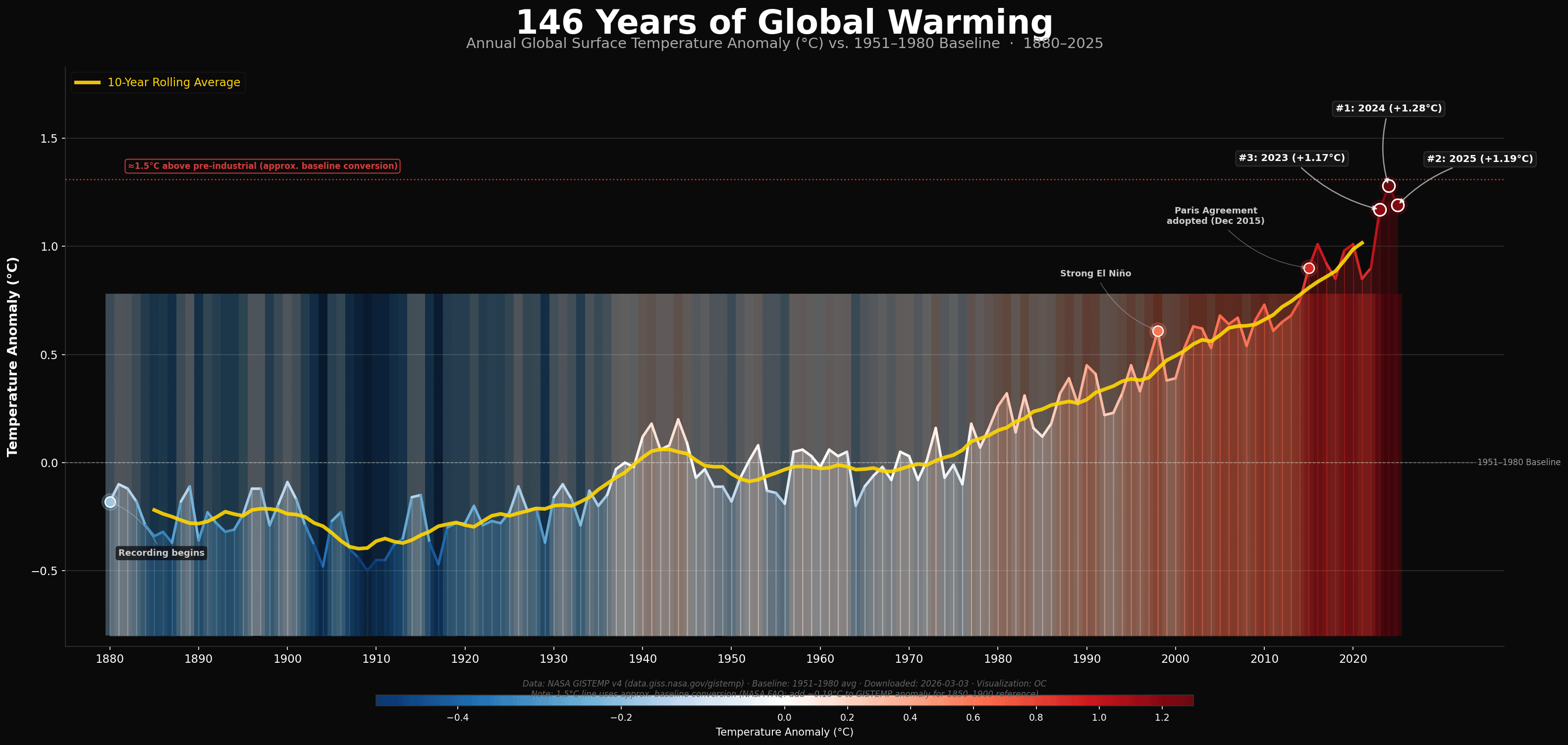
• Data: NASA GISTEMP v4 — downloaded directly from data.giss.nasa.gov/gistemp on 2026-03-03
• Baseline: Anomalies are relative to the 1951–1980 global average (NASA's standard baseline)
• Tool: Python (matplotlib + pandas), run in Google Colab.
• Key context from NASA press releases:
2024: +1.28°C — warmest year on record (NASA, Jan 10, 2025)
2025: +1.19°C — effectively tied with 2023 as 2nd warmest (NASA, Jan 14, 2026)
2024's record followed 15 consecutive months of monthly temperature records (Jun 2023–Aug 2024)
• 1.5°C threshold line note: The dashed red line shows ≈1.5°C above pre-industrial (1850–1900). Converting between baselines is approximate — NASA's FAQ (as of Jan 2025) says you can add ~0.19°C to a GISTEMP anomaly to approximate the anomaly relative to 1850–1900. So 1.5°C pre-industrial ≈ 1.31°C in GISTEMP units. This conversion may shift slightly as methodology evolves.
• Paris Agreement: Adopted Dec 12, 2015 at COP21; entered into force Nov 4, 2016. Annotated at 2015.
• Top 3 warmest years are computed dynamically from the dataset — not hardcoded. If NASA revises the data, the chart updates automatically.
• Citation: GISTEMP Team, 2025: GISS Surface Temperature Analysis (GISTEMP), version 4. NASA Goddard Institute for Space Studies. Lenssen et al. (2024), J. Geophys. Res. Atmos., 129(17), e2023JD040179.
by labubugotmyheart
6 Comments
It’s painfully obvious humans are gonna do nothing about this because we are psychologically incapable of planning ahead.
I am so glad I’m gonna die in 30 years before the water wars start lol
It has been unseasonably warm lately
Never realized it was so cold 100 years ago
Can we be an iota more terrified
[We Are Fucking Fucked](https://youtu.be/ac4E_UsmB1g)
I JUST WANT it to get bad before the phuqqed boomer denialists, like Teump, DIE ! ! !