
A growing number of people are interested in switching from dairy to plant-based alternatives.
But are they better for the environment, and which is best?
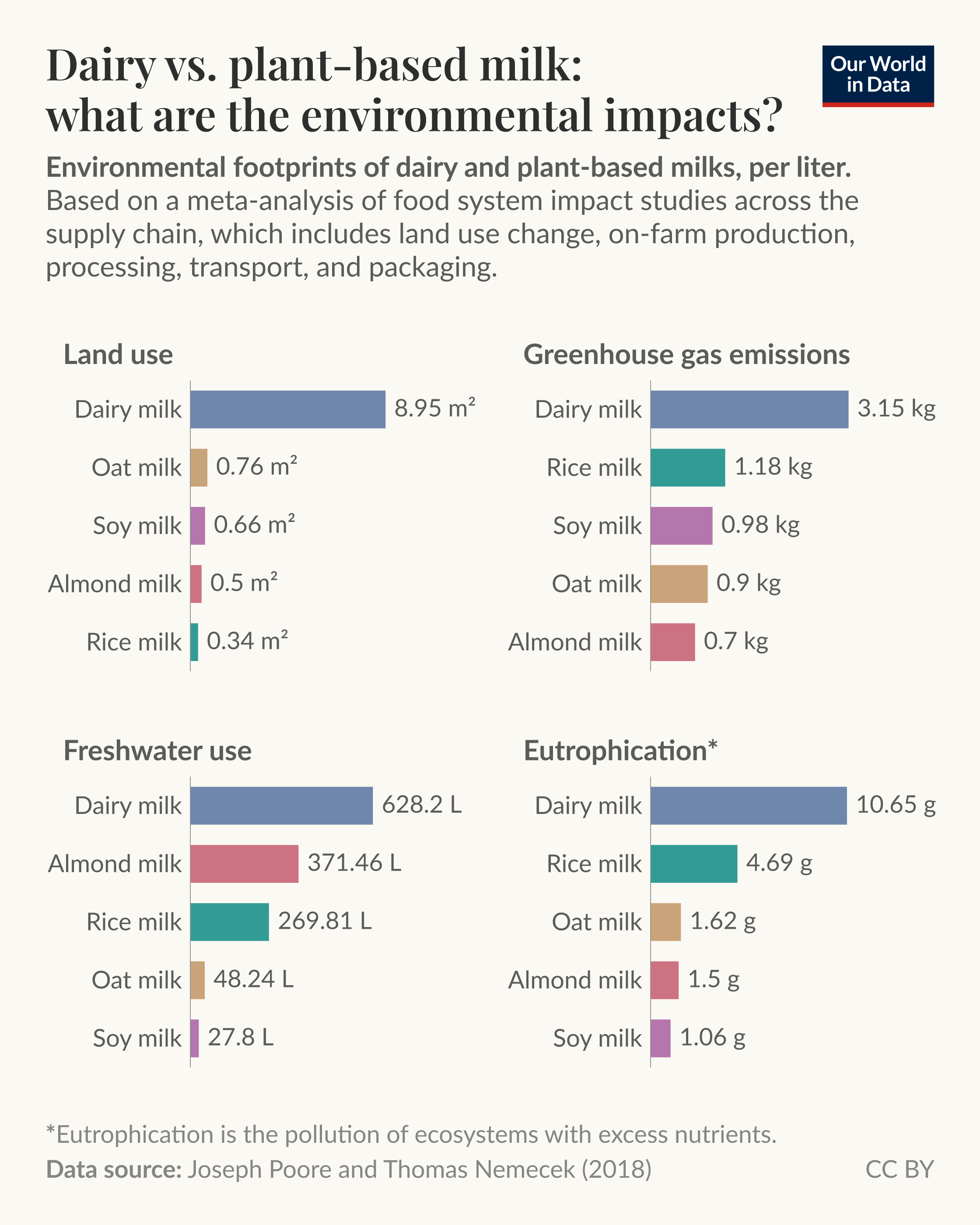
In the chart, we compare milks across a number of environmental metrics: land use, greenhouse gas emissions, water use, and eutrophication (the pollution of ecosystems with excess nutrients). These are compared per liter of milk.
Cow’s milk has significantly higher impacts than plant-based alternatives across all metrics. It causes around three times as much greenhouse gas emissions; uses around ten times as much land; two to twenty times as much freshwater; and creates much higher levels of eutrophication.
If you want to reduce the environmental footprint of your diet, switching to plant-based alternatives is a good option.
Which of the vegan milks is best?
It really depends on the impact we care most about. Almond milk has lower greenhouse gas emissions and uses less land than soy, for example, but requires more water and results in higher eutrophication.
All of the alternatives have a lower impact than dairy, but there is no clear winner across all metrics.
by ourworldindata
23 Comments
Data source: [Joseph Poore and Thomas Nemecek (2018)](https://www.science.org/doi/10.1126/science.aaq0216). Reducing food’s environmental impacts through producers and consumers. Science.
Tools used: initial plotting with the [OWID-Grapher](https://github.com/owid/owid-grapher), finishing in Figma
Add goat milk as some data shows it has 80% lower land use.
I wish these data could be normalized to resource scarcity. E.g. water usage in Wisconsin is a lot less concerning than water usage in California.
nice! could the data have been grabbed from a more recent study?
With how much better dairy milk is, this is 100% worth it
One of the issues with doing these broad comparisons, is that they miss the the regional differences in resource availability. For instance, almond milk uses less fresh water than dairy milk, but almonds are also primiraly grown in a region where there are sever fresh water shortages.
How about adding the pro and cons? Like how much nutrients you get from cow milk vs other sources? I m quite sure you dont want the full picture just to draw a bad conclusion.
oat milk drinkers rise up
You can pry my cow titty milk from my cold, dead hands
Would have loved to see more milk types, like coconut milk
Now show the nutritional value comparison.
Feel like it would be way better to compare nutritional value instead of cost of liter because if you do those metrics look way less extreme.
First of all what is a PLANT BASED MILK? I don’t think we should use that word. It’s like comparing milk with orange juice
But only one is actually a milk. The others are just branded as milk.
How much water does it take to grow almonds? When you parse data like this it’s easy to make a point. That’s just one example. This is propaganda or just “feel good” science.
Soy > Almond > Oat = Rice > Dairy
If they didn’t add this unnecessarily high markup to the price, I’d be all in.
So heute in the Alps almonds grow only in greenhouses with artificial light. On the other hand we have plenty of meadows where you can’t till and an abundance of water.
Hopefully it won’t be too long before we can start buying dairy milk that’s produced via bioreactors. It’ll be identical to cow-sourced dairy milk but much more environmentally friendly.
Do you know that data don’t lie but you can lie with data?
Also, the taste (and nutritional value) of one of them is very different from the others.
Cows milk is also significantly more nutritious if that’s of any significance.
Vegan “milks” have a fraction of the nutrients that dairy milk does. Milk is a complete diet for a developing mammal. Oat milk is a mucilaginous slurry of starches and fiber. Almond milk is mostly water with a handful of almonds and usually sugar and seaweed and other gums. They can not be compared as food sources. If you want to use vegan “milk” in your coffee, fine, but it shouldn’t be able to be called “milk”. Children have died because of the confusion this causes.
Me with my unsweetened soy milk lattes 😎