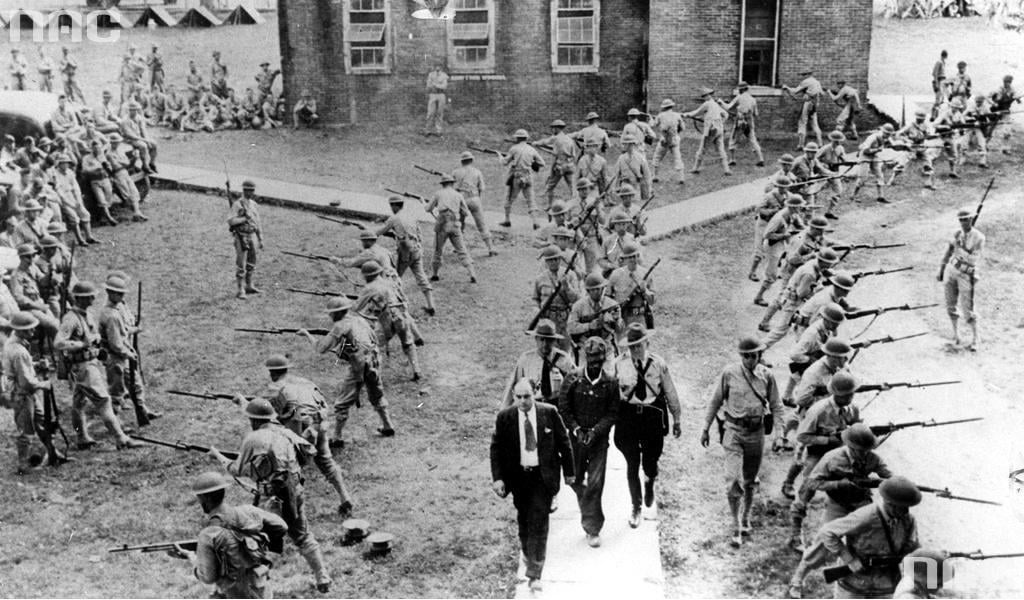
Guarded by 400 troops of the Missouri National Guard, John Henry Riney, a young black man charged with raping a white woman, is escorted to his trial (Arkansas, 1941) [1024 x 600].
Guarded by 400 troops of the Missouri National Guard, John Henry Riney, a young black man charged with raping a white woman, is escorted to his trial (Arkansas, 1941) [1024 x 600].
On April 3, 1941, a young white woman was raped in McGehee, Arkansas. A black construction worker, 25-year-old John Henry Riney, was arrested for the rape a few days later. Riney, who was married and had several children, had lived in the area all his life. On April 12, a mob of 200 white men went to the county jail, intending to lynch Riney. When the mob demanded access to the jail, Sheriff Howard Clayton let two men inside.
Riney wasn’t there. Clayton said he had already transferred Riney, whom he said had confessed to the rape, to an undisclosed jail that he refused to name.
Governor Homer Adkins felt that while the Arkansas State Police would likely be sufficient to protect Riney, it’d divert too many police officers. Normally, he would’ve used the Arkansas National Guard to guard Riney. However, all units had been inducted into federal service. As such, the state has no armed forces at its command. Governor Adkins sought permission from the War Department to use troops from a neighboring state. Permission was granted.
Some 400 members of the 140th Infantry of Missouri, stationed at Camp Robinson, were moved in automobiles and armored trucks to Arkansas City for the trial. The 120-mile trip from Camp Robinson to the small town was made without incident. The convoy cars included open trucks with mounted machine guns. Riney, who rode handcuffed in a state police automobile, was then turned over to the sheriff and placed in Desha County Jail. Over 200 soldiers took up guard duty at Courthouse Square, where Riney was returned to the sheriff, and around the courthouse and jail.
Riney went on trial on May 15, 1941.
The trial lasted a few hours. Riney offered no defense and pleaded guilty. He then took the stand and admitted his guilt for the third time. He blamed the crime on alcohol, saying, “I was drunk on wine, just like I was crazy.” The victim testified that Riney had entered her home, seized her in a bathroom, dragged her outside and to another building, stabbed her in the side, raped her, placed a wire tightly around her throat. After deliberating, the jury fixed Riney’s sentence at death. After the defense waived statutory delays, the judge imposed the sentence immediately.
The 250 spectators in the courtroom were ordered to remain seated until Riney had been escorted out of the courtroom, placed in a police car, and escorted out of town to begin the 60-mile journey to Tucker Prison Farm. The transport was guarded by the military convoy. It was described as the most elaborate protection offered to a defendant in state history.
John Riney, 25, was executed by electrocution at the Tucker Unit on June 20, 1941. It was extremely fast, even for the time. That said, Riley had waived statutory delays for sentencing and did not appeal. He did not recant his admission of guilt, and said nothing as he walked to the electric chair at dawn.

1 Comment
On April 3, 1941, a young white woman was raped in McGehee, Arkansas. A black construction worker, 25-year-old John Henry Riney, was arrested for the rape a few days later. Riney, who was married and had several children, had lived in the area all his life. On April 12, a mob of 200 white men went to the county jail, intending to lynch Riney. When the mob demanded access to the jail, Sheriff Howard Clayton let two men inside.
Riney wasn’t there. Clayton said he had already transferred Riney, whom he said had confessed to the rape, to an undisclosed jail that he refused to name.
Governor Homer Adkins felt that while the Arkansas State Police would likely be sufficient to protect Riney, it’d divert too many police officers. Normally, he would’ve used the Arkansas National Guard to guard Riney. However, all units had been inducted into federal service. As such, the state has no armed forces at its command. Governor Adkins sought permission from the War Department to use troops from a neighboring state. Permission was granted.
Some 400 members of the 140th Infantry of Missouri, stationed at Camp Robinson, were moved in automobiles and armored trucks to Arkansas City for the trial. The 120-mile trip from Camp Robinson to the small town was made without incident. The convoy cars included open trucks with mounted machine guns. Riney, who rode handcuffed in a state police automobile, was then turned over to the sheriff and placed in Desha County Jail. Over 200 soldiers took up guard duty at Courthouse Square, where Riney was returned to the sheriff, and around the courthouse and jail.
Riney went on trial on May 15, 1941.
The trial lasted a few hours. Riney offered no defense and pleaded guilty. He then took the stand and admitted his guilt for the third time. He blamed the crime on alcohol, saying, “I was drunk on wine, just like I was crazy.” The victim testified that Riney had entered her home, seized her in a bathroom, dragged her outside and to another building, stabbed her in the side, raped her, placed a wire tightly around her throat. After deliberating, the jury fixed Riney’s sentence at death. After the defense waived statutory delays, the judge imposed the sentence immediately.
The 250 spectators in the courtroom were ordered to remain seated until Riney had been escorted out of the courtroom, placed in a police car, and escorted out of town to begin the 60-mile journey to Tucker Prison Farm. The transport was guarded by the military convoy. It was described as the most elaborate protection offered to a defendant in state history.
John Riney, 25, was executed by electrocution at the Tucker Unit on June 20, 1941. It was extremely fast, even for the time. That said, Riley had waived statutory delays for sentencing and did not appeal. He did not recant his admission of guilt, and said nothing as he walked to the electric chair at dawn.