
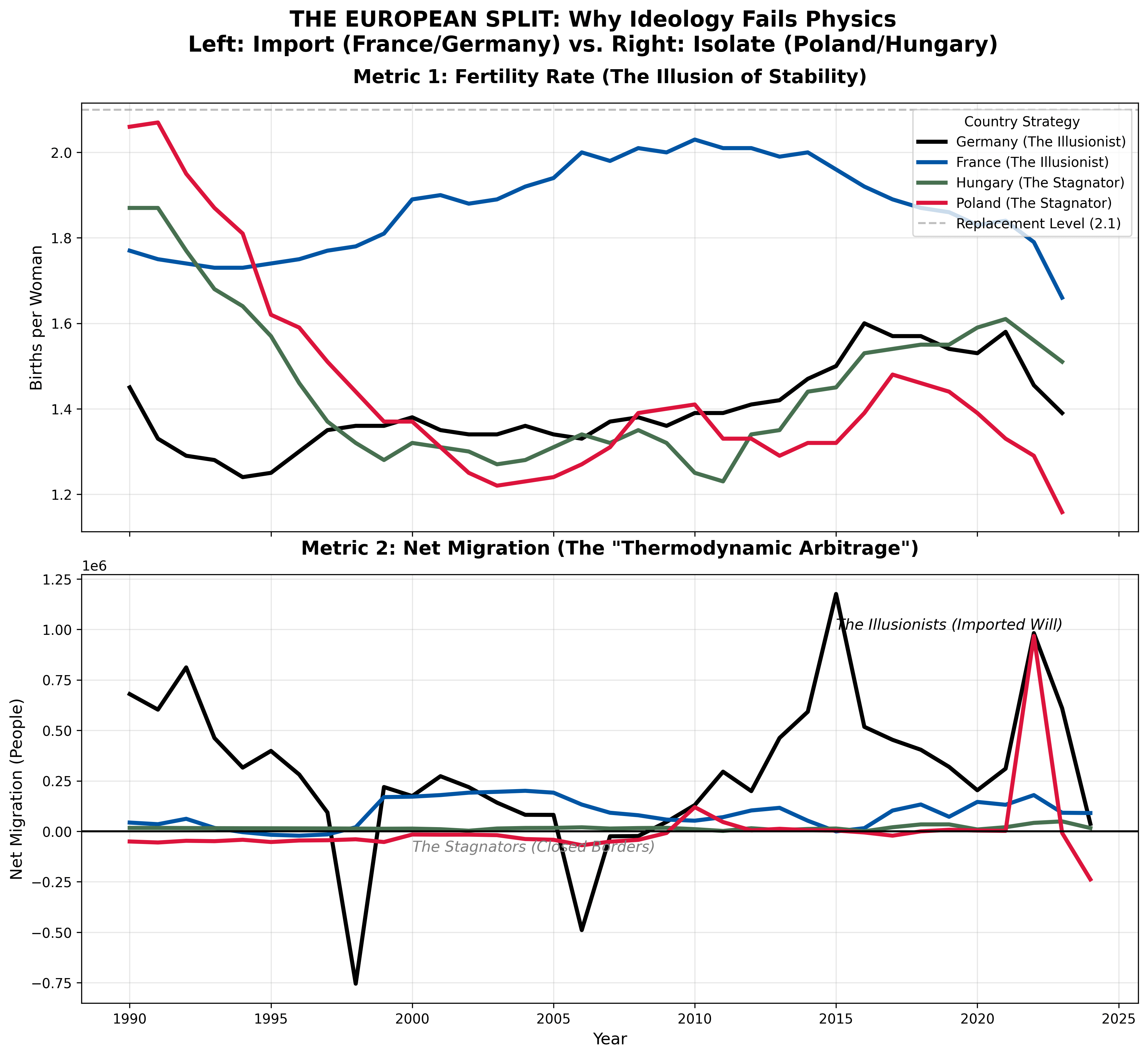
Visualization the relationship between sudden demographic injections (migration) and long-term biological replacement (fertility). I used data for Germany and Poland, recently they experienced massive and distinct migration shocks (the 2015 Syrian civil war crisis for Germany, and the 2022 Russian aggression to Ukraine for both countries).
There is a common political/economic assumption that immigration can "fix" a country's demographic decline, however it gives a temporary effect and hide the decline in early stages. Once migrants arrived and settled to new country, they are subjected to the exact same systemic economic pressures (cost of housing, inflation, living expenses) as well as local population. After a while, newcomers adapt to the host country's low-fertility environment. Migration only give a temporary labor boost, but it does not fix the structural decline that prevents people from affording families.
by Alibek2309
2 Comments
I thought most reasonably smart people knew that immigration was a bandaid to put on the actual problem. Are you telling me that people actually think immigration actually fixes these issues?
Has anyone ever seriously argued that a one-time immigration surge would stabilize birthrates? Every serious theory I’ve ever seen is that continuous immigration does that. The US achieved that through 3 *centuries* of immigration, not though a single influx. And you wouldn’t measure that through birthrate anyway, but through overall population.