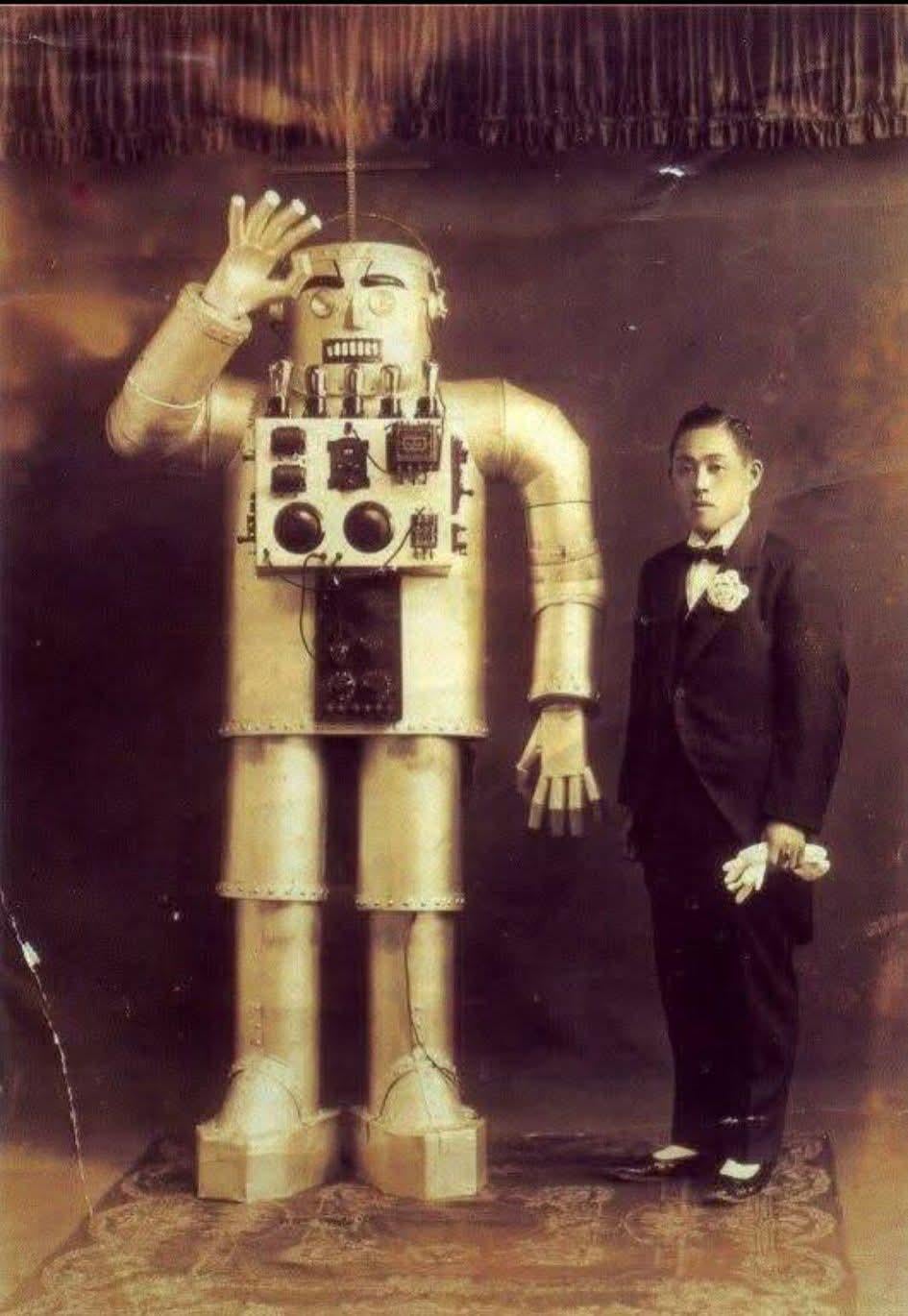
In the bustling streets of Tokyo in 1932, a remarkable figure stood proudly beside his metallic creation: Japanese inventor Yasutaro Mitsui and his imposing steel humanoid robot.This towering automaton—clad in riveted armor, sporting large goggle-like eyes, a stern mechanical face, and exposed wiring that evoked the era’s wildest visions of the future—marked one of the earliest known humanoid robots built in Japan. Captured in stark black-and-white photographs, Mitsui poses confidently in a sharp suit, one hand resting on his invention’s shoulder, as if introducing a mechanical companion to the world.Far from today’s sleek AI-driven machines, this robot was more sculpture than servant: rigid fingers, fixed neck, legs suggesting no true walking ability, and arms capable only of basic shoulder and elbow motions—perhaps a polite bow or wave, fitting for its Japanese origins. Powered likely by electricity (a cord trails up one leg), its glowing valves and dials were probably as much for dramatic show as function, echoing the theatrical robots of the West like Televox.Yet in an age when science fiction was bleeding into reality—think Metropolis (1927) or the rise of automation—Mitsui’s creation captured Japan’s budding fascination with mechanized life. Documented in later works like Haruki Inoue’s 1993 book on early Japanese robots (1920–1938), it stands as a pioneering milestone in robotics history, a bold leap from imagination to riveted steel.Nearly a century later, gazing at these vintage images feels like peering through a time portal: proof that the dream of humanoid companions was alive and clanking in Tokyo long before Asimov’s laws or modern androids.

1 Comment
In the bustling streets of Tokyo in 1932, a remarkable figure stood proudly beside his metallic creation: Japanese inventor Yasutaro Mitsui and his imposing steel humanoid robot.This towering automaton—clad in riveted armor, sporting large goggle-like eyes, a stern mechanical face, and exposed wiring that evoked the era’s wildest visions of the future—marked one of the earliest known humanoid robots built in Japan. Captured in stark black-and-white photographs, Mitsui poses confidently in a sharp suit, one hand resting on his invention’s shoulder, as if introducing a mechanical companion to the world.Far from today’s sleek AI-driven machines, this robot was more sculpture than servant: rigid fingers, fixed neck, legs suggesting no true walking ability, and arms capable only of basic shoulder and elbow motions—perhaps a polite bow or wave, fitting for its Japanese origins. Powered likely by electricity (a cord trails up one leg), its glowing valves and dials were probably as much for dramatic show as function, echoing the theatrical robots of the West like Televox.Yet in an age when science fiction was bleeding into reality—think Metropolis (1927) or the rise of automation—Mitsui’s creation captured Japan’s budding fascination with mechanized life. Documented in later works like Haruki Inoue’s 1993 book on early Japanese robots (1920–1938), it stands as a pioneering milestone in robotics history, a bold leap from imagination to riveted steel.Nearly a century later, gazing at these vintage images feels like peering through a time portal: proof that the dream of humanoid companions was alive and clanking in Tokyo long before Asimov’s laws or modern androids.