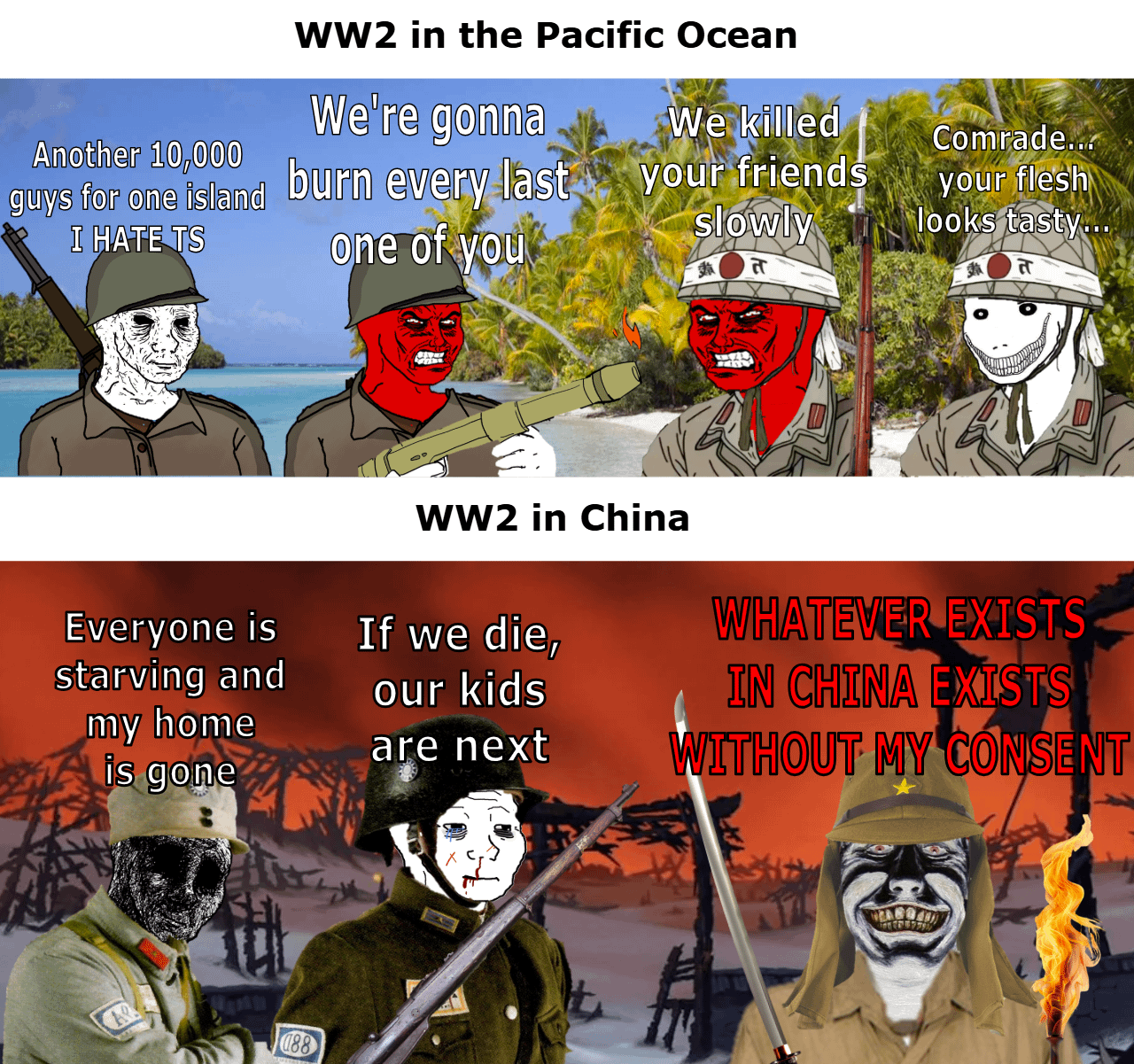
The Americans and Filipinos besieged in Bataan were reduced to fruit-scavenging and dynamite fishing, until they were starved into submission. Marines in the South Pacific lived on short rations and had to make up with coconuts and maggot-infested rice. Even after American industry caught up, it did not ease the horrendous diseases, heat, and stress of island warfare.
The Japanese had it worse. US submarines and the sheer distances of the war destroyed Japan’s supply lines. Japanese logistics remained abysmal, exemplified by Guadalcanal and 1944 Imphal. Desperate Japanese garrisons cannibalized civilians, POWs, and even their own comrades. By 1945, 22 Japanese soldiers were dying for every American.
China, already struggling with food insecurity prior to the war, lost 6,000,000 to starvation, from destroyed supply chains and the Japanese naval blockade. Most Chinese soldiers could only eat some rice seasoned with salt or gunpowder. 2,000,000 Vietnamese starved to death in the Red River Delta from terrible Japanese agricultural policies and Allied bombings. 3,000,000 Indonesians died in the Java Famine. Up to 3,000,000 Indians starved to death in Bengal from wartime shortages and British policies.
Iron_Cavalry on
Imperial Japan waged war without mercy in the Pacific. From the start, Japanese forces fed living POWs to sharks and crocodiles, enslaved women and girls as young as 10, and massacred 50,000 civilians in Malaya and Singapore (almost including LKY). They worked tens of thousands of prisoners to death on slave projects and terrorized civilians under their rule. Their garrisons fought to the death and were resorting to fanatical suicide tactics by 1944. Their brutality also extended to their own, from wasting their elite pilots in attrition to killing their own wounded to save (or gain) food.
The Americans paid them back. Enraged by Bataan and many other atrocities (e.g. finding their dead friends with their severed dicks jammed down their throats), American troops gave no quarter, routinely executing wounded or surrendering Japanese troops. They made trophies out of Japanese body parts. Curtis LeMay’s pilots had already razed Japan’s cities with firebombing long before the nukes detonated. By 1945, polling showed 13% of Americans supported the complete annihilation of the Japanese people.
And there was the China front, surpassed only by the Eastern Front in brutality. Nanjing was only the beginning: Japanese armies killed, raped and tortured civilians in every campaign. They terror bombed cities and deployed poison gas thousands of times. They used biological weapons and engineered plague epidemics (they also nearly did at Saipan and Bataan too). By 1941, the Japanese had escalated into a full-blown genocide in rural North China, slaughtering civilians by the millions in the Three Alls Policy.
By 1941, China’s economy had collapsed, and the nation was suffering from food shortages and a refugee crisis of 80,000,000. Its productive regions were occupied, destroyed, or under siege. Its armies were battered and outmatched in artillery, airpower, and supplies. But they still fought Japan’s best in a war of national survival, especially the Nationalists. At a conservative estimate, eight years of war cost the Chinese 2,000,000 military dead and 12,000,000 civilian dead.
Drexisadog on
And then you have the people in Burma, who always get forgotten about
Anastais on
Imagine being a starving Chinese soldier, already pushed to your physical limits, and then you see Judge Holden running to you.
Malthus1 on
George Bush was nearly killed and eaten by the Japanese in the Pacific theatre (he was the only one on his plane who survived: of nine airmen, eight were killed, four of whom were partly eaten; the ninth was future president George Bush, who was rescued from the water by a passing submarine before he could be grabbed by the Japanese).
Hey least in the Pacific ocean I have some chance of living, China was a killing zone
Pheren on
Once youre familiar with the monstrous nature of imperial Japan it really makes a re watch of hacksaw ridge even more impressive. I dont know anyone who would have tried to save monsters like that.

7 Comments
Hunger killed the most in the Asia-Pacific.
The Americans and Filipinos besieged in Bataan were reduced to fruit-scavenging and dynamite fishing, until they were starved into submission. Marines in the South Pacific lived on short rations and had to make up with coconuts and maggot-infested rice. Even after American industry caught up, it did not ease the horrendous diseases, heat, and stress of island warfare.
The Japanese had it worse. US submarines and the sheer distances of the war destroyed Japan’s supply lines. Japanese logistics remained abysmal, exemplified by Guadalcanal and 1944 Imphal. Desperate Japanese garrisons cannibalized civilians, POWs, and even their own comrades. By 1945, 22 Japanese soldiers were dying for every American.
China, already struggling with food insecurity prior to the war, lost 6,000,000 to starvation, from destroyed supply chains and the Japanese naval blockade. Most Chinese soldiers could only eat some rice seasoned with salt or gunpowder. 2,000,000 Vietnamese starved to death in the Red River Delta from terrible Japanese agricultural policies and Allied bombings. 3,000,000 Indonesians died in the Java Famine. Up to 3,000,000 Indians starved to death in Bengal from wartime shortages and British policies.
Imperial Japan waged war without mercy in the Pacific. From the start, Japanese forces fed living POWs to sharks and crocodiles, enslaved women and girls as young as 10, and massacred 50,000 civilians in Malaya and Singapore (almost including LKY). They worked tens of thousands of prisoners to death on slave projects and terrorized civilians under their rule. Their garrisons fought to the death and were resorting to fanatical suicide tactics by 1944. Their brutality also extended to their own, from wasting their elite pilots in attrition to killing their own wounded to save (or gain) food.
The Americans paid them back. Enraged by Bataan and many other atrocities (e.g. finding their dead friends with their severed dicks jammed down their throats), American troops gave no quarter, routinely executing wounded or surrendering Japanese troops. They made trophies out of Japanese body parts. Curtis LeMay’s pilots had already razed Japan’s cities with firebombing long before the nukes detonated. By 1945, polling showed 13% of Americans supported the complete annihilation of the Japanese people.
And there was the China front, surpassed only by the Eastern Front in brutality. Nanjing was only the beginning: Japanese armies killed, raped and tortured civilians in every campaign. They terror bombed cities and deployed poison gas thousands of times. They used biological weapons and engineered plague epidemics (they also nearly did at Saipan and Bataan too). By 1941, the Japanese had escalated into a full-blown genocide in rural North China, slaughtering civilians by the millions in the Three Alls Policy.
By 1941, China’s economy had collapsed, and the nation was suffering from food shortages and a refugee crisis of 80,000,000. Its productive regions were occupied, destroyed, or under siege. Its armies were battered and outmatched in artillery, airpower, and supplies. But they still fought Japan’s best in a war of national survival, especially the Nationalists. At a conservative estimate, eight years of war cost the Chinese 2,000,000 military dead and 12,000,000 civilian dead.
And then you have the people in Burma, who always get forgotten about
Imagine being a starving Chinese soldier, already pushed to your physical limits, and then you see Judge Holden running to you.
George Bush was nearly killed and eaten by the Japanese in the Pacific theatre (he was the only one on his plane who survived: of nine airmen, eight were killed, four of whom were partly eaten; the ninth was future president George Bush, who was rescued from the water by a passing submarine before he could be grabbed by the Japanese).
https://en.wikipedia.org/wiki/Chichijima_incident
Hey least in the Pacific ocean I have some chance of living, China was a killing zone
Once youre familiar with the monstrous nature of imperial Japan it really makes a re watch of hacksaw ridge even more impressive. I dont know anyone who would have tried to save monsters like that.