
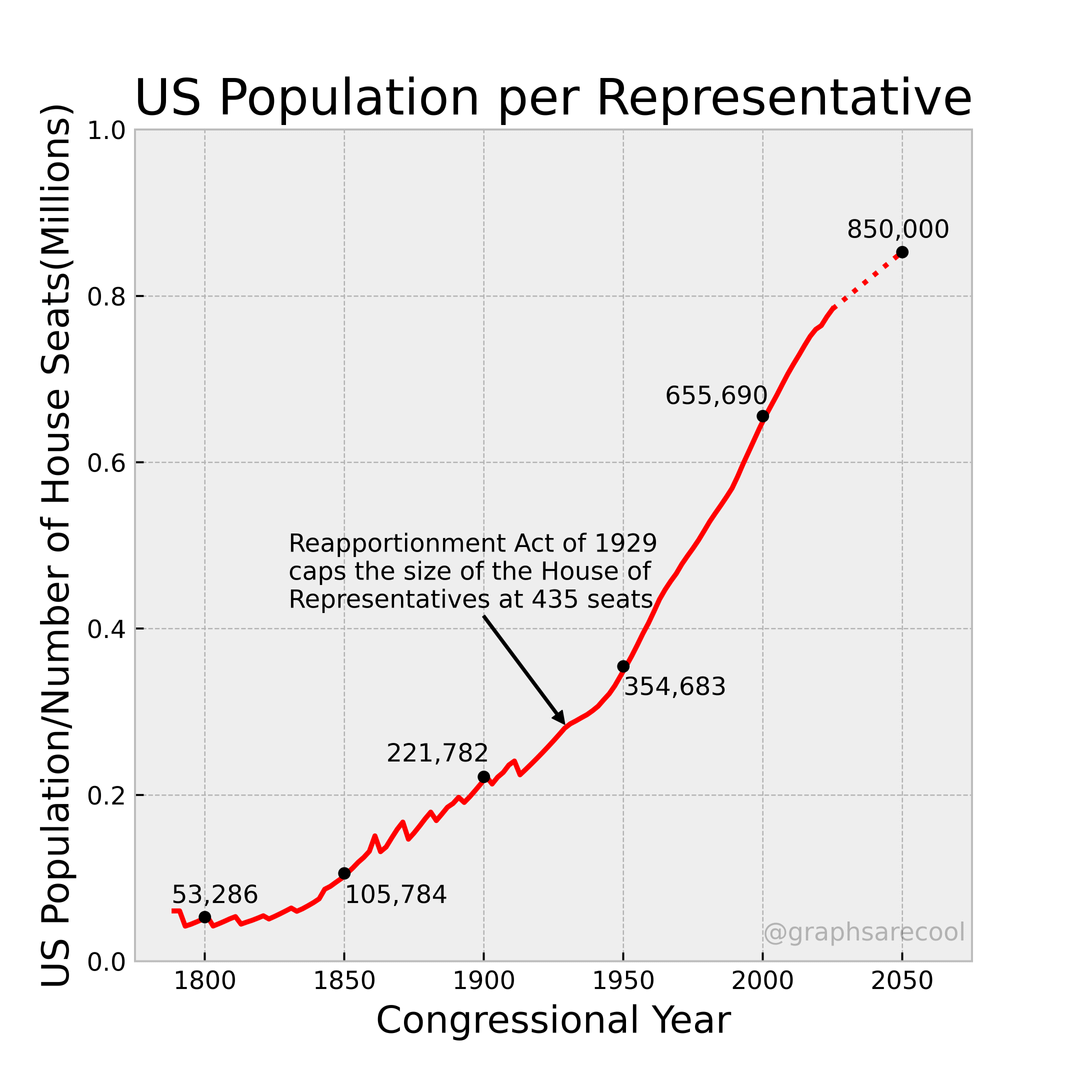
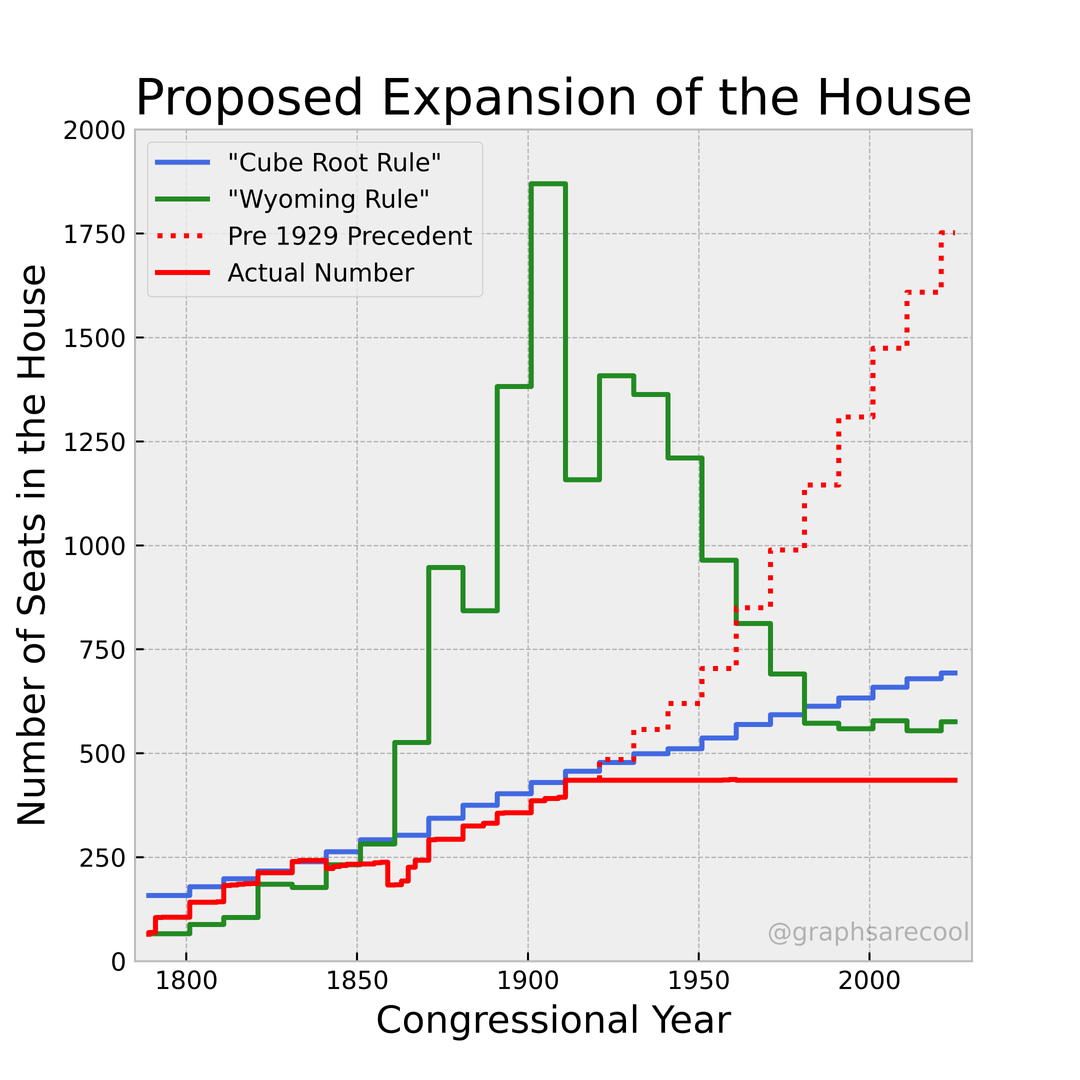
US population per seat in the house of representatives(1789-2025, 1st-119th Congress).
Data on number of House seats is from history.house.gov, historical and projected population data is from census.gov.
For the congresses during the civil war, when representatives from seceding states were expelled from the House, I have omitted the populations of states not represented in the House in the given session.
Prior to the 1920 census, congress(usually) added seats to the House to ensure no state lost representatives; however, following the 1920 census, for political and logistical reasons congress capped the House at 435 seats, where it sits today. The original apportionment procedure has been simulated on slide 2, corresponding to minimally expanding the House every 5th congress to abide by this precedent.
Contemporary ideas for expanding the House include the "Cube Root Rule", where the number of seats is the cube root of the US population, derived from observations of other democracies, and the "Wyoming Rule", where the number of seats is determined by the US population divided by the population of the smallest state. Yet other ideas include capping the population per representative at a fixed number, Washington proposed 30,000, which would put today's House at ~11,500 seats, adding a fixed number of seats to the House today, or to tie the number to a different root of the population.
If you are interested in other stuff I've made, its on Instagram.
by graphsarecool
13 Comments
Source: [history.house.gov](http://history.house.gov) and [census.gov](http://census.gov) Tools: Python with NumPy, Pandas, and matplotlib.
This is biggest undiscussed problem in the US government and has led to so much of our f*cked up situation. Much of the last 26 years’ worth of madness would have been avoided if the House had been expanded as the country grew. The Electoral College wouldn’t penalize large states as much, Bush and Trump wouldn’t have won in 2000 and 2016, and the Democrats would control the House.
I really feel like the number of represntatives in the house is a root cause of the political dysfunction we Americans feel with our governmental system. I am happy to see Representative Sean Casten bringing forward a bill to increase the size of the house, but feel like it is unlikely to get any traction because of the existing political dysfunction…
I never even thought about this. Definitely a huge problem. That will never be resolved.
I think 1700 representatives is too many. But the way they are proportioned is wrong. I think it makes sense to have every representative represent a fixed number of people. So every ten years the census gives us the population divide it by like 500 or 750 representatives and then the districts get reapportioned accordingly.
Gerrymandering would need to be completely eliminated for bringing in more reps to make sense.
Which I am both for.
I understand people get disappointed that reps aren’t as numerous as they used to be. But I don’t get the upside of adding more seats. The house of reps is already pretty big. More people in the room just makes it harder to actually get anything done.
There are lots of other issues (the way senators are apportioned, the way voting is handled as fptp, the way the electoral college works) that I would want dealt with looooooong before I give a shit about the number of reps.
I guess I don’t understand the argument that the House needs to expand. We have technology that can help us be more efficient in representing the population vs. what we had traditionally and more elections and more offices just mean more opportunities for grift and dilution of our voice.
If the argument is that we always need to have the 1920s level of humans handling any task at hand we would be a pretty shitty and inefficient workforce.
Gerrymandering is more of a problem than the actual number of representatives. Throw in ranked choice voting in primaries/elections and a national standard for redistricting based on a fair technology solution/algorithm and the number of reps is fine.
Is there meaning to the vertical ticks on marks in the first graph?
The problem is that conservatives think because Democrats are the ones presenting the idea, it’ll only benefit blue states.
The first session of Congress was around 1 rep per 60k citizens. It now ranges from 450k to 850k. Unfortunately this has made it much easier to find bottlenecks to gerrymander, diluting representation even more. The Senate already favors land over people, the House has slowly become the same. The 450k figure is for rural areas while the 850k number is for cities.
Yea it’s really dumb. The idea is you should be able to know your representative but most representative hundreds of thousands of people
No taxation without representation, and all that