Iqbal Masih was born on 1 January 1983 in Muridke, a village outside of Lahore in Punjab, Pakistan, into a poor Catholic Christian family. His parents were Saif Masih, a labourer, and Inayat Bibi, who worked as a house cleaner. Saif later abandoned the family, leaving Inayat to work and Iqbal’s older sisters to take care of him and his siblings.
In 1986, Saif Masih was to marry off one of his sons but he lacked savings and was unable to finance this: banks would not provide loans while government aid programs were few. He took a loan of 600 rupees from a thekedar (carpet factory owner), using the only collateral he had, his children. The loan was to be paid off by four-year-old Iqbal’s labor, and included undisclosed interest and expenses, an institution known as peshgi. Due to the illegality of selling children, the transaction was informal, allowing the loaner to add arbitrary expenses to the loan without oversight.
Expenses were to include the cost of a year of training (during which Iqbal would not be paid), tools, food and fines for any mistakes Iqbal was to make. He was paid 1 rupee a day. Due to the high interest rate at which the loan was taken, it stood at 13,000 rupees prior to his escape.
At the carpet maker’s, Iqbal was chained to a loom and made to work as much as 14 hours a day. He was fed little and beaten, more than other children because of his attempts at escaping and refusal to work. These conditions stunted his growth; he had the height and weight of a 6-year-old when he was 12.
At the age of 10, Iqbal escaped his slavery, after learning that bonded labour had been declared illegal by the Supreme Court of Pakistan. He escaped and attempted to report his employer Ashad to the police, but the police brought him back to the factory seeking a finder’s fee for returning escaped bonded labourers. Iqbal escaped a second time and attended the Bonded Labour Liberation Front (BLLF) school for former child slaves and quickly completed a four-year education in only two years. Iqbal helped over 3,000 Pakistani children that were in bonded labour escape to freedom and made speeches about child labour all over the world.
He expressed a desire to become a lawyer to better equip him to free bonded labourers, and he visited other countries, including Sweden and the United States, to share his story, encouraging others to join the fight to eradicate child slavery.
Iqbal was fatally shot by the “carpet mafia”, a gang that killed slaves if they ran away from a carpet factory, while visiting relatives in Muridke on 16 April 1995, Easter Sunday. He was only 12 years old. His funeral was attended by approximately 800 mourners. A protest of 3,000 people, half of whom were younger than 12, took place in Lahore demanding an end to child labor in the week that followed.
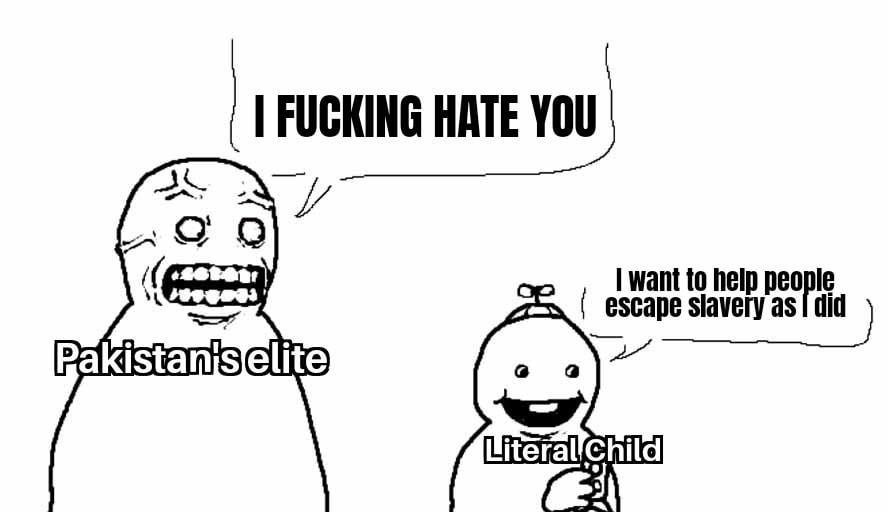
Following his death, Pakistani economic elites responded to declining carpet sales by denying that they were using bonded child labour in their factories and by employing the Federal Investigation Agency (FIA) to brutally harass and arrest activists working for the BLLF. The Pakistani press conducted a smear campaign against the BLLF, arguing that child labourers received high wages and favourable working conditions.
carlsagerson on
God. I seen a video about Pakistan and Limestone Kilns. Christ, that kind of life is hell.
BasedAustralhungary on
Every next information i have the disgrace to know about Pakistan makes me feel that there is nothing that can surprise me know, and not even a day after I have this thought It manages to surprises me again. It’s insane. I asked this the last day and I ask this again, is there something remotely good to talk about Pakistan? /gen
Manealendil on
The Rich are eating our children and our future, no matter what time or place

4 Comments
Iqbal Masih was born on 1 January 1983 in Muridke, a village outside of Lahore in Punjab, Pakistan, into a poor Catholic Christian family. His parents were Saif Masih, a labourer, and Inayat Bibi, who worked as a house cleaner. Saif later abandoned the family, leaving Inayat to work and Iqbal’s older sisters to take care of him and his siblings.
In 1986, Saif Masih was to marry off one of his sons but he lacked savings and was unable to finance this: banks would not provide loans while government aid programs were few. He took a loan of 600 rupees from a thekedar (carpet factory owner), using the only collateral he had, his children. The loan was to be paid off by four-year-old Iqbal’s labor, and included undisclosed interest and expenses, an institution known as peshgi. Due to the illegality of selling children, the transaction was informal, allowing the loaner to add arbitrary expenses to the loan without oversight.
Expenses were to include the cost of a year of training (during which Iqbal would not be paid), tools, food and fines for any mistakes Iqbal was to make. He was paid 1 rupee a day. Due to the high interest rate at which the loan was taken, it stood at 13,000 rupees prior to his escape.
At the carpet maker’s, Iqbal was chained to a loom and made to work as much as 14 hours a day. He was fed little and beaten, more than other children because of his attempts at escaping and refusal to work. These conditions stunted his growth; he had the height and weight of a 6-year-old when he was 12.
At the age of 10, Iqbal escaped his slavery, after learning that bonded labour had been declared illegal by the Supreme Court of Pakistan. He escaped and attempted to report his employer Ashad to the police, but the police brought him back to the factory seeking a finder’s fee for returning escaped bonded labourers. Iqbal escaped a second time and attended the Bonded Labour Liberation Front (BLLF) school for former child slaves and quickly completed a four-year education in only two years. Iqbal helped over 3,000 Pakistani children that were in bonded labour escape to freedom and made speeches about child labour all over the world.
He expressed a desire to become a lawyer to better equip him to free bonded labourers, and he visited other countries, including Sweden and the United States, to share his story, encouraging others to join the fight to eradicate child slavery.
Iqbal was fatally shot by the “carpet mafia”, a gang that killed slaves if they ran away from a carpet factory, while visiting relatives in Muridke on 16 April 1995, Easter Sunday. He was only 12 years old. His funeral was attended by approximately 800 mourners. A protest of 3,000 people, half of whom were younger than 12, took place in Lahore demanding an end to child labor in the week that followed.
Following his death, Pakistani economic elites responded to declining carpet sales by denying that they were using bonded child labour in their factories and by employing the Federal Investigation Agency (FIA) to brutally harass and arrest activists working for the BLLF. The Pakistani press conducted a smear campaign against the BLLF, arguing that child labourers received high wages and favourable working conditions.
God. I seen a video about Pakistan and Limestone Kilns. Christ, that kind of life is hell.
Every next information i have the disgrace to know about Pakistan makes me feel that there is nothing that can surprise me know, and not even a day after I have this thought It manages to surprises me again. It’s insane. I asked this the last day and I ask this again, is there something remotely good to talk about Pakistan? /gen
The Rich are eating our children and our future, no matter what time or place