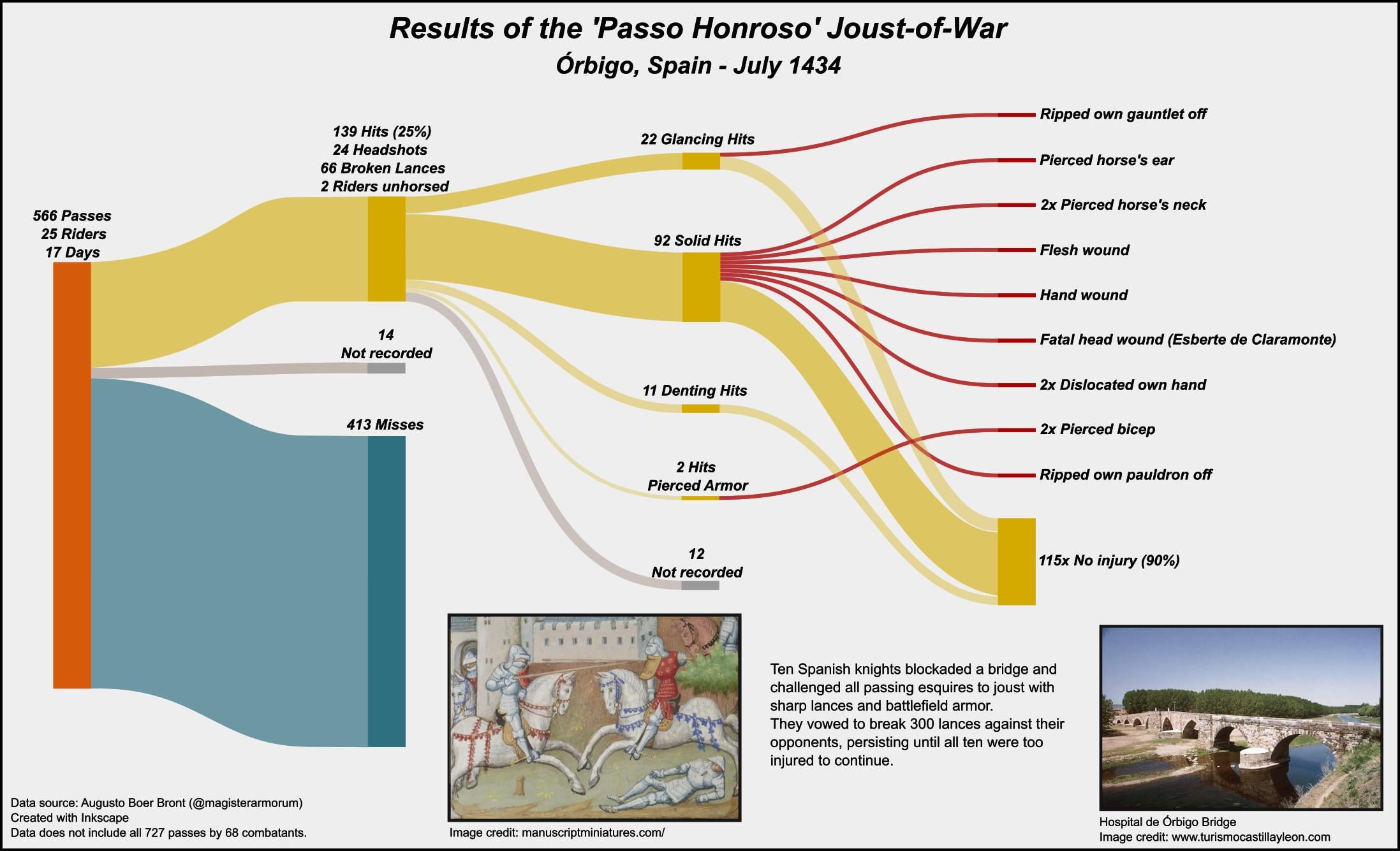
[OC] In 1434 AD, ten Spanish knights blockaded a bridge and challenged all noble passersby to joust with sharp lances, fighting hundreds of duels over 17 days, until all were too wounded to carry on. These were the results:
[OC] In 1434 AD, ten Spanish knights blockaded a bridge and challenged all noble passersby to joust with sharp lances, fighting hundreds of duels over 17 days, until all were too wounded to carry on. These were the results:
Data source: Table by Augusto Boer Bront (@magisterarmorum)
Created with Inkscape
More information: It is extremely unusual to have such comprehensive, statistically significant data from the medieval era, regarding anything other financial matters. In this case, the series of quasi-compulsory and particularly dangerous jousts was sanctioned by the King. Therefore, the royal secretary was on hand to carefully record the results of most passes.
Typical tournament jousting involved weakened lances with blunt tips, but the ‘Passo Honroso’ seems to have been fought with lighter battlefield armor and the same lances used in wartime. The chief challenger, Suero de Quiñones, described the event as a ‘ransom’ to prove his courtly love for an anonymous lady. All noble ladies passing the blockaded bridge had to surrender their right glove, unless defended by a man-at-arms who would participate in the joust. Any knight who passed by without fighting was required to surrender the spurs on one foot, and abandoning the joust after just one or two passes meant the forfeiture of his armor. Arms and armor were provided to any gentlemen who lacked them.
From a statistical standpoint, the data are very interesting because they show the rate of hits. They also demonstrate the extremely high resiliency of plate armor in this period, with only two penetrating hits, both to thinner parts of the armor. The data do not include at least one penetration of a breastplate that resulted in no injury, and a penetration of Quiñones’ helmet, which drew blood. There were a few additional instances of a vambrace or other limb armor being torn off, attested in other sources. The unlucky Esberte de Claramonte was killed instantly by a lance tip entering his visor. Due to his sinful death in a tournament, he was buried in unconsecrated ground.

1 Comment
Data source: Table by Augusto Boer Bront (@magisterarmorum)
Created with Inkscape
More information: It is extremely unusual to have such comprehensive, statistically significant data from the medieval era, regarding anything other financial matters. In this case, the series of quasi-compulsory and particularly dangerous jousts was sanctioned by the King. Therefore, the royal secretary was on hand to carefully record the results of most passes.
Typical tournament jousting involved weakened lances with blunt tips, but the ‘Passo Honroso’ seems to have been fought with lighter battlefield armor and the same lances used in wartime. The chief challenger, Suero de Quiñones, described the event as a ‘ransom’ to prove his courtly love for an anonymous lady. All noble ladies passing the blockaded bridge had to surrender their right glove, unless defended by a man-at-arms who would participate in the joust. Any knight who passed by without fighting was required to surrender the spurs on one foot, and abandoning the joust after just one or two passes meant the forfeiture of his armor. Arms and armor were provided to any gentlemen who lacked them.
From a statistical standpoint, the data are very interesting because they show the rate of hits. They also demonstrate the extremely high resiliency of plate armor in this period, with only two penetrating hits, both to thinner parts of the armor. The data do not include at least one penetration of a breastplate that resulted in no injury, and a penetration of Quiñones’ helmet, which drew blood. There were a few additional instances of a vambrace or other limb armor being torn off, attested in other sources. The unlucky Esberte de Claramonte was killed instantly by a lance tip entering his visor. Due to his sinful death in a tournament, he was buried in unconsecrated ground.
Further reading: https://willscommonplacebook.blogspot.com/2009/07/passo-honroso-1434.html