https://www.myheritage.com/wiki/Japanese_surnames
> Surnames are a relatively modern aspect of Japanese culture. Prior to the Meiji Restoration, a political revolution that lasted from 1868 to 1889, surnames were only used by the aristocracy of Japan. Affluent commoners could pay for permission to bear a surname, but this was limited to use in their local communities and were not permitted for official use.
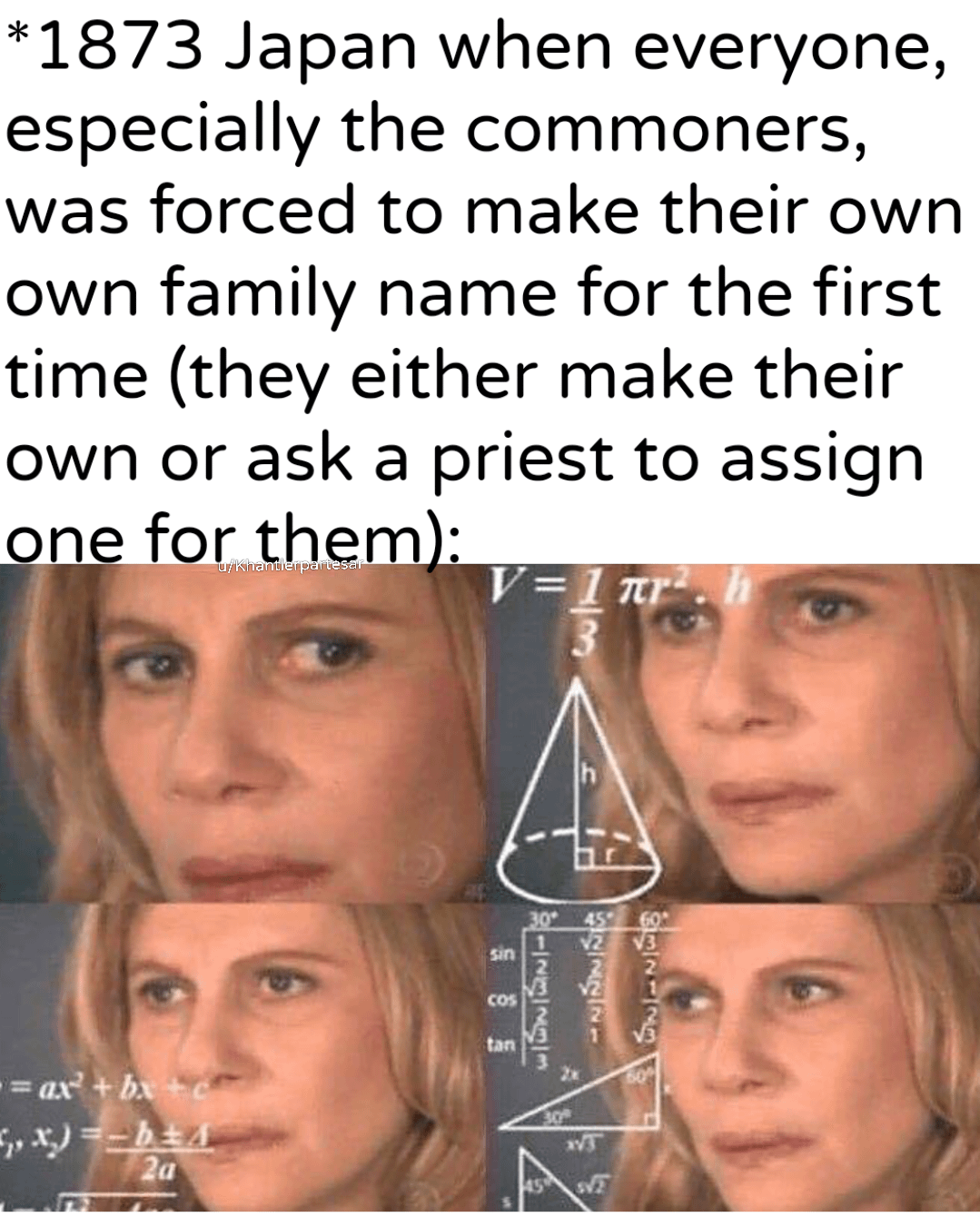
> In 1870, the laws of Japan changed to allow commoners to take a surname. Shortly after, in 1873, a new law made it mandatory for all citizens of Japan, regardless of their social or economic status, to have a surname. Because many Japanese didn’t have surnames that were passed down through generations, families either came up with a surname themselves or asked a priest to assign one to them.
*NOTE: I just realized that I put two “own”s , smh.
carlsagerson on
Makes Me wonder. If i recall, Kim was a popular surname due to its origins as the surname of a Royal Family in one of the 3 Kingdoms of Korea before it was united.
I wonder what were some of the less popular surnames chosen.
PrimodiumUpus on
Hm.. I wonder, if there’s a mad lad who named his family name like ‘Big Dong’ or ‘Big D*ck’
Training2Life on
But the royal family didn’t take one.
Alex103140 on
Same reason why so many names are “Middle of Mountain”, “Field and River”, etc. They lowkey just go outside and name themselves after the first thing they saw.
ogodilovejudyalvarez on
“I have three water chestnuts left on my plate, so I shall call myself mitsu-bishi”
sealcub on
I mean their surnames probably aren’t so different from how Europeans got surnames. Those are mostly occupation names or the name, or description, of their residence at some point.

9 Comments
https://www.myheritage.com/wiki/Japanese_surnames
> Surnames are a relatively modern aspect of Japanese culture. Prior to the Meiji Restoration, a political revolution that lasted from 1868 to 1889, surnames were only used by the aristocracy of Japan. Affluent commoners could pay for permission to bear a surname, but this was limited to use in their local communities and were not permitted for official use.
> In 1870, the laws of Japan changed to allow commoners to take a surname. Shortly after, in 1873, a new law made it mandatory for all citizens of Japan, regardless of their social or economic status, to have a surname. Because many Japanese didn’t have surnames that were passed down through generations, families either came up with a surname themselves or asked a priest to assign one to them.
*NOTE: I just realized that I put two “own”s , smh.
Makes Me wonder. If i recall, Kim was a popular surname due to its origins as the surname of a Royal Family in one of the 3 Kingdoms of Korea before it was united.
I wonder what were some of the less popular surnames chosen.
Hm.. I wonder, if there’s a mad lad who named his family name like ‘Big Dong’ or ‘Big D*ck’
But the royal family didn’t take one.
Same reason why so many names are “Middle of Mountain”, “Field and River”, etc. They lowkey just go outside and name themselves after the first thing they saw.
“I have three water chestnuts left on my plate, so I shall call myself mitsu-bishi”
I mean their surnames probably aren’t so different from how Europeans got surnames. Those are mostly occupation names or the name, or description, of their residence at some point.
Wait… But there were clan names, like Tokugawa.
Why not just use them?
40% of the Vietnamese: Nguyen is fine