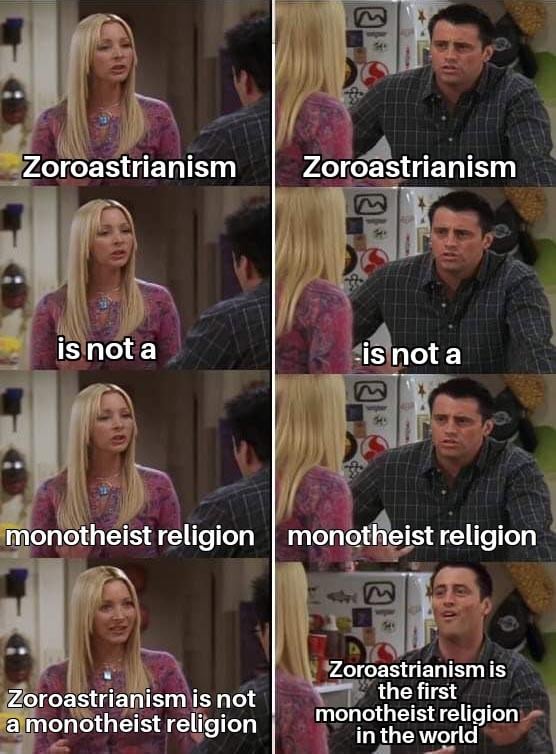
Yazata and Amesha Spentas aren’t angels, they’re seen as angels not because Zoroastrianism considers them to be angels they’re gods they’re literally “worthy of worship” you can give them sacrifices and they’re not like Abrahamic angels who have no free will or are just tools they have free will and duties and stories they’re not mere inferior angels who are lesser than humans
Also:
In the 1860s and 1870s, the linguist Martin Haug interpreted Zoroastrian scripture in Christian terms, and compared the yazatas to the angels of Christianity. In this scheme, the Amesha Spentas are the arch-angel retinue of Ahura Mazda, with the hamkars as the supporting host of lesser angels.
At the time Haug wrote his translations, the Parsi (i.e. Indian Zoroastrian) community was under intense pressure from English and American missionaries, who severely criticized the Zoroastrians for—as John Wilson portrayed it in 1843—”polytheism”, which the missionaries argued was much less worth than their own “monotheism”. At the time, Zoroastrianism lacked theologians of its own, and so the Zoroastrians were poorly equipped to make their own case. In this situation, Haug’s counter-interpretation came as a welcome relief, and was (by-and-large) gratefully accepted as legitimate.[9]
Haug’s interpretations were subsequently disseminated as Zoroastrian ones, which then eventually reached the west where they were seen to corroborate Haug. Like most of Haug’s interpretations, this comparison is today so well entrenched that a gloss of ‘yazata’ as ‘angel’ is almost universally accepted; both in publications intended for a general audience[10][11] as well as in (non-philological) academic literature.[12][13]
Amongst the Muslims of Iran, Sraosha came to be “arguably the most popular of all the subordinate Yazatas”, for as the angel Surush, only he (of the entire Zoroastrian pantheon) is still venerated by name.[14]
So this idea that Zoroastrianism only worships one god and others are just angels comes from a Christian Orientalist who wrongly and based on his own religion (Christianity) portrayed our religion to the west
AGAINST THOSE WHO DENY DUALISM, WORSHIP OF NATURE & THE YAZADS, AND ACCEPT MONOTHEISM.
Historical Zoroastrianism cannot be explained as Monotheistic in any way except in the sense that one God was held as supreme (Ahura Mazda) over the many other gods within the Zoroastrian pantheon. The ancient Zoroastrians, in their daily religious life, would have understood themselves as engaging with multiple divine figures, each with their own attributes, powers, and spheres of influence, Mithra over truth, Asha and sunlight, Anahita over the waters, and Drvaspa over pastures, and cattle.
These divine beings would have been referred to as Yazata or Yazdan. (still are)
In the Avestan language, ‘Yazata’ means ‘worthy of worship/sacrifice/adoration.’ The term is used not only for Ahura Mazda and his divine emanations (Amesha Spentas), but also for a group of spiritual beings known collectively as the Yazata. These divine beings help safeguard the good creations of the world and offer strength, guidance, and support to those who invoke them, they are co-workers (hamkār) of the Amesha Spentas and Ahura Mazda and aid in the fight against evil, they preside over cosmic functions as well as mainyava, ‘spiritual or celestial,’ creations and gaethya, ‘material or terrestrial. creations, and they are said to combat evil and the Daevas
the worship of the Yazads is continuously affirmed in the Avestan hymnals. (1500-1200 BCE), especially in the Yasna and Yashts.
> *1. Ahura Mazda spoke unto Spitama Zarathushtra, saying: ‘Verily, when I created Mithra, the lord of wide pastures, O Spitama! I created him as worthy of sacrifice, as worthy of prayer as myself, Ahura Mazda.* – the starting verse from the Avestan hymn to Mithra
> *90. ‘Zarathushtra asked Ardvi Sura Anahita: “O Ardvi Sura Anahita! With what manner of sacrifice shall I worship thee? With what manner of sacrifice shall I worship and forward thee? So that Mazda may make thee run down (to the earth), that he may not make thee run up into the heavens, above the sun; and that the Serpent may not injure thee with…., with…., with…., and…. Poisons.”*- from the Avestan hymn to Ava Ardevi sur Anahita
> *26. We worship the good, strong, beneficent Fravashis of the faithful, who are the mightiest of drivers, the lightest of those driving forwards, the slowest of the retiring, the safest of all bridges, the least-erring of all weapons and arms, and who never turn their backs. – from the Avestan hymn to the Fravashis.*
We also see the worship of the natural elements such as fire.
> *25:7-8. Yea, we worship thee, the Fire, Ahura Mazda’s son I the holy lord of the ritual order; and we worship all the Fires, and Mount Ushi-darena (which holds the light) Mazda-made and holy, the Yazad mount, brilliant with sanctity. And we worship every holy spiritual Yazad; and every holy earthly Yazad (who exists)! – From Yasna*
———————————————————————————-
I must add that Yazdan is the plural form for Yazata because our lord Ahura Mazda is the god of gods, Kartyr in his own texts refers to Yazata as gods and says that don’t do things that displeases the Gods!
Edit: I will put verses from the Old Avestan hymnals that show the worship of the Yazata explicitly alongside Ahura Mazda’s.
I will mainly use the Yasna Haptanghaiti, though Gathas and Airyaman Ishyo also contain invocation of the Yazads.
Johanna Narten (1986), Narten, YH, 20f, has shown us that the Grammar and language of the Yasna Haptanghaiti is identical to the Gathas, the only difference being on the lexical level, therefore this text cannot be rejected in the same manner as the young Avestan hymnals.
hereforinfoyo on
But it was borrowed from and heavily reworked by Abrahamic religions and so people conflate it with monotheistic stuff.
No_Bluebird_1368 on
Based mention
lassysbee on
Abrahamic religions aren’t monotheistic either if it comes to the definition given by OP in the comments. Judaism, maybeee, but that’s debatable.
The_Madoff on
It’s Monolatry with extra steps. Change my mind
DazSamueru on
For the longest time it was useful for Zoroastrians to claim they were monotheists because Islam is much more tolerant of monotheists religions than polytheism.
Suspicious-Capital12 on
Zoroastrianism is a religion that’s hard to pin down, because what is know about the religion doesn’t fit with our understanding of monotheism, dualism and polytheism.
Doesn’t help that the original language it was writing in is a dead language, and a lot of religious works have been destroyed by Alexander the Great and the Muslim invasion of Iran.
Thalesian on
Don’t listen to memes from Aingra Mainyu guys.
An_educated_dig on
Christianity is not an original idea, just a best selling one.
Its_MichaelB on
Someone been reading the Sapiens
battlerez_arthas on
Didn’t Judaism originally recognize the existence of other gods but prohibit their worship?
Isn’t Zoroastrianism pretty similar in that regard?
shitposter9876 on
Zoroastrianism is a monotheistic religion, but its roots does have other deities.
Ok_Sun_4345 on
What is everyone’s fixation on categorization? There doesn’t have to be a technical definition that Zoroastrianism fits into, it’s just there
MauschelMusic on
Wait until you hear about this one religion. Can’t remember the name. They claim to have one god, but then it’s actually three guys. And they have all these saints they pray to but claim to not worship. Top of my tongue.
tomispev on
People should really learn the word “monolatry” instead of any of the -theism words. A lot of world religions would make more sense that way.

15 Comments
Yazata and Amesha Spentas aren’t angels, they’re seen as angels not because Zoroastrianism considers them to be angels they’re gods they’re literally “worthy of worship” you can give them sacrifices and they’re not like Abrahamic angels who have no free will or are just tools they have free will and duties and stories they’re not mere inferior angels who are lesser than humans
Also:
In the 1860s and 1870s, the linguist Martin Haug interpreted Zoroastrian scripture in Christian terms, and compared the yazatas to the angels of Christianity. In this scheme, the Amesha Spentas are the arch-angel retinue of Ahura Mazda, with the hamkars as the supporting host of lesser angels.
At the time Haug wrote his translations, the Parsi (i.e. Indian Zoroastrian) community was under intense pressure from English and American missionaries, who severely criticized the Zoroastrians for—as John Wilson portrayed it in 1843—”polytheism”, which the missionaries argued was much less worth than their own “monotheism”. At the time, Zoroastrianism lacked theologians of its own, and so the Zoroastrians were poorly equipped to make their own case. In this situation, Haug’s counter-interpretation came as a welcome relief, and was (by-and-large) gratefully accepted as legitimate.[9]
Haug’s interpretations were subsequently disseminated as Zoroastrian ones, which then eventually reached the west where they were seen to corroborate Haug. Like most of Haug’s interpretations, this comparison is today so well entrenched that a gloss of ‘yazata’ as ‘angel’ is almost universally accepted; both in publications intended for a general audience[10][11] as well as in (non-philological) academic literature.[12][13]
Amongst the Muslims of Iran, Sraosha came to be “arguably the most popular of all the subordinate Yazatas”, for as the angel Surush, only he (of the entire Zoroastrian pantheon) is still venerated by name.[14]
So this idea that Zoroastrianism only worships one god and others are just angels comes from a Christian Orientalist who wrongly and based on his own religion (Christianity) portrayed our religion to the west
AGAINST THOSE WHO DENY DUALISM, WORSHIP OF NATURE & THE YAZADS, AND ACCEPT MONOTHEISM.
Historical Zoroastrianism cannot be explained as Monotheistic in any way except in the sense that one God was held as supreme (Ahura Mazda) over the many other gods within the Zoroastrian pantheon. The ancient Zoroastrians, in their daily religious life, would have understood themselves as engaging with multiple divine figures, each with their own attributes, powers, and spheres of influence, Mithra over truth, Asha and sunlight, Anahita over the waters, and Drvaspa over pastures, and cattle.
These divine beings would have been referred to as Yazata or Yazdan. (still are)
In the Avestan language, ‘Yazata’ means ‘worthy of worship/sacrifice/adoration.’ The term is used not only for Ahura Mazda and his divine emanations (Amesha Spentas), but also for a group of spiritual beings known collectively as the Yazata. These divine beings help safeguard the good creations of the world and offer strength, guidance, and support to those who invoke them, they are co-workers (hamkār) of the Amesha Spentas and Ahura Mazda and aid in the fight against evil, they preside over cosmic functions as well as mainyava, ‘spiritual or celestial,’ creations and gaethya, ‘material or terrestrial. creations, and they are said to combat evil and the Daevas
the worship of the Yazads is continuously affirmed in the Avestan hymnals. (1500-1200 BCE), especially in the Yasna and Yashts.
> *1. Ahura Mazda spoke unto Spitama Zarathushtra, saying: ‘Verily, when I created Mithra, the lord of wide pastures, O Spitama! I created him as worthy of sacrifice, as worthy of prayer as myself, Ahura Mazda.* – the starting verse from the Avestan hymn to Mithra
> *90. ‘Zarathushtra asked Ardvi Sura Anahita: “O Ardvi Sura Anahita! With what manner of sacrifice shall I worship thee? With what manner of sacrifice shall I worship and forward thee? So that Mazda may make thee run down (to the earth), that he may not make thee run up into the heavens, above the sun; and that the Serpent may not injure thee with…., with…., with…., and…. Poisons.”*- from the Avestan hymn to Ava Ardevi sur Anahita
> *26. We worship the good, strong, beneficent Fravashis of the faithful, who are the mightiest of drivers, the lightest of those driving forwards, the slowest of the retiring, the safest of all bridges, the least-erring of all weapons and arms, and who never turn their backs. – from the Avestan hymn to the Fravashis.*
We also see the worship of the natural elements such as fire.
> *25:7-8. Yea, we worship thee, the Fire, Ahura Mazda’s son I the holy lord of the ritual order; and we worship all the Fires, and Mount Ushi-darena (which holds the light) Mazda-made and holy, the Yazad mount, brilliant with sanctity. And we worship every holy spiritual Yazad; and every holy earthly Yazad (who exists)! – From Yasna*
———————————————————————————-
I must add that Yazdan is the plural form for Yazata because our lord Ahura Mazda is the god of gods, Kartyr in his own texts refers to Yazata as gods and says that don’t do things that displeases the Gods!
Edit: I will put verses from the Old Avestan hymnals that show the worship of the Yazata explicitly alongside Ahura Mazda’s.
I will mainly use the Yasna Haptanghaiti, though Gathas and Airyaman Ishyo also contain invocation of the Yazads.
Johanna Narten (1986), Narten, YH, 20f, has shown us that the Grammar and language of the Yasna Haptanghaiti is identical to the Gathas, the only difference being on the lexical level, therefore this text cannot be rejected in the same manner as the young Avestan hymnals.
But it was borrowed from and heavily reworked by Abrahamic religions and so people conflate it with monotheistic stuff.
Based mention
Abrahamic religions aren’t monotheistic either if it comes to the definition given by OP in the comments. Judaism, maybeee, but that’s debatable.
It’s Monolatry with extra steps. Change my mind
For the longest time it was useful for Zoroastrians to claim they were monotheists because Islam is much more tolerant of monotheists religions than polytheism.
Zoroastrianism is a religion that’s hard to pin down, because what is know about the religion doesn’t fit with our understanding of monotheism, dualism and polytheism.
Doesn’t help that the original language it was writing in is a dead language, and a lot of religious works have been destroyed by Alexander the Great and the Muslim invasion of Iran.
Don’t listen to memes from Aingra Mainyu guys.
Christianity is not an original idea, just a best selling one.
Someone been reading the Sapiens
Didn’t Judaism originally recognize the existence of other gods but prohibit their worship?
Isn’t Zoroastrianism pretty similar in that regard?
Zoroastrianism is a monotheistic religion, but its roots does have other deities.
What is everyone’s fixation on categorization? There doesn’t have to be a technical definition that Zoroastrianism fits into, it’s just there
Wait until you hear about this one religion. Can’t remember the name. They claim to have one god, but then it’s actually three guys. And they have all these saints they pray to but claim to not worship. Top of my tongue.
People should really learn the word “monolatry” instead of any of the -theism words. A lot of world religions would make more sense that way.