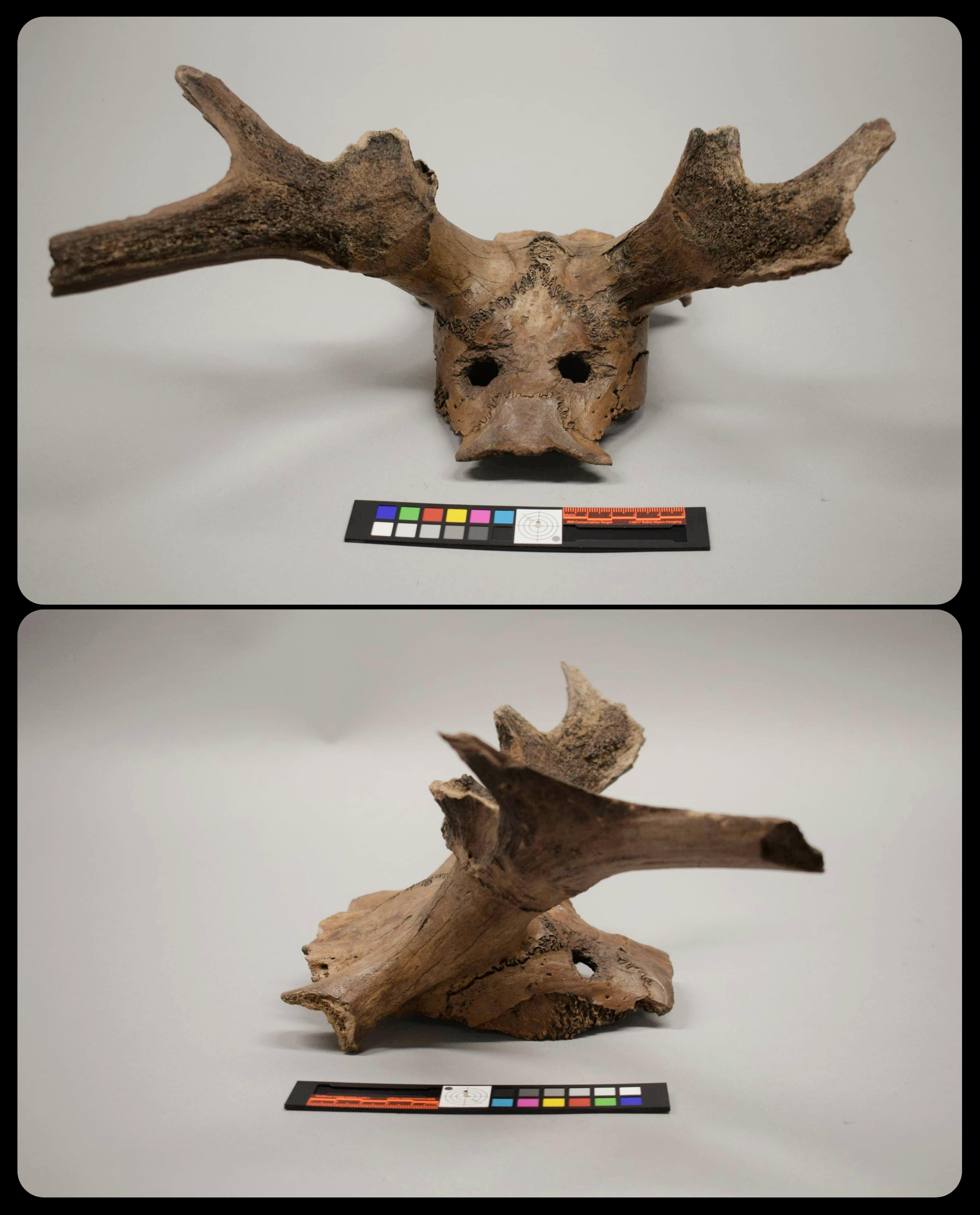
This headdress was discovered at Star Carr, which is an archaeological site located in North Yorkshire. More than 30 other deer-skull headdresses (also known as frontlets) have been unearthed at the same site, all dating back to the Mesolithic period, c.9000-8000 BCE.
> The most famous of the Star Carr finds are the enigmatic headdresses crafted from deer skulls, with holes drilled into them and parts of the antlers removed. Some headdresses are smaller than others, and could have been worn by children.
> The headdresses are uncommon artefacts, with only three similar objects known elsewhere (in Germany), which raises the question of why there are so many at Star Carr.
The two holes that were carved into the parietal bone of the skull were likely used to secure the headdress onto the wearer’s head.
> The initial dichotomised interpretations offered by Dr. Graham Clark as to the frontlets’ purpose have characterised their discussion for the vast majority of the latter 20th century as either a shamanic headdress or a hunting disguise. More recently, however, researchers have critiqued this dichotomy, noting that many hunter-gatherer worldviews afford little meaningful distinction between functional and symbolic actions.
> It can be argued that as shamans are widely regarded as playing a key role in negotiating human/animal relations and hunting luck, an artefact which aids the corporeal transformation of a human body into that of a deer could be used in both capacities interchangeably. Certainly, the contexts into which the frontlets were being deposited at Star Carr suggests that a complex set of meanings were attached to them.

1 Comment
This headdress was discovered at Star Carr, which is an archaeological site located in North Yorkshire. More than 30 other deer-skull headdresses (also known as frontlets) have been unearthed at the same site, all dating back to the Mesolithic period, c.9000-8000 BCE.
According to [this article:](https://archaeology.co.uk/articles/reviews/museum/review-a-survival-story-prehistoric-life-at-star-carr.htm)
> The most famous of the Star Carr finds are the enigmatic headdresses crafted from deer skulls, with holes drilled into them and parts of the antlers removed. Some headdresses are smaller than others, and could have been worn by children.
> The headdresses are uncommon artefacts, with only three similar objects known elsewhere (in Germany), which raises the question of why there are so many at Star Carr.
The two holes that were carved into the parietal bone of the skull were likely used to secure the headdress onto the wearer’s head.
The purpose and significance of these artifacts remains unclear. Some experts believe that they were worn as hunting disguises, while others argue that they served a ceremonial purpose. Those two theories may not be mutually exclusive, as [this author](https://archive.org/details/oapen-20.500.12657-30161/page/331/mode/1up?q=%22The+initial+dichotomised%22) points out:
> The initial dichotomised interpretations offered by Dr. Graham Clark as to the frontlets’ purpose have characterised their discussion for the vast majority of the latter 20th century as either a shamanic headdress or a hunting disguise. More recently, however, researchers have critiqued this dichotomy, noting that many hunter-gatherer worldviews afford little meaningful distinction between functional and symbolic actions.
> It can be argued that as shamans are widely regarded as playing a key role in negotiating human/animal relations and hunting luck, an artefact which aids the corporeal transformation of a human body into that of a deer could be used in both capacities interchangeably. Certainly, the contexts into which the frontlets were being deposited at Star Carr suggests that a complex set of meanings were attached to them.
#Sources & More Info:
– The British Museum: [Headdress](https://www.britishmuseum.org/collection/object/H_1953-0208-1)
– Current Archaeology: [A Survival Story: Prehistoric Life at Star Carr](https://archaeology.co.uk/articles/reviews/museum/review-a-survival-story-prehistoric-life-at-star-carr.htm)
– Star Carr Volume Two: Studies in Technology, Subsistence and Environment: [Antler Frontlets](https://archive.org/details/oapen-20.500.12657-30161/page/297/mode/1up?q=%22Star+carr+antler+frontlets%22)
– Star Carr Archaeological Project: [Antler Headdresses](http://www.starcarr.com/headdress.html)
– York Archaeology: [Mesolithic Marvels: Conserving the Star Carr Headdresses](https://commercial.yorkarchaeology.co.uk/mesolithic-marvels-conserving-the-star-carr-headdresses/)
– PLoS One: [Technological Analysis of the World’s Earliest Shamanic Costume](https://pmc.ncbi.nlm.nih.gov/articles/PMC4830440/)
– Archaeologica Baltica: [The Cult of the Deer and “Shamans” in Deer-Hunting Societies](https://www.researchgate.net/publication/335276721_THE_CULT_OF_THE_DEER_AND_SHAMANS_IN_THE_DEER_HUNTING_SOCIETIES)