
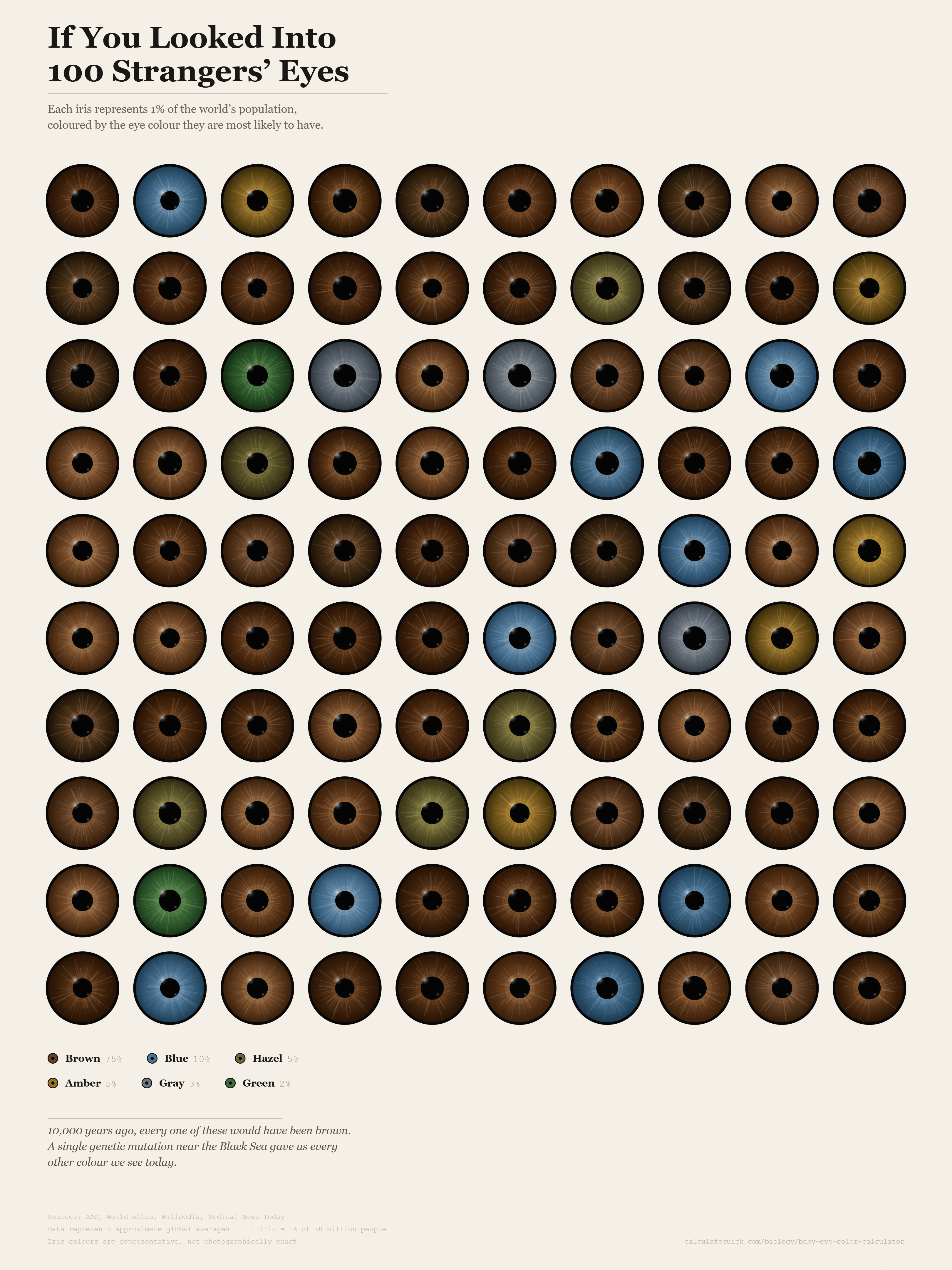
Source: CalculateQuick (visualization & probability model), AAO, World Atlas, Medical News Today.
Tools: Canvas-based procedural iris rendering. Each iris generated individually with radial fiber textures and color variation. 1 iris = 1% of ~8 billion people. 10,000 years ago, every one of these would have been brown.
by CalculateQuick
22 Comments
Source: [CalculateQuick](https://calculatequick.com/biology/baby-eye-color-calculator/) (visualization & probability model), **AAO**, **World Atlas**, **Medical News Today**.
Tools: Canvas-based procedural iris rendering. Each iris generated individually with radial fiber textures and color variation. 1 iris = 1% of ~8 billion people. 10,000 years ago, every one of these would have been brown.
There’s something to be said here about racism, diversity, etc…..
A global map would be insightful in presenting the distribution
There aren’t really any hazel eyes here. The kind with the really clear brown/green outer and an explosion of blue in the center.
Are these supposed to represent different shades of brown? Looks more like a set of samples rather than a distribution.
This is tough, because while the rendering and display is nice in terms of quality, it doesn’t really convey the data effectively at all – I can’t tell the relative distributions at a glance, I can’t easily tell apart the shades of brown, and so it turns kind of muddled in the aggregate.
I think grouping it by eye color would be a start, and maybe further breaking down by region would make the data itself more interesting.
It’s hard for me to see the difference between the brown and hazel eyes, which is funny, because I’m actually not sure whether my eyes are brown or hazel.
Ok so… isn’t that 50 strangers eyes?
there should be a cutoff where you call eye color black instead of brown. even if it’s a spectrum, lumping “light browns” together with “nearly pitch black unless you really squint and get a ton of light on them” doesn’t feel like the whole story
Since there are only 6 colors here this would be better as a bar chart.
Ohhh I understand law enforcement’s infatuation with iris scanning now. They look like little doughnuts.
I always thought my eyes were brown until about 25yo I realized I had a deep green ring around the outside of my brown. And when my eyes diolate (???) it becomes very prominent. Is this unique, do I have cancer now. Etc. etc.
I have grey (slightly blue) eyes, I had no idea they were that rare. I grew up wishing they were just a bit more blue than grey.
I was once told that blue eyes mutated a second time sub-saharan Africa and that the people of sub Saharan Africa have some of the widest diversity of genes on the planet.
Could be a decent pie chart.
This visualization is looking good but hard to extract data from.
So green is actually more rare than blue
Wow
it’s a super cool visual but i think the story would be easier to convey if all like colored irises were grouped
So heterochromia just doesn’t exist in your world huh?
This is simply a visual representation of the world’s percentages of eye colors. The title of the post is misleading
All White/European-origin people are at most 10% of the world population and probably less than half of them have light coloured eyes (depending on country of course, e.g. Norway vs Greece). Outside of European-origin people, light eyes are very rare. So I highly doubt that blue, grey and green add up to 15% of the world population.
I think I heard the figure 2% once but can’t remember where.
This is kind of disconcerting to look at.