
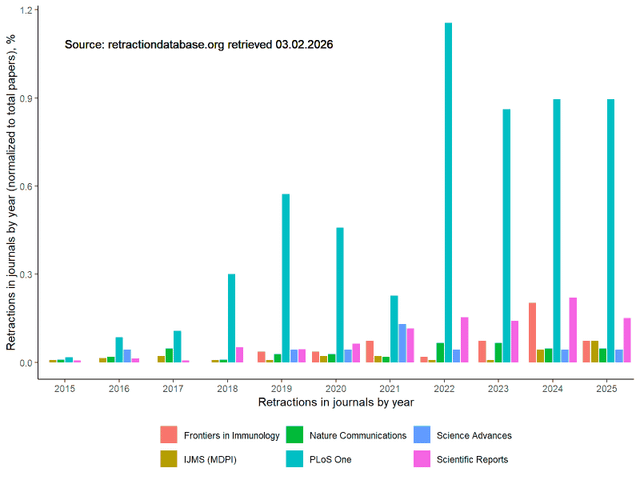
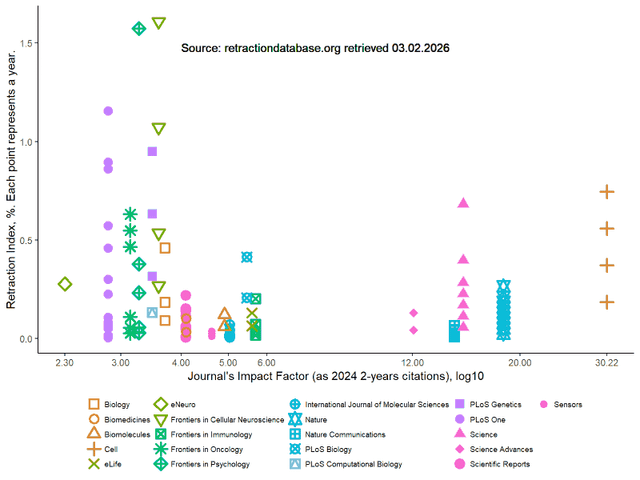
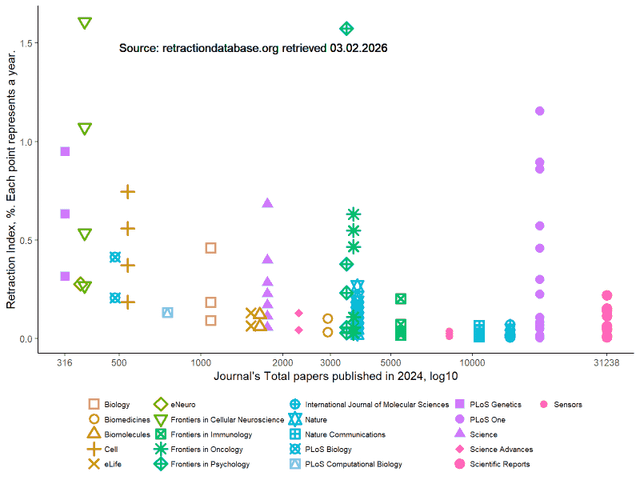
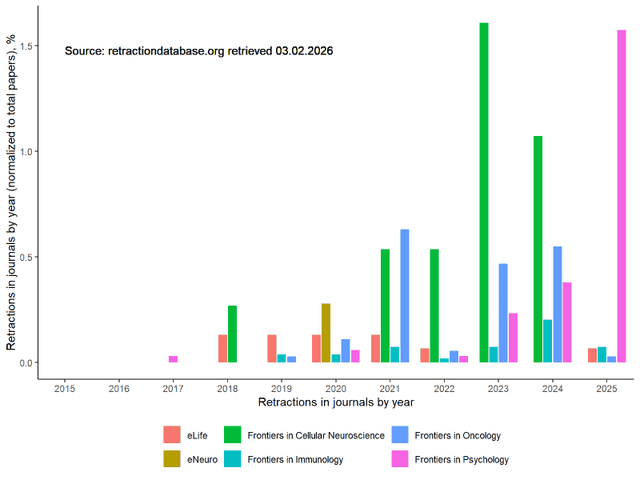
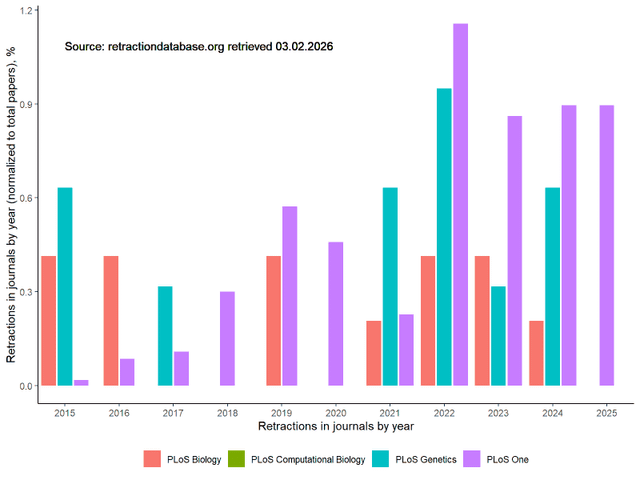
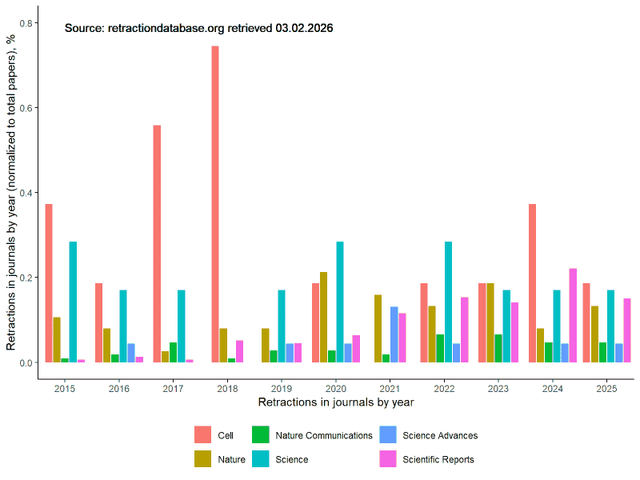
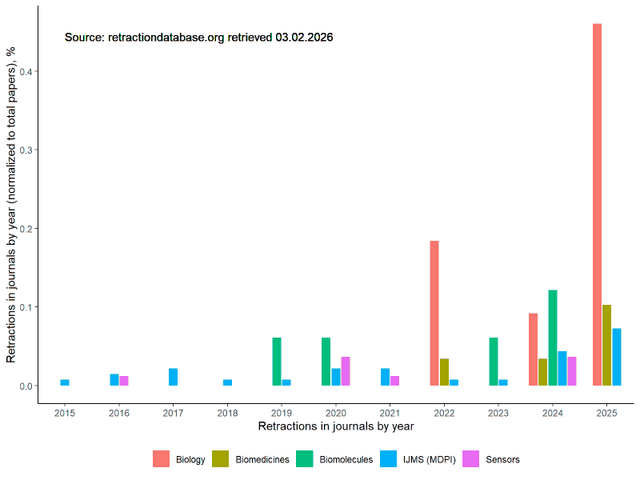
I made some infographics from recent data of retractiondatabase.org and scimagojr.com .
Retractions is one of metrics of scientific fraud or misconduct, but must be taken with caution. The process of retraction is nontransparent, depends on retraction politics of journal/publisher. It may take years – eg. famous "arsenic life" paper was retracted 15 years after publication, and gliphosate fraud paper was retracted 25 years after publication. There a lot of cries in academic community about "predatory" OA publishers, like MDPI and Frontiers, so I plot the retractions by these journals and NSC (Nature, Science, Cell) top journals and their OA daughter journals.
Main results:
* Absolute retractions numbers are not informative, as journals varies by total papers published on the degree of one order. So, I used Index of Retraction (IR), calculated as Retractions per year/Total papers published in 2024 (as most recent open data).
* From the NSC domain, Nature has most strict rules of retractions (IR is lowest).
* Surprisingly, MDPI journals have the same IR, as NSC journals.
* Most rubbish were retracted from absolute favorite PLoS ONE journal, next one Scientific Reports.
* Frontiers and PLoS journals have higher IR, then MDPI journals.
* Total retractions per year is around 1% of total published papers for all journals – that is low, in contrast to numbers, voiced by science critics-alarmists. But again, IR is underrepresenting the total degree of scientific misconduct in modern science.
* IR is not depended of Impact Factor of journals or Total papers published.
To whom of you, who want to redo analysis with most recent database or check your own factors, I upload the R script to my GitHub.
by mikkifox_dromoman
3 Comments
This is really important data but these visualizations are . . . obtuse
My first ever paper got published literally today, and as pleased as I am at the career milestone, my biggest fear is that I’ve fucked it in some way without even realising and it’ll be retracted.
Wondering about your bulleted list of conclusions. Is that quoted from somewhere is that your own?
I agree that it’s difficult to compare retractions between separate journals, unless those journals adopt the same standard of retraction (and even then, nowadays, the likelihood of retraction is probably quite different, depending on the amount of public scrutiny and the internal resources).
I’d expect the worst-quality journals, including many/most from MDPI, to have some of the lowest retraction rates. (Not sure whether or not this is true in practice.) Otherwise-considered-high quality journals that operate on thin or negative margins should also have low retraction rates, for lack of resources. Of course a completely-open-publishing journal will by definition have a retraction rate of zero.