I’m guessing for about a second before we’re pulled into it
franky07890 on
Would those Saturn cars then be called ‘moon’?
PauseAffectionate720 on
Yes – lovely view, until within a day Saturn’s gravity would tear off our atmosphere, our water, and destroy all life as we know it.
Separate-Simple-5101 on
And yet my city would still find a way to hide it behind smog..
Diced_and_Confused on
Also it would look like you are dead.
basic_model on
No one would pay for movies.
Northwest6891 on
People in the comments are taking this too seriously 😭
Glittering-Lynx6991 on
That would be dope.
GotszFren on
It’s beautiful actually. If it had no adverse effects that would be a sight (and site) to see.
Environmental-Ball24 on
If Uranus were that close, it would smell like shit🫡
roof_baby on
How much more would that affect the tides?
notanyimbecile on
Would be so great, like saturnday everyday!
SuperRevy on
This is so beautiful
Dan_Dan2025 on
Not true
ekxtasy on
yeah only for like 2 seconds, then our entire planet would crash onto saturn.
HarveyNix on
Looks like the ending of the New Zealand film The Quiet Earth, from the 80s.

SilyLavage on
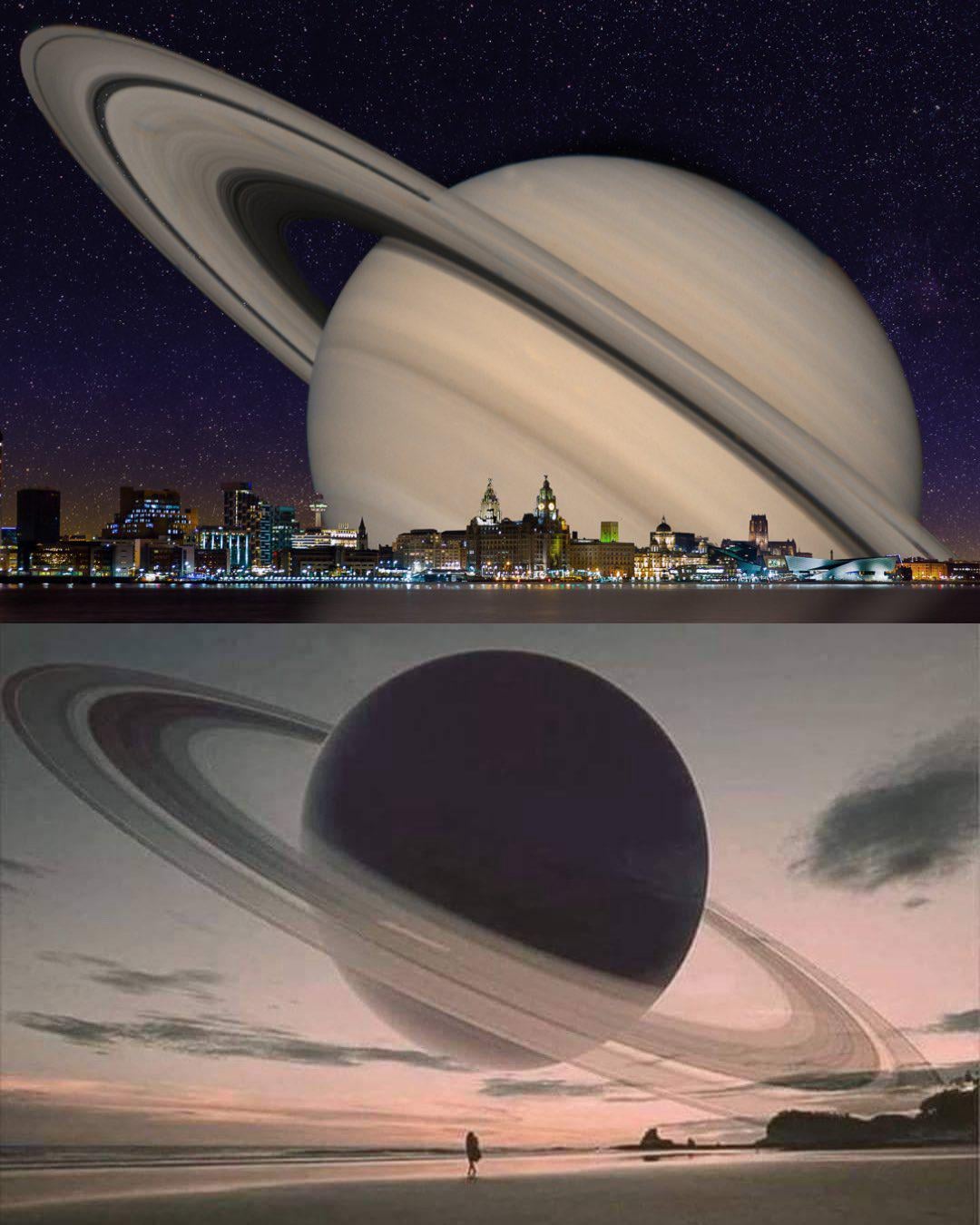
It certainly sets off the Liver Building nicely
Dagobertdelta on
That would bother me
dustycanuck on
Here’s your dose of AI for the day, cough, cough.
If you “swap in” Saturn where our Moon is now (same average distance: ~384,000 km), Earth basically becomes a planet–giant-planet binary. It wouldn’t be a cute sky change — it would rewrite oceans, geology, and the length of day.
1) The sky would look absurd
Saturn’s apparent size would be enormous.
The Moon is ~0.5° wide in the sky. Saturn at lunar distance would be about ~17° wide (roughly 34× the Moon’s diameter).
The rings would span a huge arc across the sky and would be very bright.
2) Tides would be catastrophically larger
Tidal strength scales roughly like mass / distance³. Distance stays the same, so it’s mostly a mass swap:
Saturn is about 7,700× the Moon’s mass.
So tidal forcing would be ~7,700× stronger than what drives our current ocean tides.
What that means on Earth:
Ocean tides could become hundreds of meters to kilometers in extreme scenarios (real oceans hit limits from coastlines, friction, resonance, etc., but it’s still “planet-wrecking” scale).
Solid Earth tides (the ground flexing) would be far larger too → much more earthquake and volcanic activity.
Expect constant, violent coastal flooding and mega-currents as the tidal bulges sweep around.
3) The “month” becomes a ~3-day cycle
At the Moon’s distance, an Earth–Saturn orbit would be much faster because Saturn’s gravity is huge.
Using orbital physics at 384,000 km, the orbital period would be roughly ~2.8 days.
So instead of a ~29.5-day lunar cycle, you’d get:
A “Saturn cycle” every ~67 hours,
With major tide swings tied to that rapid period.
4) Earth’s rotation would get brake-slammed
Those massive tides would act like a giant brake on Earth’s spin.
Earth would likely be driven toward tidal locking (same face toward Saturn) much faster than with the Moon.
The end-state (if it survived long enough) would trend toward an Earth day more like a few days long (comparable to that ~2.8-day orbital period), with extreme heating and stress during the transition.
5) Nights become much brighter
Saturn’s disk would cover ~1000× the sky area of the full Moon. Even though Saturn isn’t perfectly reflective, the sheer size means:
Nights could be bright like deep twilight / bright indoor lighting, plus ring-glow.
You’d also get frequent, dramatic solar eclipses (Saturn would block a big chunk of sky).
6) Would Earth be ripped apart?
Probably not instantly just from being inside a “Roche limit” (at this distance, Earth is likely outside Saturn’s Roche disruption distance for an Earth-density body).
But “not ripped apart” is a low bar: the tidal chaos + heating + ocean rearrangement + tectonics is more than enough to make Earth far less habitable.
Quick pros vs cons (because your brain asked “could anything be cool?”)
Pros
The sky would be spectacular.
Nights would be bright (less darkness).
Cons
Ocean tides become world-shaking.
Earthquakes/volcanism likely spike.
Day length changes dramatically.
Coastal life (and probably a lot inland) gets wrecked.
Takeaways
Tides scale with mass (distance³), so Saturn at Moon distance → ~7,700× stronger tides.
Earth–Saturn would orbit in about ~2.8 days, so everything cycles fast.
Expect massive flooding, mega-currents, and intense tectonic activity.
The sky would be huge Saturn + brilliant rings, and nights would be much brighter.
If you want, I can also run a “what-if” variant: Jupiter instead of Saturn, or Saturn at a safe distance (how far away it would need to be for tides to feel “Moon-like”).
Six-Seven-Oclock on
And we would be Saturns moon and everyone would die.
SnuggleyFluff on
Love the Liver Building in the first pic.
komokazi on
Earth wouldn’t exist….
njpandabbc on
This is really frightening
smokky on
Let me introduce you to something called gravity
ScowlyBrowSpinster on
Now I want Saturn to be as close as the moon. It’s the best, most stylish planet, after Earth.
Anyway, what could possibly go wrong?
Bobdadood on
If my Grandma has wheels she’d be a bike.
Oiggamed on
Civilization would have been long gone if this were to happen. It might look like this but there would be total global devastation long before Saturn got this close. Gravity would be all fucked I’m. The moon would probably be gone too. Most likely absorbed by Saturn.
Although the bottom picture would be entirely under water
UnexpectedFeatures on
This would make Earth a moon of Saturn at a similar distance to Saturn’s moon Dione. Assuming the scenario includes this being a stable orbit, Earth would eventually become tidally locked to Saturn and the length of a day on Earth would increase to reflect its orbital period of roughly 65 hours. Things would potentially get very chaotic when you add the influence that Earth and Saturns many moons would have on each other.
dap00man on
I mean we would be inside the e-ring so this guy would be really fuzzy and hazy.
Normal_Cut8368 on
insert two drastically different sized representationa
Own-Shelter-9897 on
Hell of a view, don’t think humanity would have evolved though, lol
jojohohanon on
We would orbit Saturn of course.
Despite common sense, the moon doesn’t pull water toward it – the tides are cause by the common center of mass of the two bodies being slightly towards the moon. In this case it would be within Saturn. This would likely quickly scatter the rings. The center of mass would be very close to the center of Saturn and lo-high swing tides would be 2 miles high.
MattyS71 on
Surf’s up
ELSknutson on
Ya the seas seem a bit to calm I think. I would imagine like 100Ft tidal waves.

48 Comments
Imagine the tides, Florida would only exist half the day lol
Duuuuuuuuuuude
That would be cool
That is not what it would it look like. The tides would destroy those buildings and humanity would not have evolved to the state that it has.
I’m in!
Wouldn’t Earth be engulfed by Saturn’s gravitational pull?
Apparently alll of the other planets would fit between the earth and moon.
https://preview.redd.it/g7l3wkkrswhg1.jpeg?width=3302&format=pjpg&auto=webp&s=1d37135edc253f8ae950179d9b89e534901f2b53
You mean if Earth was a moon of Saturn?
That actually looks way too small.
I’m guessing for about a second before we’re pulled into it
Would those Saturn cars then be called ‘moon’?
Yes – lovely view, until within a day Saturn’s gravity would tear off our atmosphere, our water, and destroy all life as we know it.
And yet my city would still find a way to hide it behind smog..
Also it would look like you are dead.
No one would pay for movies.
People in the comments are taking this too seriously 😭
That would be dope.
It’s beautiful actually. If it had no adverse effects that would be a sight (and site) to see.
If Uranus were that close, it would smell like shit🫡
How much more would that affect the tides?
Would be so great, like saturnday everyday!
This is so beautiful
Not true
yeah only for like 2 seconds, then our entire planet would crash onto saturn.
Looks like the ending of the New Zealand film The Quiet Earth, from the 80s.

It certainly sets off the Liver Building nicely
That would bother me
Here’s your dose of AI for the day, cough, cough.
If you “swap in” Saturn where our Moon is now (same average distance: ~384,000 km), Earth basically becomes a planet–giant-planet binary. It wouldn’t be a cute sky change — it would rewrite oceans, geology, and the length of day.
1) The sky would look absurd
Saturn’s apparent size would be enormous.
The Moon is ~0.5° wide in the sky. Saturn at lunar distance would be about ~17° wide (roughly 34× the Moon’s diameter).
The rings would span a huge arc across the sky and would be very bright.
2) Tides would be catastrophically larger
Tidal strength scales roughly like mass / distance³. Distance stays the same, so it’s mostly a mass swap:
Saturn is about 7,700× the Moon’s mass.
So tidal forcing would be ~7,700× stronger than what drives our current ocean tides.
What that means on Earth:
Ocean tides could become hundreds of meters to kilometers in extreme scenarios (real oceans hit limits from coastlines, friction, resonance, etc., but it’s still “planet-wrecking” scale).
Solid Earth tides (the ground flexing) would be far larger too → much more earthquake and volcanic activity.
Expect constant, violent coastal flooding and mega-currents as the tidal bulges sweep around.
3) The “month” becomes a ~3-day cycle
At the Moon’s distance, an Earth–Saturn orbit would be much faster because Saturn’s gravity is huge.
Using orbital physics at 384,000 km, the orbital period would be roughly ~2.8 days.
So instead of a ~29.5-day lunar cycle, you’d get:
A “Saturn cycle” every ~67 hours,
With major tide swings tied to that rapid period.
4) Earth’s rotation would get brake-slammed
Those massive tides would act like a giant brake on Earth’s spin.
Earth would likely be driven toward tidal locking (same face toward Saturn) much faster than with the Moon.
The end-state (if it survived long enough) would trend toward an Earth day more like a few days long (comparable to that ~2.8-day orbital period), with extreme heating and stress during the transition.
5) Nights become much brighter
Saturn’s disk would cover ~1000× the sky area of the full Moon. Even though Saturn isn’t perfectly reflective, the sheer size means:
Nights could be bright like deep twilight / bright indoor lighting, plus ring-glow.
You’d also get frequent, dramatic solar eclipses (Saturn would block a big chunk of sky).
6) Would Earth be ripped apart?
Probably not instantly just from being inside a “Roche limit” (at this distance, Earth is likely outside Saturn’s Roche disruption distance for an Earth-density body).
But “not ripped apart” is a low bar: the tidal chaos + heating + ocean rearrangement + tectonics is more than enough to make Earth far less habitable.
Quick pros vs cons (because your brain asked “could anything be cool?”)
Pros
The sky would be spectacular.
Nights would be bright (less darkness).
Cons
Ocean tides become world-shaking.
Earthquakes/volcanism likely spike.
Day length changes dramatically.
Coastal life (and probably a lot inland) gets wrecked.
Takeaways
Tides scale with mass (distance³), so Saturn at Moon distance → ~7,700× stronger tides.
Earth–Saturn would orbit in about ~2.8 days, so everything cycles fast.
Expect massive flooding, mega-currents, and intense tectonic activity.
The sky would be huge Saturn + brilliant rings, and nights would be much brighter.
If you want, I can also run a “what-if” variant: Jupiter instead of Saturn, or Saturn at a safe distance (how far away it would need to be for tides to feel “Moon-like”).
And we would be Saturns moon and everyone would die.
Love the Liver Building in the first pic.
Earth wouldn’t exist….
This is really frightening
Let me introduce you to something called gravity
Now I want Saturn to be as close as the moon. It’s the best, most stylish planet, after Earth.
Anyway, what could possibly go wrong?
If my Grandma has wheels she’d be a bike.
Civilization would have been long gone if this were to happen. It might look like this but there would be total global devastation long before Saturn got this close. Gravity would be all fucked I’m. The moon would probably be gone too. Most likely absorbed by Saturn.
https://preview.redd.it/ettj5ij6zwhg1.jpeg?width=1536&format=pjpg&auto=webp&s=6737d092e022c7d86ca31e86fdde709f1577f4b3
I think might be more accurate.
Except the ocean would be pulled aaaalll the way over that city
Wouldn’t the gravitational pull of Saturn either make Earth a moon of Saturn or slowly pull Earth toward Saturn?
[Here](https://www.fotopiaimages.com/if-the-planets-were-as-close-as-the-moon-what-would-the-sky-at-night-look-like/) is the source of the top image and what it what it would look like with the other planets in the solar system. [Here](https://i.imgur.com/FLEH8GN.gif) is an animated version.
Credit to /u/ajamesmccarthy for [making that version of the bottom image](https://x.com/AJamesMcCarthy/status/1617734800475058183?ref_src=twsrc%5Etfw). (There are [other versions too](https://x.com/BrianRoemmele/status/1315127024965488640)).
[Here](https://c1.peakpx.com/wallpaper/947/103/761/people-dark-sky-clouds-wallpaper.jpg) is the original version of the picture on the bottom. [Here](https://unsplash.com/photos/1HiJlE4CBQI) is the source. Credit to the photographer, [Jason Briscoe](https://unsplash.com/@jsnbrsc), who took this in Playa Maderas, Nicaragua.
Although the bottom picture would be entirely under water
This would make Earth a moon of Saturn at a similar distance to Saturn’s moon Dione. Assuming the scenario includes this being a stable orbit, Earth would eventually become tidally locked to Saturn and the length of a day on Earth would increase to reflect its orbital period of roughly 65 hours. Things would potentially get very chaotic when you add the influence that Earth and Saturns many moons would have on each other.
I mean we would be inside the e-ring so this guy would be really fuzzy and hazy.
insert two drastically different sized representationa
Hell of a view, don’t think humanity would have evolved though, lol
We would orbit Saturn of course.
Despite common sense, the moon doesn’t pull water toward it – the tides are cause by the common center of mass of the two bodies being slightly towards the moon. In this case it would be within Saturn. This would likely quickly scatter the rings. The center of mass would be very close to the center of Saturn and lo-high swing tides would be 2 miles high.
Surf’s up
Ya the seas seem a bit to calm I think. I would imagine like 100Ft tidal waves.
