but Americans are charged an obscene amount for it
duncanteabag on
And yet the price of insulin (in the US at least) has skyrocketed…
jgoverman17 on
Honestly wild to think something that once depended on animals is now made with precision biology science quietly improving lives without most people even noticing.
LankyOldie71 on
And a huge thank you to the family of Frederick Banting and Charles Best and the wonderful Team for giving so much to us Diabetics, I would have been dead 30 years ago if it wasn’t for them. They sold it for $1 in 1923.
Existing-Mulberry382 on
Thank you, David V. Goeddel, Arthur Riggs and Keiichi Itakura for making it happen.
Thank you, Frederick Banting, John Macleod, and Charles Best for their work on insulin, that saved millions of lives.
Loud-Ad-2280 on
Then some billionaires decided they could monopolize it and drive up the price! Fun!
RevolutionaryEdge718 on
Science – F yeah!
Billionaires – F yourselves!
Popular-Lemon6574 on
Amazing
Idontrememberalot on
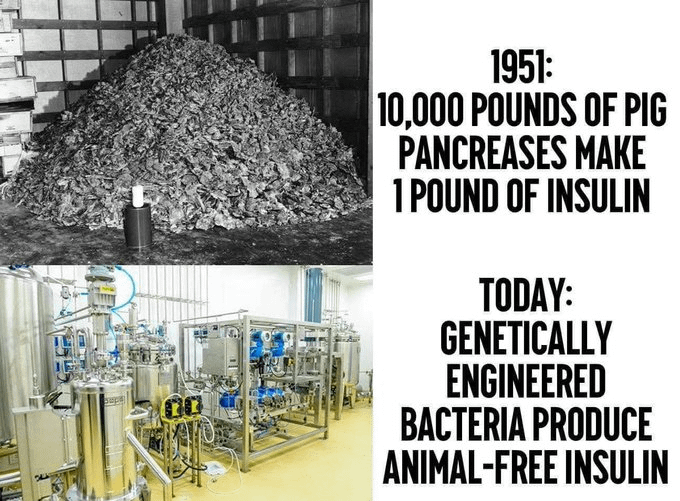
So do we now have heaps of pig pancreases just sitting there?
Were those pigs raised just for the pancreases is what I’m asking?
EDIT. Oh lord. So many spelling mistakes and typos.
ThinkBlueberry515 on
I’ve been in remission from T2 nearly ten years. My A1C hovers between 4.9-5.1.
chickey23 on
But if we have the pig pancreas anyway, what are we supposed to do with them now?
amanset on
This has been true for a very, very long time.
As an example, I was diagnosed type one in 1993 and have never used an animal insulin.
EmptyForest5 on
Presently recombinant insulin is a $30B market and animal insulin is a $1.5B market, according to some light research. The pig parts are still in use because some patients resist human insulin.
ZonaPunk on
and yet it costs 1000x in the 1951
Jackof-AllTrade on
Dont they still produce it inside horse pancreas?
perldawg on
i feel obligated to point out that the pancreases were, and still are, a byproduct of the pork industry. pigs have never been raised for the specific purpose of insulin production.
interestingly, i’ve actually talked with someone who used to work for a major food company in pig pancreas processing. they get a lot more than just insulin from them, there are several drugs derived from the process, and certain pigs have more valuable pancreases than others. how fresh the pancreas is is also very important. they put a ton of effort into identifying pigs with high value pancreases and getting them from the slaughterhouses to the processing facility as fast as possible, distances from all over the US.
momdank on
Yet it’s still about $400+ dollars per vial WITHOUT insurance.
Let me remind us, that insulin was sold for $1 when it first was created and marketed as a treatment method.
SubstantialPressure3 on
And yet, somehow it used to be more affordable
Delicious_Rabbit4425 on
And yet it keeps getting more expensive
Michael_J_Patrick on
Once you pay 10,000 pig prices it’s hard to go back
Tackysackjones on
And the evolution of greed ensures that anyone who needs insulin will be destitute
Ime81 on
What about rennet? What percentage is made without material of animal background?
Expert_Bat4612 on
The price has only gone up
Rogueshadow_32 on
I see someone else watched the latest chubbyemu video
thenikolaka on
Aren’t bacteria in the animal kingdom? I’m just curious.
Kyrie_Blue on
Insulin was discovered in my hometown by Banting, who swore to always have insulin be affordable to those that need it.
Capitalism is a fucking cancer
Johnny_Dickshot on
I saw 10,000 lbs of Pig Pancreas open for GWAR back in ‘89.
ode_2_firefly on
I love bacteria. Tiny gods!
DullMind2023 on
But, but Genetically Engineered is scary and bad. /s
pinniped90 on
Lmao my brain spent too long wondering what a pan-crease was.
I need coffee.
Partsguy420 on
OHH BOY….GMO insulin
some_loaded_tots on
but do bacteria have a soul?
PercMaint on
This will make it cheaper, right…
Ambitious-Concern-42 on
If the inventors sold the patent for $1 in 1923, how the hell are American corporations charing a fortune for it???
kevbry on
The US will do anything to avoid the metric system
Fathomless_Black on
I work in the plant where the magic happens!
watboy on
Similar thing happened with cheese and is why you can find labels on them telling you if they’re vegetarian or not.
Rennet is an enzyme used in the production of cheese to curdle milk which was traditionally extracted from the stomach of calves, until 1990 when the FDA approved a genetically modified bacteria that could be used instead and now the vast majority of cheese is made using it instead.
GlitteringBandicoot2 on
Not just that, the “artifical” one is also LEAGUES better and cheaper!
Like for example, the pig insulin worked about a 30 minutes later, so you had to inject 30 minutes before eating, and the whole point is to not let the blood glucose get to high, so you have to have it working while eating.
Good luck timing that, unless dinner is already done and you just wait for 30 minutes till you can eat. But imagine being out in a restaurant or something. Impossible task. And when you don’t eat after those 30 minutes, you blood glucose is gonna plummet and can and probably will lead to hypo, which can result in a quick death.
EquivalentSnap on
And yet insulin is patented by big pharma in the us meaning its expensive to buy
atuan on
Are we using the pig pancreases for something else now?
gussy1976 on
and the price hasn’t fucking changed in America
HardyPollutant on
Thank you to all the pigs and animals that made it so I and many other diabetics are able to live. 🖤✨️
sancho_sk on
I’m looking forward to future where we have similar comparison for 1kg of steak meet from cow vs some precision fermentation process to create the same.
Iron_Aez on
Sooo what do we do with pig pancreas’s now?
okram2k on
I’m fairly sure those pigs were going to become pork regardless of what happened to their pancreases
schnokobaer on
I know at least a couple of people who’d go NUUUOOOOOOOOO I WANT MY PIG PANCREAS BACK NOT THE WOKE ANIMAL-FREE PRODUCT
>Our meta-analysis has shown a linear dose-response relationship between total meat, red meat and processed meat intakes and T2D risk. In addition, a non-linear relationship of intake of processed meat with risk of T2D was detected.
>Unprocessed and processed red meat consumption are both associated with higher risk of CVD, CVD subtypes, and diabetes, with a stronger association in western settings but no sex difference. Better understanding of the mechanisms is needed to facilitate improving cardiometabolic and planetary health.
[Does Poultry Consumption Increase the Risk of Mortality for Gastrointestinal Cancers? A Preliminary Competing Risk Analysis](https://www.mdpi.com/2072-6643/17/8/1370)
>Our study showed that poultry consumption above 300 g/week is associated with a statistically significant increased mortality risk both from all causes and from GCs.
>Epidemiological studies confirm a correlation between cow’s milk consumption and birthweight, body mass index, onset of menarche, linear growth during childhood, acne vulgaris, type 2 diabetes mellitus, prostate cancer, breast cancer, hepatocellular carcinoma, diffuse large B-cell lymphoma, neurodegenerative diseases, and all-cause mortality.
-KFBR392 on
To be fair we weren’t short on pig pancreases.
Fun-Result-6343 on
Science for the win. Capitalism for snatching defeat from the jaws of victory.

50 Comments
but Americans are charged an obscene amount for it
And yet the price of insulin (in the US at least) has skyrocketed…
Honestly wild to think something that once depended on animals is now made with precision biology science quietly improving lives without most people even noticing.
And a huge thank you to the family of Frederick Banting and Charles Best and the wonderful Team for giving so much to us Diabetics, I would have been dead 30 years ago if it wasn’t for them. They sold it for $1 in 1923.
Thank you, David V. Goeddel, Arthur Riggs and Keiichi Itakura for making it happen.
Thank you, Frederick Banting, John Macleod, and Charles Best for their work on insulin, that saved millions of lives.
Then some billionaires decided they could monopolize it and drive up the price! Fun!
Science – F yeah!
Billionaires – F yourselves!
Amazing
So do we now have heaps of pig pancreases just sitting there?
Were those pigs raised just for the pancreases is what I’m asking?
EDIT. Oh lord. So many spelling mistakes and typos.
I’ve been in remission from T2 nearly ten years. My A1C hovers between 4.9-5.1.
But if we have the pig pancreas anyway, what are we supposed to do with them now?
This has been true for a very, very long time.
As an example, I was diagnosed type one in 1993 and have never used an animal insulin.
Presently recombinant insulin is a $30B market and animal insulin is a $1.5B market, according to some light research. The pig parts are still in use because some patients resist human insulin.
and yet it costs 1000x in the 1951
Dont they still produce it inside horse pancreas?
i feel obligated to point out that the pancreases were, and still are, a byproduct of the pork industry. pigs have never been raised for the specific purpose of insulin production.
interestingly, i’ve actually talked with someone who used to work for a major food company in pig pancreas processing. they get a lot more than just insulin from them, there are several drugs derived from the process, and certain pigs have more valuable pancreases than others. how fresh the pancreas is is also very important. they put a ton of effort into identifying pigs with high value pancreases and getting them from the slaughterhouses to the processing facility as fast as possible, distances from all over the US.
Yet it’s still about $400+ dollars per vial WITHOUT insurance.
Let me remind us, that insulin was sold for $1 when it first was created and marketed as a treatment method.
And yet, somehow it used to be more affordable
And yet it keeps getting more expensive
Once you pay 10,000 pig prices it’s hard to go back
And the evolution of greed ensures that anyone who needs insulin will be destitute
What about rennet? What percentage is made without material of animal background?
The price has only gone up
I see someone else watched the latest chubbyemu video
Aren’t bacteria in the animal kingdom? I’m just curious.
Insulin was discovered in my hometown by Banting, who swore to always have insulin be affordable to those that need it.
Capitalism is a fucking cancer
I saw 10,000 lbs of Pig Pancreas open for GWAR back in ‘89.
I love bacteria. Tiny gods!
But, but Genetically Engineered is scary and bad. /s
Lmao my brain spent too long wondering what a pan-crease was.
I need coffee.
OHH BOY….GMO insulin
but do bacteria have a soul?
This will make it cheaper, right…
If the inventors sold the patent for $1 in 1923, how the hell are American corporations charing a fortune for it???
The US will do anything to avoid the metric system
I work in the plant where the magic happens!
Similar thing happened with cheese and is why you can find labels on them telling you if they’re vegetarian or not.
Rennet is an enzyme used in the production of cheese to curdle milk which was traditionally extracted from the stomach of calves, until 1990 when the FDA approved a genetically modified bacteria that could be used instead and now the vast majority of cheese is made using it instead.
Not just that, the “artifical” one is also LEAGUES better and cheaper!
Like for example, the pig insulin worked about a 30 minutes later, so you had to inject 30 minutes before eating, and the whole point is to not let the blood glucose get to high, so you have to have it working while eating.
Good luck timing that, unless dinner is already done and you just wait for 30 minutes till you can eat. But imagine being out in a restaurant or something. Impossible task. And when you don’t eat after those 30 minutes, you blood glucose is gonna plummet and can and probably will lead to hypo, which can result in a quick death.
And yet insulin is patented by big pharma in the us meaning its expensive to buy
Are we using the pig pancreases for something else now?
and the price hasn’t fucking changed in America
Thank you to all the pigs and animals that made it so I and many other diabetics are able to live. 🖤✨️
I’m looking forward to future where we have similar comparison for 1kg of steak meet from cow vs some precision fermentation process to create the same.
Sooo what do we do with pig pancreas’s now?
I’m fairly sure those pigs were going to become pork regardless of what happened to their pancreases
I know at least a couple of people who’d go NUUUOOOOOOOOO I WANT MY PIG PANCREAS BACK NOT THE WOKE ANIMAL-FREE PRODUCT
Hmmm….Bad era to be a pig.
Speaking of “using animals”…
[Meat Consumption as a Risk Factor for Type 2 Diabetes](https://www.ncbi.nlm.nih.gov/pmc/articles/PMC3942738/)
>Meat consumption is consistently associated with diabetes risk.
[Meat and fish intake and type 2 diabetes: Dose-response meta-analysis of prospective cohort studies](https://pubmed.ncbi.nlm.nih.gov/32302686/)
>Our meta-analysis has shown a linear dose-response relationship between total meat, red meat and processed meat intakes and T2D risk. In addition, a non-linear relationship of intake of processed meat with risk of T2D was detected.
[Red meat consumption, cardiovascular diseases, and diabetes: a systematic review and meta-analysis](https://pubmed.ncbi.nlm.nih.gov/37264855/)
>Unprocessed and processed red meat consumption are both associated with higher risk of CVD, CVD subtypes, and diabetes, with a stronger association in western settings but no sex difference. Better understanding of the mechanisms is needed to facilitate improving cardiometabolic and planetary health.
[Does Poultry Consumption Increase the Risk of Mortality for Gastrointestinal Cancers? A Preliminary Competing Risk Analysis](https://www.mdpi.com/2072-6643/17/8/1370)
>Our study showed that poultry consumption above 300 g/week is associated with a statistically significant increased mortality risk both from all causes and from GCs.
[Egg consumption and risk of cardiovascular diseases and diabetes: a meta-analysis](https://pubmed.ncbi.nlm.nih.gov/23643053/)
>Our study suggests that there is a dose-response positive association between egg consumption and the risk of CVD and diabetes.
[Lifetime Impact of Cow’s Milk on Overactivation of mTORC1: From Fetal to Childhood Overgrowth, Acne, Diabetes, Cancers, and Neurodegeneration](https://pmc.ncbi.nlm.nih.gov/articles/PMC8000710/)
>Epidemiological studies confirm a correlation between cow’s milk consumption and birthweight, body mass index, onset of menarche, linear growth during childhood, acne vulgaris, type 2 diabetes mellitus, prostate cancer, breast cancer, hepatocellular carcinoma, diffuse large B-cell lymphoma, neurodegenerative diseases, and all-cause mortality.
To be fair we weren’t short on pig pancreases.
Science for the win. Capitalism for snatching defeat from the jaws of victory.