
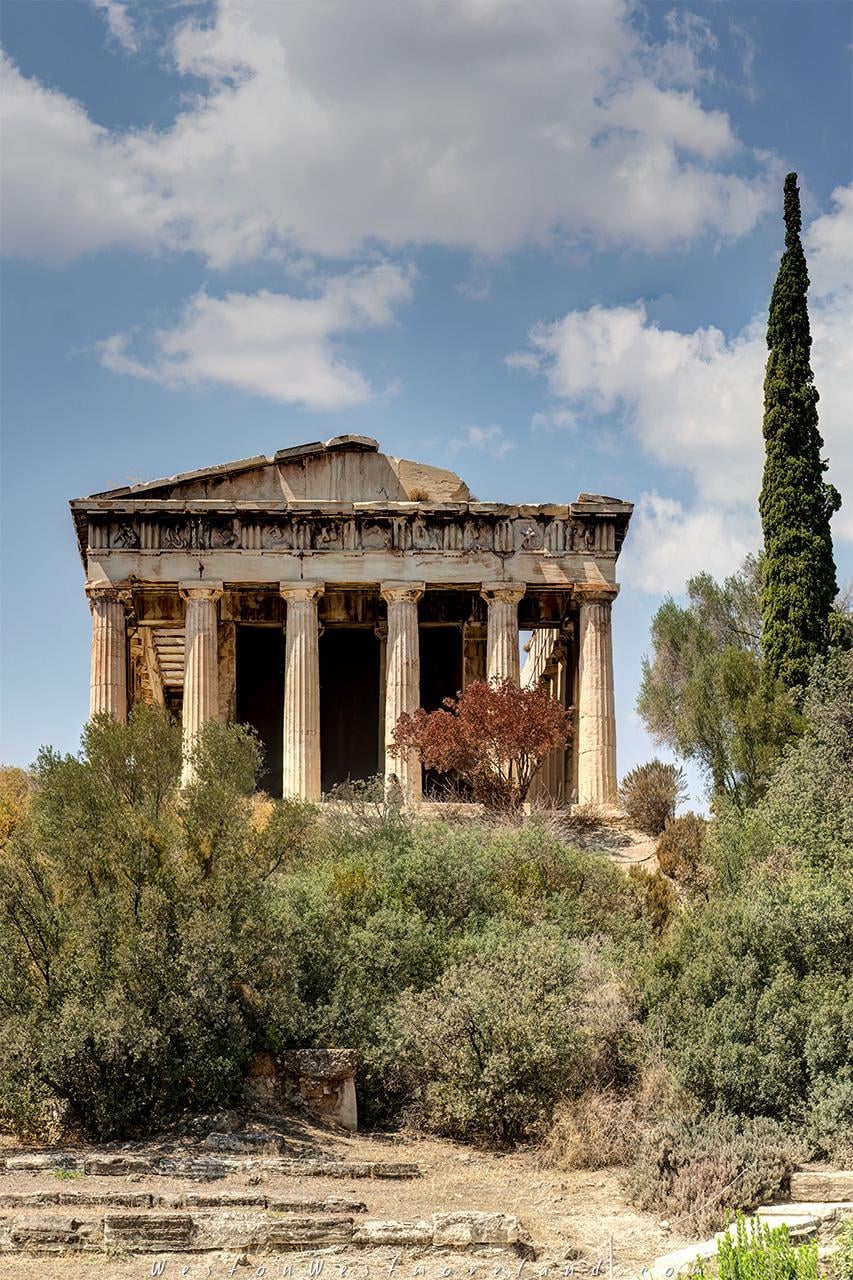
The Temple of Hephaestus (c. 430 BC), a Doric peripteral temple at the north-west side of the Agora of Athens, is one of the best-preserved Greek temples anywhere. It remains standing largely intact today. The building keeps the frieze, pronaos, cella and opisthodomos structures… [1280×753] [OC]
by WestonWestmoreland
1 Comment
…The temple was constructed during the golden age of Athens under the leadership of Pericles. Unlike many other Greek sanctuaries destroyed by Persian invasions, the Athenians chose to honor their oath to leave those ruins untouched as reminders of the Persian Wars. Instead, Pericles commissioned the construction of new temples, of which the Temple of Hephaestus became a principal example. It was dedicated to two deities: Hephaestus, the god of metalworking, fire, and craftsmanship, and Athena Ergani (Athena the Craftswoman), who protected potters and artisans.
The temple was deliberately located within a district teeming with metalworking shops and foundries, making its dedication to the patron god of smiths particularly significant. Pausanias, the ancient Greek geographer and travel writer, documented the presence of bronze cult statues of both deities within the temple, which were created by the renowned sculptor Alkamenis between 421 and 415 BCE.
From the 7th century CE through 1834, the temple was converted into the Church of Saint George Akamates, a Greek Orthodox Christian place of worship. This religious continuity protected the exterior structure from destruction and ruin. The interior was substantially modified to serve Christian liturgical functions, but the exterior—the columns, pediments, and much of the roof—remained largely intact.
During Ottoman rule, the temple served as the principal Greek Orthodox church in Athens. When King Otto formally entered Athens in 1834, his welcoming ceremony was held within its walls. This event marked the temple’s transition from active religious use to preservation as an archaeological monument.
The temple exemplifies the Doric order. Its hexastyle design features six columns on the east and west ends and thirteen columns along the north and south sides (34 columns total when counting corner columns), all surrounding the central enclosed chamber known as the cella. This peripteral arrangement allows visitors to circumambulate the structure and appreciate its proportions from every angle.
The entire building, from its marble platform (crepis) to the roof, was constructed from Pentelic marble from nearby Mount Pendeli. The sculptural decorations were crafted from the finer Parian marble, renowned for its pure white appearance and superior sculptural qualities.
The temple’s interior contained a two-part colonnade arranged in a Π (pi) shape, leading to a pedestal that held the bronze statues of Hephaestus and Athena. The structure also featured a [pronaos ](https://www.reddit.com/r/ArtefactPorn/comments/179v9b5/the_temple_of_hephaestus_c_421_bc_a_doric/#lightbox)(front porch) and opisthodomos (rear chamber), both distyle in antis (with two columns between pilasters).
The temple’s sculptural program tells rich narratives drawn from Greek mythology. The eastern metopes (the rectangular panels between triglyphs in the Doric frieze) are renowned for their depiction of the Labours of Heracles, showcasing scenes of the legendary hero’s famous tasks. The northern and south sides feature four exploits of Theseus, the mythological founder-hero of Athens, depicting scenes such as his battle with the Pallantides. The western frieze presents the dramatic Fall of Troy, one of the most consequential events in Greek mythology.
The friezes don’t extend across all four sides of the temple but concentrate on the pronaos (front entrance area), demonstrating the Classical Greek convention of placing the most important sculptural narratives in the most prominent locations. While many of the original sculptural decorations have been lost to time, weathering, and looting, sufficient remains to convey the temple’s original artistic richness.
Today, the Temple of Hephaestus stands as one of the most accessible ancient monuments in Athens. It is surrounded by a modest ornamental garden and can be approached closely by visitors. It is integrated within the Agora Archaeological Museum site.
The temple remains a powerful illustration of how the ancient Greeks achieved harmony through mathematical proportion, balance, and the integration of structural function with artistic expression—principles that would influence Western architecture for millennia to come.
My apologies for inaccuracies and mistakes.