
Apartheid, literally meaning “apartness” in Afrikaans, was the system of institutionalized racial segregation imposed in South Africa beginning in 1948. For years, resistance was led by the African National Congress (ANC), the party of Nelson Mandela, until Mandela was imprisoned in the early 1960s and the ANC was banned. In its place, the more militant Black Consciousness Movement (BCM) rose to prominence, rejecting multiracial cooperation and emphasizing Black self-determination.
On June 16, 1976, in Soweto, a township outside Johannesburg, thousands of Black schoolchildren, encouraged in part by activists aligned with the BCM, protested the government’s decision to impose Afrikaans as a mandatory language of instruction. As many as 20,000 students joined the demonstrations.
They were met with tear gas, batons, police dogs, and live ammunition. Officers fired directly into the crowd. The commonly cited death toll is 176, though the apartheid government claimed only 23; more than a thousand were wounded. Emergency clinics were overwhelmed with injured and bloodied children. Police demanded hospitals provide the names of students treated for gunshot wounds so they could be charged with rioting. Doctors refused, recording bullet wounds as “abscesses” to protect their patients.
Two white civilians were killed during the unrest. One, Melville Edelstein, was a social worker attempting to build programs for disabled individuals. He had entered the protest area hoping to protect a colleague. His body was later found with a note reading, “Beware Afrikaans is the most dangerous drug for our future.” An African reporter suggested that had the students known who he was, he would not have been targeted.
Like the Sharpeville massacre before it, Soweto triggered nationwide protests and drew global condemnation. Yet even as the unrest unfolded, U.S. Secretary of State Henry Kissinger visited South Africa to meet with its president; the riots were not discussed.
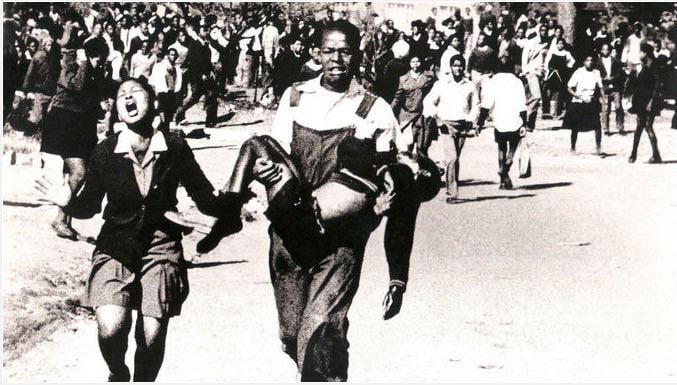
One of the most enduring images from that day shows 12-year-old Hector Pieterson, fatally shot, being carried by 22-year-old activist Mbuyisa Makhubo, with Pieterson’s sister in anguish next to them. The photograph became an international symbol of apartheid’s brutality. Makhubo himself was harassed by authorities, fled the country, and disappeared in 1979, never seen again.
If interested, I write about Nelson Mandela and the end of apartheid here: https://open.substack.com/pub/aid2000/p/hare-brained-history-volume-63-mandela?r=4mmzre&utm\\\\\\\_medium=ios&shareImageVariant=overlay
by aid2000iscool