**Grave find outside Guddal Church in Sunnfjord.**
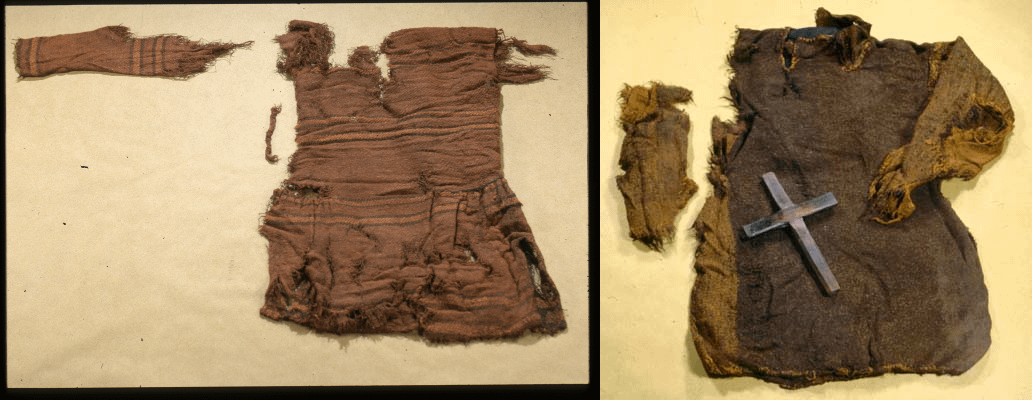
During trench digging near the church in the summer of 1970, two garments, a blanket, as well as a wooden grave cross and a pointed hazel staff were found. These items were brought to the Historical Museum in Bergen. One of the garments (no. BRM 31/1) has many features in common with the shirt from Skjoldehamn. It has a rectangular basic cut, lacks central gores, and is thigh-length. The garment has only one side gore, while the lower part of the body panel on the opposite side is widened and drawn forward so that it forms a counterpart to the gore. The garment is gathered on both sides here. The chest width is approximately 102 cm, while the lower width is about 110 cm. In the Guddal garment, however, a slit of about 20 cm has been made on each side of the garment, which greatly increases freedom of movement. The garment is sewn from four-shaft twill wool fabric patterned with groups of stripes. To create the horizontal striped decoration in the garment, natural color variations in the wool have been used.
Similar striped decoration is found on fragments of a number of twill fabrics in Norwegian archaeological collections. Remains of a 4 mm wide braided band were found at the opening; this has not been color analyzed.
Another garment with a rectangular basic cut was also found in the grave from Guddal. This is also thigh-length, but completely lacks gores. To create greater flexibility at the lower edge of the garment, 30 cm high slits have been made on both sides. Fragments of garments with similar gores have been found during excavations at Bryggen in Bergen. This garment from Guddal (BRM 31/2) differs from all other medieval garments with a rectangular basic cut in that the garment shows an adaptation toward a fitted bodice. At chest height, a curved cut has been made on both sides of the garment, creating a clear shaping to the body. This garment is therefore not as loose in cut as the other garments in this group and also lacks gores. In this respect, the garment forms a category of its own, but like the others it has a simple rectangular cut without shoulder seams. The sleeves show traces of heavy wear, and the garment has been patched with pieces of fabric in a lighter brown color. The body has received a special color distribution in that the outermost part is light brown, while the rest is dark brown. This gives the garment an asymmetrical color impression, which is nevertheless somewhat balanced by the fact that parts of the sleeves and collar have the same light warp color.
This garment also has a distinctive neckline: the body is cut down into two points on each side of the neck opening so that the opening forms a W. Around the neck runs an 8.5 cm high collar with a fastening flap on one side. The Guddal garments likely date from around the years 990–1160, but they may also be younger.

1 Comment
From [Heimskringla.no](https://heimskringla.no/wiki/Klede_og_tekstilar_i_middelalderen) (translated)
**Grave find outside Guddal Church in Sunnfjord.**
During trench digging near the church in the summer of 1970, two garments, a blanket, as well as a wooden grave cross and a pointed hazel staff were found. These items were brought to the Historical Museum in Bergen. One of the garments (no. BRM 31/1) has many features in common with the shirt from Skjoldehamn. It has a rectangular basic cut, lacks central gores, and is thigh-length. The garment has only one side gore, while the lower part of the body panel on the opposite side is widened and drawn forward so that it forms a counterpart to the gore. The garment is gathered on both sides here. The chest width is approximately 102 cm, while the lower width is about 110 cm. In the Guddal garment, however, a slit of about 20 cm has been made on each side of the garment, which greatly increases freedom of movement. The garment is sewn from four-shaft twill wool fabric patterned with groups of stripes. To create the horizontal striped decoration in the garment, natural color variations in the wool have been used.
Similar striped decoration is found on fragments of a number of twill fabrics in Norwegian archaeological collections. Remains of a 4 mm wide braided band were found at the opening; this has not been color analyzed.
Another garment with a rectangular basic cut was also found in the grave from Guddal. This is also thigh-length, but completely lacks gores. To create greater flexibility at the lower edge of the garment, 30 cm high slits have been made on both sides. Fragments of garments with similar gores have been found during excavations at Bryggen in Bergen. This garment from Guddal (BRM 31/2) differs from all other medieval garments with a rectangular basic cut in that the garment shows an adaptation toward a fitted bodice. At chest height, a curved cut has been made on both sides of the garment, creating a clear shaping to the body. This garment is therefore not as loose in cut as the other garments in this group and also lacks gores. In this respect, the garment forms a category of its own, but like the others it has a simple rectangular cut without shoulder seams. The sleeves show traces of heavy wear, and the garment has been patched with pieces of fabric in a lighter brown color. The body has received a special color distribution in that the outermost part is light brown, while the rest is dark brown. This gives the garment an asymmetrical color impression, which is nevertheless somewhat balanced by the fact that parts of the sleeves and collar have the same light warp color.
This garment also has a distinctive neckline: the body is cut down into two points on each side of the neck opening so that the opening forms a W. Around the neck runs an 8.5 cm high collar with a fastening flap on one side. The Guddal garments likely date from around the years 990–1160, but they may also be younger.