
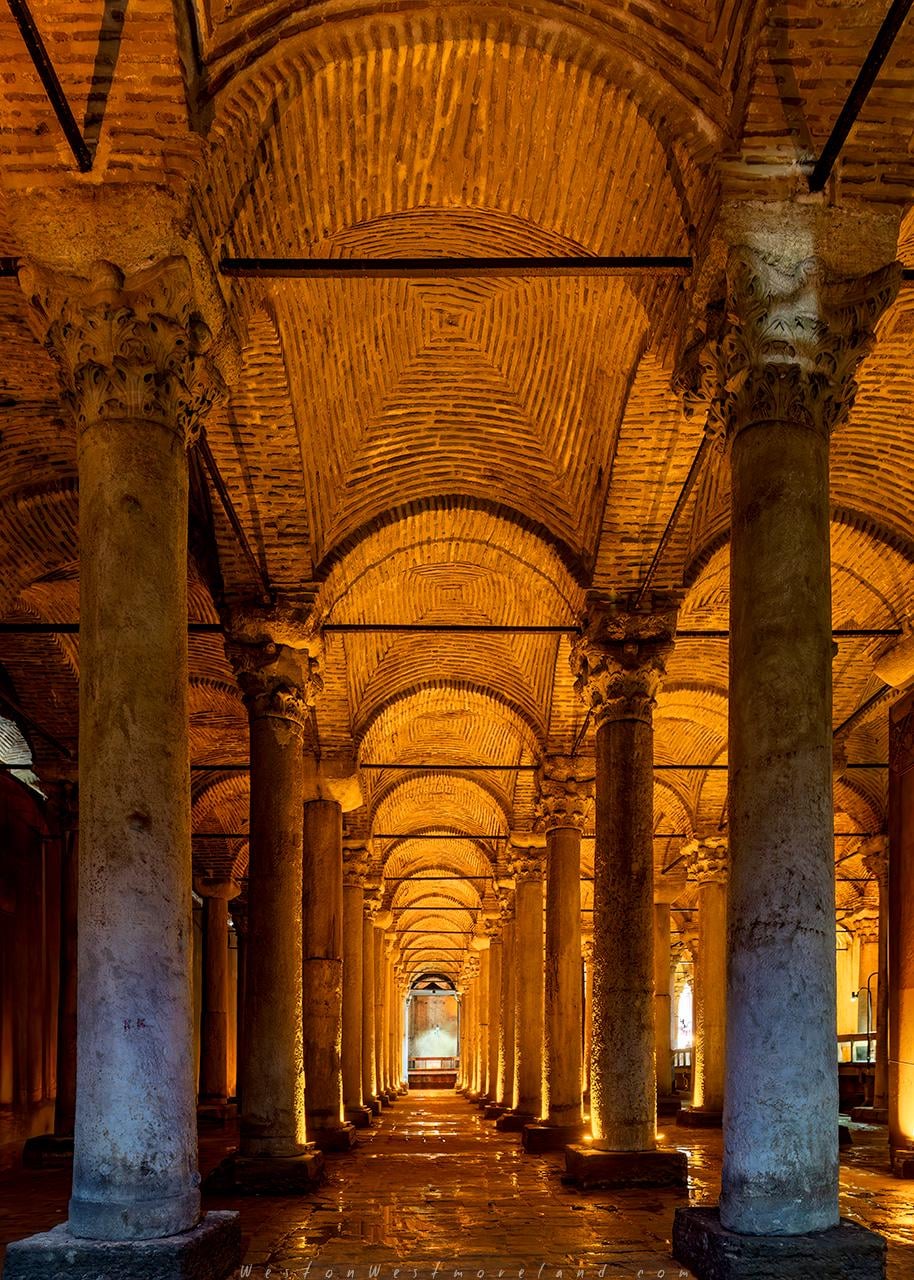
Cisterna Basilica, the largest of hundreds of cisterns beneath Constantinople, the capital city of the Roman Empire from 330 CE until its fall in 1453. The cistern, 500 ft SW from Hagia Sophia, was built in the 6th century during the reign of Emperor I, who also built the cathedral… [1280×914] [OC]
by WestonWestmoreland
2 Comments
…This subterranean monument served as the vital water supply infrastructure for Constantinople’s imperial palace and surrounding urban centers. Measuring 140x70x9 m, the cistern’s cavernous chamber—supported by 336 repurposed marble columns—exemplifies the sophistication of Roman hydraulic engineering and strategic resourcefulness in material procurement.
The Basilica Cistern was commissioned by Emperor Justinian I (reigning 527–565) following the catastrophic Nika Riots of 532, which devastated Constantinople and claimed approximately 30,000 lives. This construction represented part of an ambitious urban renewal initiative that included the legendary Hagia Sophia, reflecting Justinian’s determination to restore Constantinople’s prominence and assert his imperial authority through monumental building projects.
The structure derives its name from the Stoa Basilica, the large public square that originally stood above it. Prior to the cistern’s construction, the site hosted an earlier basilica built during the Early Roman Age (3rd–4th centuries), which had functioned as a commercial, legal, and artistic center. The earlier cistern constructed under Constantine I was rebuilt and substantially enlarged.
Contemporary historical texts record that approximately 7,000 enslaved individuals labored on the cistern’s construction. The monumental effort required to excavate the massive underground chamber, transport and position hundreds of columns, and complete the complex masonry and waterproofing work attests to both Roman organizational capacity and the human cost of such imperial ambitions.
The cistern could hold approximately 80,000 cubic meters of water—sufficient to sustain Constantinople’s population of roughly 100,000 for an entire year—and was the city’s most critical water reserve during sieges and periods of aqueduct disruption.
Its most distinctive architectural feature comprises 336 marble columns, each standing approximately 9 meters tall, arranged in 12 rows of 28 columns with spacing of approximately 5 meters. These columns support a complex brick vaulted ceiling engineered to distribute the immense weight of the overlying structures and earth while resisting the hydrostatic pressure of the water below.
The columns themselves embody Roman resourcefulness through widespread use of spolia—the practice of recycling architectural elements from earlier structures. Most columns originated from Roman temples and buildings across the empire, with distinctive stylistic variations: the majority feature Ionic or Corinthian capitals characteristic of classical architecture, while some exhibit simpler Doric designs with minimal ornamentation, revealing their secondary rather than original purpose. This heterogeneous collection underscores both the pragmatic cost considerations of Roman construction and the theological shift of the early Christian empire, which repurposed pagan religious architecture to serve imperial Christian needs.
Roman engineers employed sophisticated waterproofing techniques that ensured the cistern’s structural integrity across centuries. The external walls, constructed with 4.8-meter thickness, were rendered impermeable through application of multiple protective layers. The primary waterproofing mechanism comprised a specialized mortar formulation combining hydraulic lime—known locally as “Horasan lime”—with volcanic ash or other natural binders, applied in layers approximately 3.5 centimeters thick.
The internal surfaces of walls and floors received similar treatment, creating a dense, chemically stable barrier resistant to water infiltration and the corrosive effects of prolonged moisture exposure. The construction methodology incorporated Roman cement, a pozzolanic material enabling underwater setting and exceptional durability under saturated conditions. The careful arrangement of brick and marble components, reinforced through precise joint sealing and Roman masonry expertise, minimized water leakage across the entire structure.
The vaulted ceiling—constructed from layered brick arranged in carefully engineered patterns—functioned as both structural support and decorative element. The systematic use of arches distributed weight efficiently, preventing localized stress concentration and enabling the structure to withstand the cumulative pressure of water, overlying soil, and subsequently constructed buildings… (follows in replay)
Was there last year! It’s a pretty cool atmosphere. Entry is ridiculous tho.