
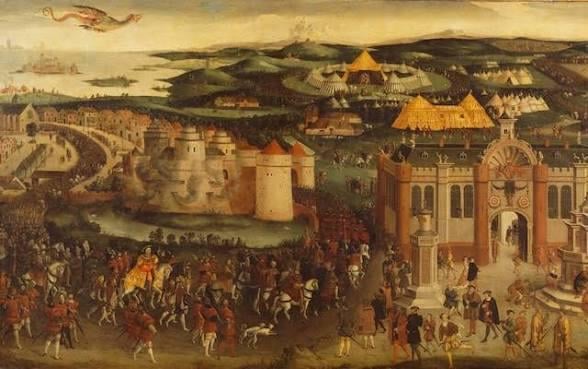
The famed Field of the Cloth of Gold emerged from rising tensions in early-16th-century Europe. After the death of Holy Roman Emperor Maximilian I, two rivals competed for dominance: King Francis I of France and Maximilian’s grandson, Charles, the teenage king of Spain elected Emperor over Francis.
In 1520, the twenty-year-old Charles paid a state visit to England to see his aunt, Queen Catherine of Aragon, and confer with her husband, Henry VIII. Catherine strongly urged Henry to ally with her powerful nephew against France. Henry listened, and then promptly crossed the Channel to meet Francis himself at an extravagant diplomatic summit near Calais: the Field of the Cloth of Gold.
Officially, the meeting celebrated peace between two traditional enemies following a treaty signed six years earlier. In reality, it devolved almost immediately into Renaissance-era posturing. The summit featured tents made of cloth of gold, absurdly lavish costumes, and feasts on a staggering scale: 50,000 fish, 98,000 eggs, 2,000 sheep, 700 conger eels, 13 swans, three porpoises, and 66,000 liters of beer. Henry even arrived with two royal monkeys, a gift from the Ottoman sultan. Cardinal Thomas Wolsey noted that “the French King was overcome with much curiosity playing with those little knaves.”
The dragon flying in this painting depicts a real spectacle from the summit. Created by the English, it combined Francis’s salamander emblem with Henry’s Welsh Tudor dragon, symbolizing the supposed new friendship. In reality, it was a massive kite, made of canvas stretched over wooden hoops and flown from a rope tethered to a carriage. Eyewitnesses reported that its eyes blazed and its mouth hissed, suggesting it may have been filled with fireworks.
The entire event became a competition over who was the superior Renaissance man: who dressed better, jousted better, feasted better, and even wrestled better. Henry challenged Francis to a wrestling match and was promptly pinned by the sturdier French king, an outcome that did little to ease the already thick rivalry.
Any genuine intent at friendship was overwhelmed. Less than a year later, Wolsey negotiated a treaty with Emperor Charles, and within another year the Italian Wars resumed in earnest.
If interested, I write more about Henry VIII here: https://open.substack.com/pub/aid2000/p/hare-brained-history-volume-61-henry?r=4mmzre&utm\\\_medium=ios&shareImageVariant=overlay
by aid2000iscool