
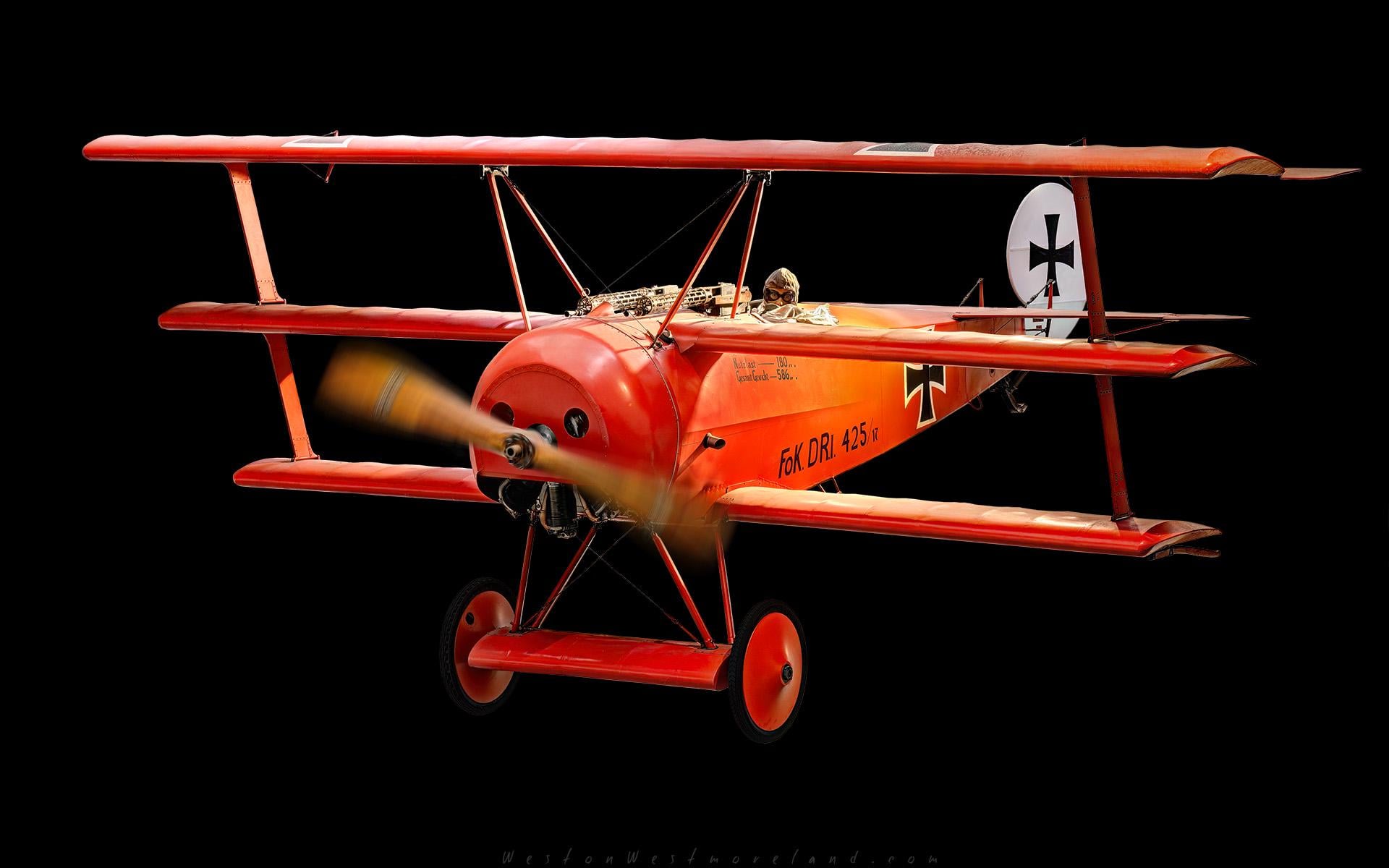
Fokker Dr.I with the colors and numeration of Manfred von Richthofen, aka the Red Baron. Designed from a captured British Sopwith Triplane, the Dr.I saw widespread service in 1918. It became famous as the aircraft in which the Red Baron gained his last 17 victories, and was killed… [1920×1200][OC]
by WestonWestmoreland
2 Comments
…Manfred von Richthofen (2 May 1892 – 21 April 1918), the Red Baron, was a German fighter pilot during World War I. He is considered the top ace of the war, being officially credited with 80 air combat victories.
Richthofen was wounded twice during the Great War, but never shot down. It is believed he was killed by a single bullet shot from an Australian Vickers machine gun on the ground. Richthofen managed to land his airplane behind the enemy lines and was still alive when they got to him. His final word is said to be “Kaputt”, broken.
The Red Baron was buried near Amiens. Six enemy officers served as pallbearers, and a guard of honor fired a salute. Allied squadrons stationed nearby presented memorial wreaths, one of which was inscribed with the words, “To Our Gallant and Worthy Foe”. He died at the age of 26. This romantic view of the pilot is not altogether shared by everybody, though.
His triplane didn’t survive after the landing, as by the time he was killed, the Red Baron and his conspicuous triplane were already famous among friends and foes and everybody wanted a souvenir. The triplane was made of canvas and wood, and the red canvas was cut into pieces and vanished in all directions.
The Fokker Dr.I (Dreidecker, ‘triplane’ in German), often known simply as the Fokker Triplane, was a World War I fighter aircraft built by Fokker-Flugzeugwerke.
In February 1917, the Sopwith Triplane began to appear over the Western Front. Despite its single Vickers machine gun armament, the Sopwith swiftly proved itself superior to the more heavily armed Albatros fighters then in use by the Luftstreitkräfte. In April 1917, Anthony Fokker viewed a captured Sopwith Triplane while visiting Jasta 11. Upon his return to the Schwerin factory, Fokker instructed Reinhold Platz to build a triplane, but gave him no further information about the Sopwith design. Platz responded with the V.4, a small, rotary-powered triplane with a steel tube fuselage and thick cantilever wings, first developed during Fokker’s government-mandated collaboration with Hugo Junkers. Initial tests revealed that the V.4 had unacceptably high control forces resulting from the use of unbalanced ailerons and elevators.
Instead of submitting the V.4 for a type test, Fokker produced a revised prototype designated V.5. The most notable changes were the introduction of horn-balanced ailerons and elevators, as well as longer-span wings. The V.5 also featured interplane struts, which were not necessary from a structural standpoint, but which minimized wing flexing.[9] On 14 July 1917, Idflieg issued an order for 20 pre-production aircraft. The V.5 prototype, serial 101/17, was tested to destruction at Adlershof on 11 August 1917.
The first two pre-production triplanes were designated F.I, in accord with Idflieg’s early class prefix for triplanes. These aircraft, serials 102/17 and 103/17, were the only machines to receive the F.I designation and could be distinguished from subsequent aircraft by a slight convex curve. Archived 2010-11-03 at the Wayback Machine The two aircraft were sent to Jastas 10 and 11 for combat evaluation, arriving at Markebeeke, Belgium on 28 August 1917.
Richthofen first flew 102/17 on 1 September 1917 and shot down two enemy aircraft in the next two days. He reported to the Kogenluft (Kommandierender General der Luftstreitkräfte) that the F.I was superior to the Sopwith Triplane. Richthofen recommended that fighter squadrons be reequipped with the new aircraft as soon as possible. The combat evaluation came to an abrupt conclusion when Oberleutnant Kurt Wolff, Staffelführer of Jasta 11, was shot down in 102/17 on 15 September, and Leutnant Werner Voss, Staffelführer of Jasta 10, was killed in 103/17 on 23 September.
The remaining pre-production aircraft, designated Dr.I, were delivered to Jasta 11. Idflieg issued a production order for 100 triplanes in September, followed by an order for 200 in November. Apart from the straight leading edge of the tailplane, these aircraft were almost identical to the F.I. The primary distinguishing feature was the addition of wingtip skids, which proved necessary because the aircraft was tricky to land and prone to ground looping. In October, Fokker began delivering the Dr.I to squadrons within Richthofen’s Jagdgeschwader I.
My apologies for inaccuracies and mistakes.
Edit:
Might be interesting to take a look at the general features of the Dr.I. Nothing to do with current fighters.
**General characteristics:**
Length: 5.77 m (18 ft 11 in)
Upper wingspan: 7.19 m (23 ft 7 in)
Height: 2.95 m (9 ft 8 in)
Empty weight: 406 kg (895 lb)
Powerplant: 1 × Oberursel Ur.II 9-cylinder air-cooled rotary piston engine, 82 kW (110 hp)
Propellers: 2-bladed fixed-pitch wooden propeller
Maximum speed: 180 km/h (110 mph, 97 kn) at 2600m
Stall speed: 72 km/h (45 mph, 39 kn)
Range: 300 km (190 mi, 160 nmi)
Service ceiling: 6,100 m (20,000 ft)
Rate of climb: 5.7 m/s (1,120 ft/min)
Guns: 2 × 7.92 mm (0.312 in) Maschinengewehr 08 “Spandau” machine guns
26 when he was killed, jeez. Always pictured him in his 40s. I sometimes forget that pretty much everyone that wasn’t a general in WW1 was barely older than a child.