* RD 17 October 1869, n. 65342 (extension of Piedmontese holidays to Italy as a whole)
* L 23 June 1878, n. 1968 (New Year’s Day added)
* L 19 July 1985, n. 401 (Liberation of Rome added)
* RD 4 August 1913, n. 1027 (Immaculate Conception, Nativity of Mary, Corpus Christi, Sts. Peter and Paul removed)
* RD 22 October 1922, n. 1354 (Victory in the Great War Day added)
* RD 19 April 1923, n. 833 (Foundation of Rome added, to replace the unofficial holiday of 1st May)
* RD 23 December 1923, n. 2859 (Corpus Christi, Sts. Peter and Paul, Immaculate Conception reinstated)
* RD 21 October 1926, n. 1779 (March on Rome added)
* L 6 December 1928, n. 2756 (St. Joseph added)
* L 27 December 1930, n. 1726 (Liberation of Rome removed)
* L 5 May 1939, n. 661 (Foundation of the Empire added)
* RD 24 July 1941, n. 781 (suspension of non-religious holidays)
* L 27 May 1929, n. 810, Concordat – art. 11 (list of religious holidays)
* Bulletin of Mail and Telecommunications, 1944, n. 9, Service Prescription §139 «Festività» (Victory of Great War reinstated, other minor commemorations reinstated)
* DLL 22 April 1946, n. 185 (Liberation Day, 1st May, Victory of WW2 in Europe Day added)
* L 27 May 1949, n. 260 (Victory of WW2 in Europe Day removed; Repubblic Day, Easter Monday, St. Stephen added)
* L 5 March 1977, n. 54 (Epiphany, St. Joseph, Ascension, Corpus Christi, Sts. Peter and Paul, Republic Day, Victory of WW2 Day removed)
* DPR 28 December 1985, n. 792 (Epiphany reinstated)
* L 20 November 2000, n. 336 (Republic Day reinstated)
* L 8 October 2025, n. 151 (St. Francis of Assisi added as public holiday)
* L 4 March 1958, n. 132 (St. Francis of Assisi added as civic commemoration)
Piastrellista88 on
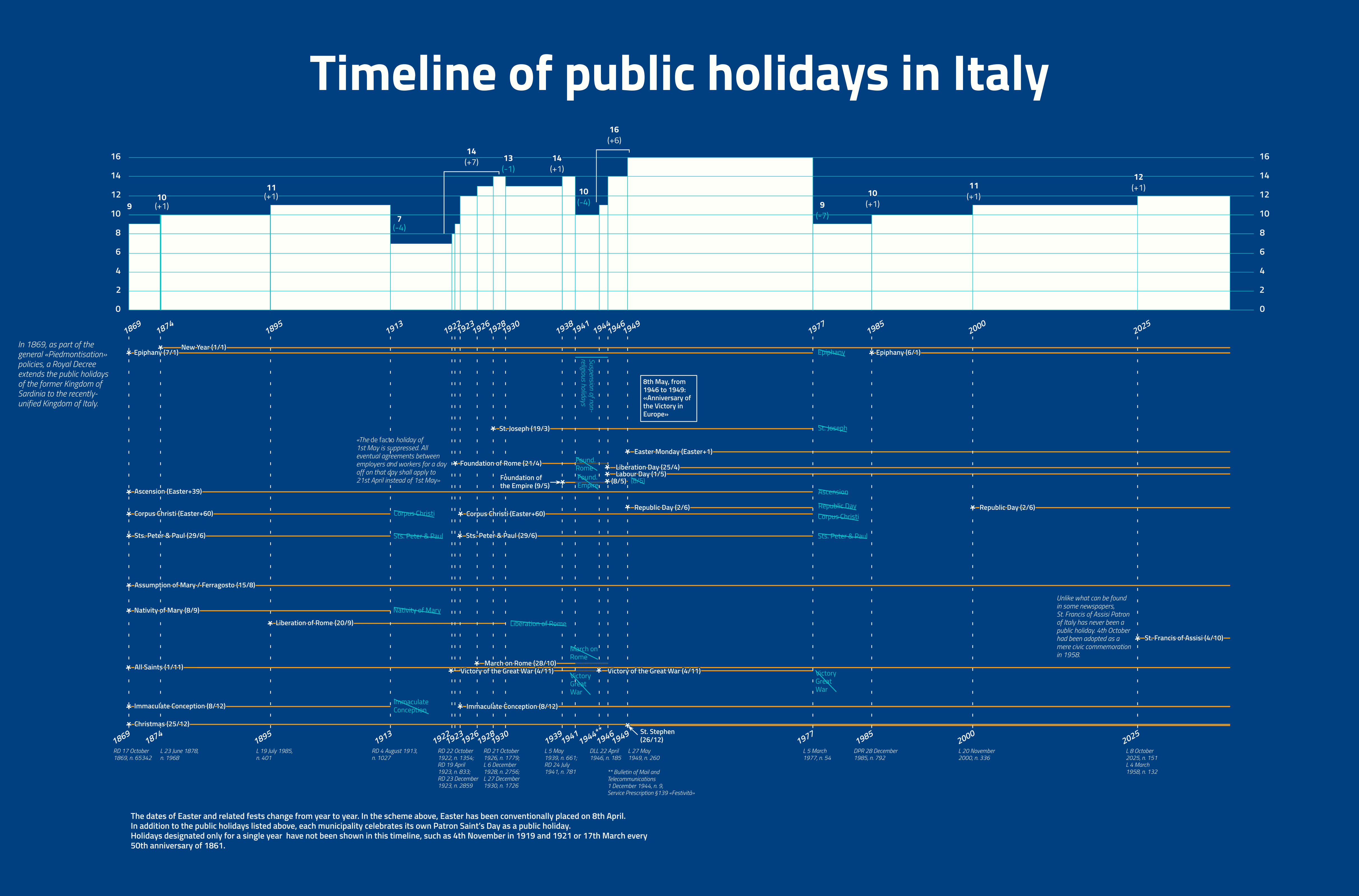
This post is a timeline of public holidays in Italy, starting from 1869 to today. I had originally [posted it](https://www.reddit.com/r/italy/comments/1q67olh/oc_storia_dei_giorni_festivi_in_italia/) with a vertical arrangement, but I’ve tried to rearrange it horizontally after u/crazyseph’s suggestion. After the law passed last year, we will have an extra holiday on the 4th October for St. Francis of Assisi, patron saint of Italy. In general, I think it can be interesting to see how holidays changed as society or politics changed through the decades, from the early religious feasts, to the fascist regime’s attempts to appropriate the calendar or appease the Church, to the post-war changes, to the 70’s austerity period.
**A few points**
1. The timeline starts from Royal Decree n. 65342 of 17th October 1869, which extended the calendar used in the former Kingdom of Sardinia to Italy as a whole.
2. As I wanted to represent all holidays in a diagram, I have fixed Easter to 8th April, as a conventional day. Easter is not represented on this diagram, as it always falls on a Sunday, which is already a public holiday by itself.
3. Only three holidays have been observed on all years since 1869 to today: Assumption/Ferragosto, All Saints’ Day and Christmas. All other holidays have experienced some sort of interruption.
4. The shortest-lived holidays have been the Foundation of the Empire (9th May) 1938-1941 and VE Day (8th May) 1946-1949.
5. The Foundation of Rome Day had been added with the explicit aim to replace Labour Day on 1st May, which was getting more and more observed while not being an official holiday yet. From Royal Decree 21st October 1926, n. 1779 – «The- de facto – holiday of 1st May is suppressed. All eventual agreements between employers and workers for a day off on that day shall apply to 21st April instead of 1st May»- .
6. In 1941 all non-religious holidays were cancelled for the duration of the war, suspending (but not officially abolishing) the Foundation of Rome, the Foundation of the Empire, the March on Rome and the Victory of the Great War. Only the latter was eventually reinstated in 1944 for the following years.
7. On the previous point, New Year’s Day is a holiday of religious obligation listed in the Concordat; hence it stayed during the war.
8. The circular reinstating the holiday of the 4th November doesn’t really use a clear language, but its most reasonable interpretation is that it reinstates only the 4th November as a public holiday.
9. Unlike could be foud in some Italian newspapers, St. Francis was never a public holiday and it’s not one of the holidays suppressed in 1977. 4th October had only been adopted as a civic commemoration in 1958 (L 4 March 1958, n. 132).
10. Holidays designated only for a single year have not been shown in this timeline, such as 4th November in 1919 and 1921 or 17th March every 50th anniversary of 1861.

4 Comments
**Sources**
* RD 17 October 1869, n. 65342 (extension of Piedmontese holidays to Italy as a whole)
* L 23 June 1878, n. 1968 (New Year’s Day added)
* L 19 July 1985, n. 401 (Liberation of Rome added)
* RD 4 August 1913, n. 1027 (Immaculate Conception, Nativity of Mary, Corpus Christi, Sts. Peter and Paul removed)
* RD 22 October 1922, n. 1354 (Victory in the Great War Day added)
* RD 19 April 1923, n. 833 (Foundation of Rome added, to replace the unofficial holiday of 1st May)
* RD 23 December 1923, n. 2859 (Corpus Christi, Sts. Peter and Paul, Immaculate Conception reinstated)
* RD 21 October 1926, n. 1779 (March on Rome added)
* L 6 December 1928, n. 2756 (St. Joseph added)
* L 27 December 1930, n. 1726 (Liberation of Rome removed)
* L 5 May 1939, n. 661 (Foundation of the Empire added)
* RD 24 July 1941, n. 781 (suspension of non-religious holidays)
* L 27 May 1929, n. 810, Concordat – art. 11 (list of religious holidays)
* Bulletin of Mail and Telecommunications, 1944, n. 9, Service Prescription §139 «Festività» (Victory of Great War reinstated, other minor commemorations reinstated)
* DLL 22 April 1946, n. 185 (Liberation Day, 1st May, Victory of WW2 in Europe Day added)
* L 27 May 1949, n. 260 (Victory of WW2 in Europe Day removed; Repubblic Day, Easter Monday, St. Stephen added)
* L 5 March 1977, n. 54 (Epiphany, St. Joseph, Ascension, Corpus Christi, Sts. Peter and Paul, Republic Day, Victory of WW2 Day removed)
* DPR 28 December 1985, n. 792 (Epiphany reinstated)
* L 20 November 2000, n. 336 (Republic Day reinstated)
* L 8 October 2025, n. 151 (St. Francis of Assisi added as public holiday)
* L 4 March 1958, n. 132 (St. Francis of Assisi added as civic commemoration)
This post is a timeline of public holidays in Italy, starting from 1869 to today. I had originally [posted it](https://www.reddit.com/r/italy/comments/1q67olh/oc_storia_dei_giorni_festivi_in_italia/) with a vertical arrangement, but I’ve tried to rearrange it horizontally after u/crazyseph’s suggestion. After the law passed last year, we will have an extra holiday on the 4th October for St. Francis of Assisi, patron saint of Italy. In general, I think it can be interesting to see how holidays changed as society or politics changed through the decades, from the early religious feasts, to the fascist regime’s attempts to appropriate the calendar or appease the Church, to the post-war changes, to the 70’s austerity period.
**A few points**
1. The timeline starts from Royal Decree n. 65342 of 17th October 1869, which extended the calendar used in the former Kingdom of Sardinia to Italy as a whole.
2. As I wanted to represent all holidays in a diagram, I have fixed Easter to 8th April, as a conventional day. Easter is not represented on this diagram, as it always falls on a Sunday, which is already a public holiday by itself.
3. Only three holidays have been observed on all years since 1869 to today: Assumption/Ferragosto, All Saints’ Day and Christmas. All other holidays have experienced some sort of interruption.
4. The shortest-lived holidays have been the Foundation of the Empire (9th May) 1938-1941 and VE Day (8th May) 1946-1949.
5. The Foundation of Rome Day had been added with the explicit aim to replace Labour Day on 1st May, which was getting more and more observed while not being an official holiday yet. From Royal Decree 21st October 1926, n. 1779 – «The- de facto – holiday of 1st May is suppressed. All eventual agreements between employers and workers for a day off on that day shall apply to 21st April instead of 1st May»- .
6. In 1941 all non-religious holidays were cancelled for the duration of the war, suspending (but not officially abolishing) the Foundation of Rome, the Foundation of the Empire, the March on Rome and the Victory of the Great War. Only the latter was eventually reinstated in 1944 for the following years.
7. On the previous point, New Year’s Day is a holiday of religious obligation listed in the Concordat; hence it stayed during the war.
8. The circular reinstating the holiday of the 4th November doesn’t really use a clear language, but its most reasonable interpretation is that it reinstates only the 4th November as a public holiday.
9. Unlike could be foud in some Italian newspapers, St. Francis was never a public holiday and it’s not one of the holidays suppressed in 1977. 4th October had only been adopted as a civic commemoration in 1958 (L 4 March 1958, n. 132).
10. Holidays designated only for a single year have not been shown in this timeline, such as 4th November in 1919 and 1921 or 17th March every 50th anniversary of 1861.
https://preview.redd.it/236vzvfks9cg1.png?width=4849&format=png&auto=webp&s=d476211cefd0052cae468f18e4c228e90b595662
For mobile users
That 1977 government must be the most hated one in history