
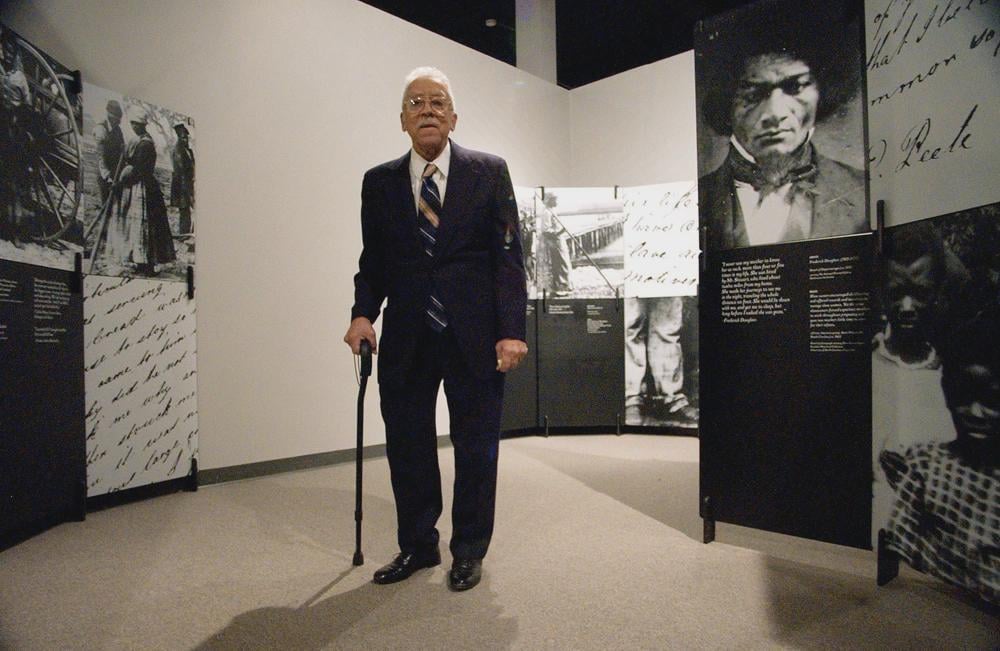
James Cameron, 88, stands in a gallery of Black Holocaust Museum, which he founded, in Milwaukee. When Cameron was 16, he was nearly lynched in Indiana. The noose was around his neck, but he was spared when someone in the mob vouched for him at the last moment (Wisconsin, 2003) [1000 x 651].
by lightiggy
1 Comment
Two older youths who were with Cameron, [Thomas Shipp and Abram Smith](https://en.wikipedia.org/wiki/Lynching_of_Thomas_Shipp_and_Abram_Smith), both 19, would be lynched by the mob. The three were accused of murdering Cameron Deeter, a white man, and raping his girlfriend, Mary Ball, during a robbery. In 1931, Cameron was tried for being an accessory before the fact to murder. He was convicted of being an accessory before the fact to manslaughter and sentenced to two to 21 years in prison. He served four years at the Indiana State Prison and was paroled in 1935. Cameron was pardoned in 1993.
In his memoirs years later, Cameron explained what happened that night.
For starters, Thomas Shipp and Abram Smith had indeed both murdered Cameron Deeter. After reading parts of the book *A Lynching in the Heartland: Race and Memory in America*, Smith presumably raped Mary Ball. It’s been claimed that Ball later retracted her claims of rape. This is not true. Ball said she had been raped, her injuries indicate that there was a rape, and she never retracted her claims. As such, my assumption is that the confession of Abram Smith, the presumed triggerman, to raping Ball was truthful. That said, at the trial, Ball said that she could not identify Cameron as one of her attackers.
That’s because Cameron didn’t attack her.
Cameron said he participated in the robbery, but got cold feet upon recognizing the person whom he was robbing and ran away in shame:
>”I opened the door and I said, ‘Stick them up,’ and this white fellow gets out of the car, and he didn’t recognize me because I had my hat pulled down. And I noticed him just like that. He was my friend, a real nice white fellow. I was his shoeshine boy. And his girlfriend got out of the car. Her face was so pale and lovely and frightened, and that scared me. So I took the gun, give it to one of my confederates. I said, ‘Here, I’m not going to have anything to do with you guys.'”