
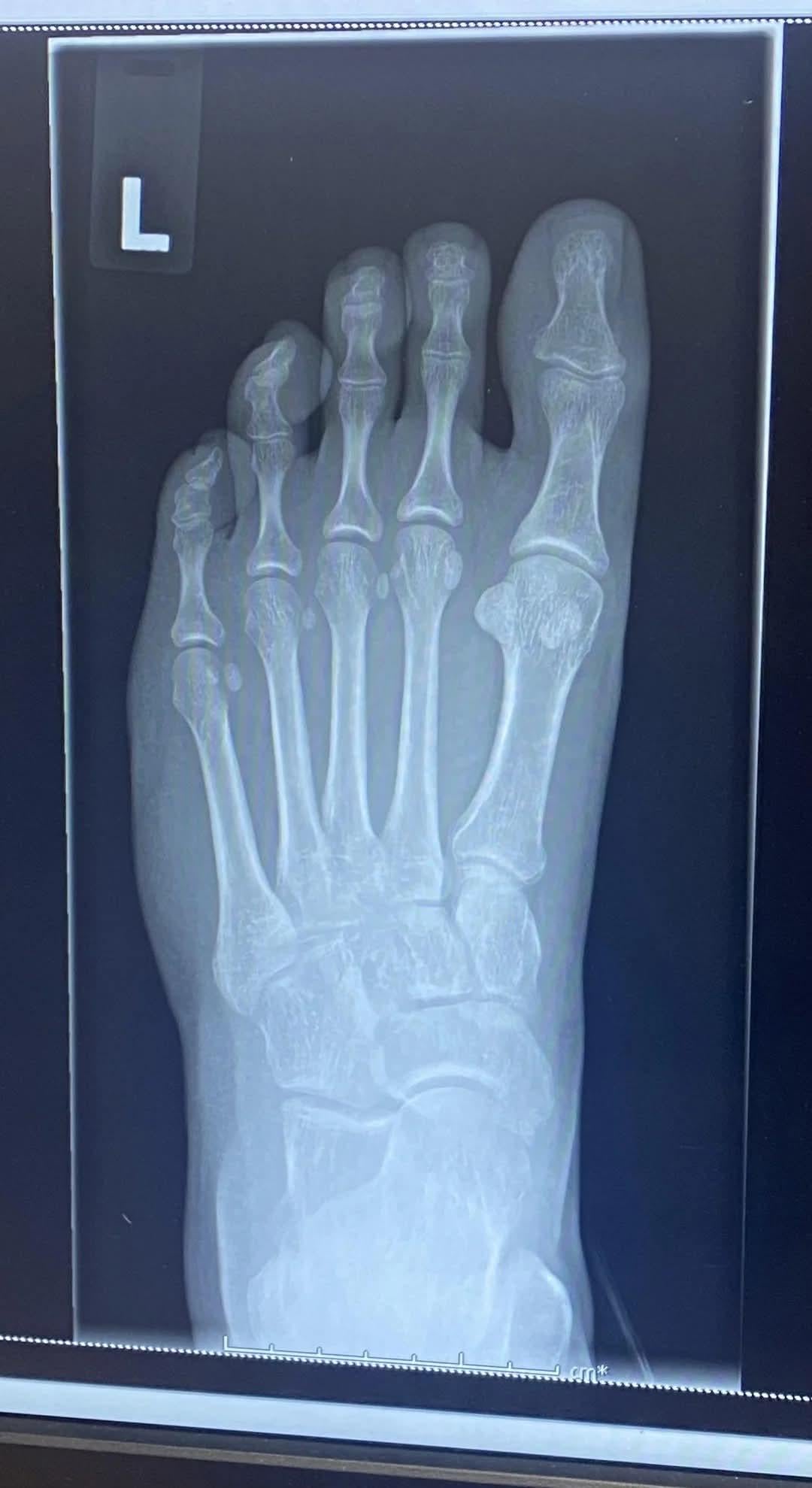
Doctor: “Do you want to see something strange I’ve never seen before?” “Have you ever seen an X-ray of your feet before? I need to show you something strange”. She told me that everyone has Sesamoid bones in their big toes but she has never seen someone with the bones in all their toes.
by Old-Psychology-2400
31 Comments
“Is it safe?!”
Mutant
They are referring to the little knob on the top of the ankle-most bones.
Monkey feet, for grasping!!
OOF. I have one on my big toe one and it points downwards, I gotta wear special insoles. The one I have by PowerStep for ball-of-foot-pain makes it painless to walk, at least till I might need the expensive orthotic inserts
Evolution realized and said.
https://preview.redd.it/54wmnn4ld7cg1.jpeg?width=640&format=pjpg&auto=webp&s=9c09bccdffd46410e2f7d96e0fd87d2818dd655b
Get those monkey feet back in circulation.
What I am I supposed to be shocked by? I’m not super familiar with foot bone structure.
Yes, every typical adult human skeleton has bones that make up the toes, which are called **phalanges**. In fact, 14 of the 26 bones in each foot are toe bones, accounting for more than 25% of the total bones in the entire body when both feet are considered.

https://preview.redd.it/yt4ijwjrd7cg1.png?width=402&format=png&auto=webp&s=6dd8ac107abcf92e6b784ebd3a97ec851a109884
this is mine. Notice something interesting? hahah
Learned a new thing today on Reddit
See you tomorrow
[foot xray – Search](https://www.bing.com/search?pglt=297&q=foot+xray&cvid=364c8feb754b4560a6632b64e9af6ab6&gs_lcrp=EgRlZGdlKgYIABBFGDkyBggAEEUYOTIGCAEQABhAMgYIAhAAGEAyBggDEAAYQDIGCAQQABhAMgYIBRAAGEAyBggGEAAYQDIGCAcQABhAMgYICBAAGEDSAQgzMTkwajBqMagCCLACAQ&FORM=ANNTA1&PC=HCTS)
for those that don’t know and are going to be scrolling for the information in the comments here shortly,
“the sesamoid bone is a small bone commonly found embedded within a muscle or tendon near joint surfaces, existing as focal areas of ossification and functioning as a pulley to alleviate stress on that particular muscle or tendon.”
in this case, the small bone is located at the top of all metatarsal bones, which are the bones in the middle of your foot.
Good luck learning to fly or living in your swimmer pool.
Do your toes look like they have an extra bone in real life?
I just found out about them myself. I went in for foot pain and a xalray later they said Ihave a broken sesamoid bones. Never even heard of them before.
Let’s see em bare lol
Can you tell me how to get, how to get to sesamoid street?
this finding represents a normal anatomical variant rather than a pathological or exceptional condition.
sesamoid bones are small, rounded ossicles that develop within tendons at sites of increased mechanical stress. their primary function is to modify pressure, reduce friction, and alter the line of pull of tendons across joints. in the foot, paired sesamoid bones at the plantar aspect of the first metatarsophalangeal joint are considered a constant anatomical feature in the majority of individuals.
however, sesamoid bones may also be present at other metatarsophalangeal or interphalangeal joints. the number, size, and distribution of sesamoid bones show significant interindividual variation. accessory sesamoids in the lesser toes have been described in anatomical dissections and radiographic studies and are typically incidental findings.
the presence of sesamoid bones beneath multiple toes is therefore uncommon but documented. it does not indicate a developmental anomaly, systemic skeletal disorder, or pathological process in the absence of symptoms. such variants are usually asymptomatic and have no clinical significance unless associated with localized pain, inflammation, fracture, or altered biomechanics.
the statement that this configuration has “never been seen before” reflects limited personal exposure rather than medical rarity. anatomical variation is broad, and many benign variants are underrepresented in routine clinical practice.
tldr: this radiographic appearance is best classified as a benign anatomical variant within the normal spectrum of human skeletal morphology, with no inherent pathological implication. it’s not really clinically significant or anything; it’s just a variant
Not my proudest wank
Are you flat footed? Nothing to do with the Sesamoid bones.
Join the circus now
That looks like it ll be painful at some point. Bunions.
One of the few occasions where red circles would actually be helpful and it has none smh
What power does this give you, mutant?
BonelyFans
Cool! I have seen plenty of foot Xrays and never seen that before either. This is quite interesting.
Harambe would be proud
You could have at least highlighted them so we laymen who weren’t shown by the doctor know wtf you’re talking about without having to use Google, lol
As a wiseman once told me, “You gotta let those piggies fly free.”
Honestly isn’t particularly unusual or interesting whatsoever, just a normal variant for which anyone could have.