
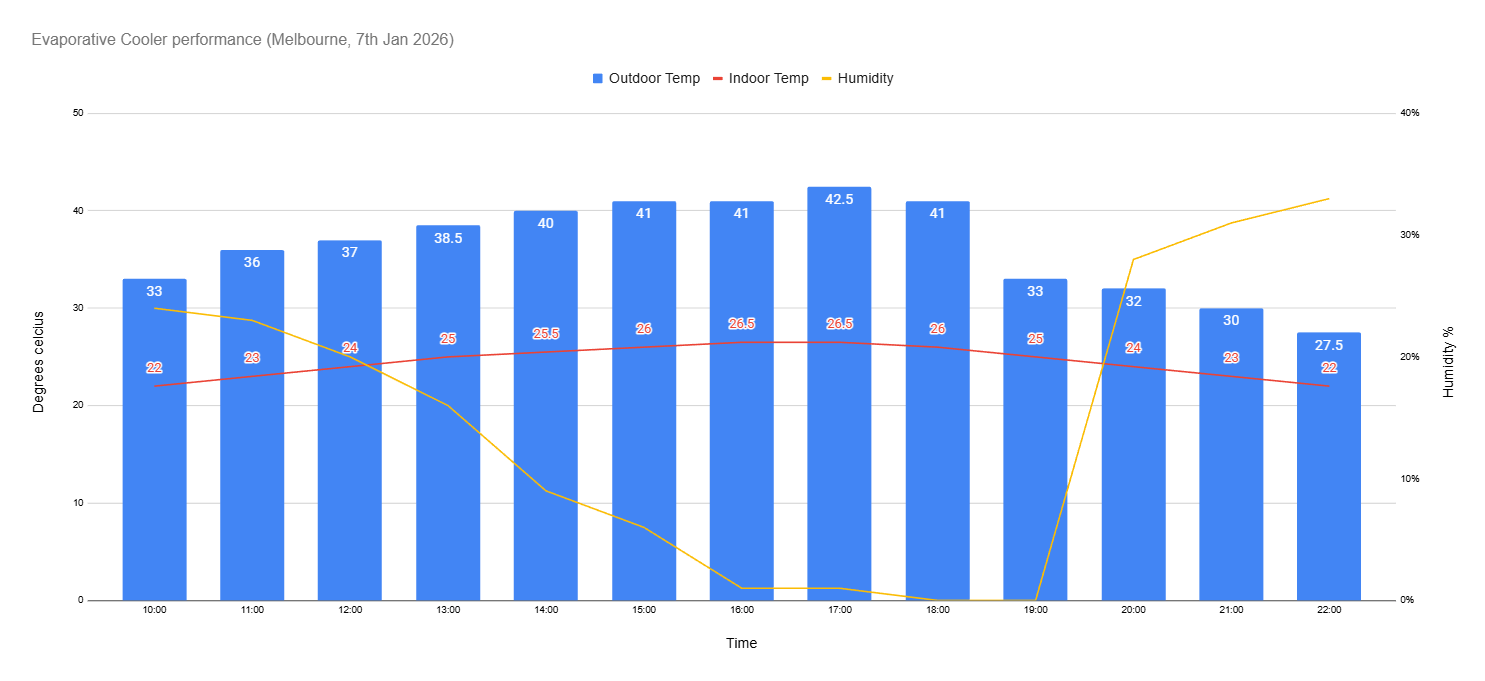
How do evaporative coolers perform on hot days and does humidity influence them?
It's a question I often see, so with a hot day in Melbourne, we tracked some data. We're in a rental so don't have split system options.
Outdoor vs indoor temps seemed to average around 12 degress celcius, with the largest gap being 16 degrees. Temperature indoors only increased and decreased by 1 degree each hour (up or down), despite larger swings outdoors, suggesting a buffering effect.
It's harder to gauge how much humidity affects the performance: if we take two time points: 10am (33 deg + 22 deg @ 24$ humidity) vs 5pm (42.5 deg + 26.5 dev @ 1% humidity), we see that at higher humidity there's a 11 degrees differential, and at almost no humidity there's a 16 degree differential. So a potential swing of 5 degrees based on humidity, but maybe I need more data to prove that link.
by Asica
3 Comments
GENERAL STRIKE, JAN 20th, TELL EVERYONE
That sort of correlates with my perception. I’m in Perth so the humidity is a bit lower overall, but a rising humidity really affects the performance, as you would expect. The 27.5 deg at 10:00 pm though… ouch.
I like your charts! The specific kind of analysis you’re looking at is called “psychrometrics”. It’s a bit over the top in terms of raw math, but there’s a powerful chart called the Mollier Chart which helps engineers bypass the calculations and look up the effects of temperature, humidity, pressure etc from the chart.
It’s not sexy math, but it’s awesome to see how it applies to saving energy and costs from using evaporative cooling vs. refrigerated aircon. You’d probably enjoy trying out my free mobile app, the Evaporative Cooler Forecaster, which tells you when and how well your evap cooler will work, using your weather forecast data. As well as showing cumulative and projected energy and cost savings! It even has historical weather data to show general trends as monthly bar charts for the past 10 years. (Soon it will have 2025’s data- I have some lag on that data source, but I’ll crunch it soon.)
The app uses psychrometrics extensively, as well as some modeling of pad performance that I spent a couple years testing and refining. There’s a slider in the Settings tab for adjusting your pad performance up or down, so you can calibrate the app precisely to your cooler’s performance, with a little patience and time.
I made the app mainly to help solve the mystery of knowing when or whether my own swamp cooler would work well here in Palm Springs, California where it regularly reaches up to 122°F or 50°C (yes 50!) I feel like evap coolers have a similar kind of “range anxiety” that EVs have.. It’s work to keep up with the weather forecast, when you have a regular busy life, so I wrote the code to do the work for me. 🙂
There’s a ton of performance variables at play with evap coolers, of course. I’m mostly just excited to see how the strangely simple power of evaporating water saves a ton of energy, a fair bit of money (in the right climate) and improves indoor air quality all while reducing strain on the local power grid during heat waves. It’s such a crazy win-win. Oh, and it reduces wear and tear on your aircon by spreading out the workload between evap and aircon.
I like to think of my cooling systems like a hybrid system that combines the best of both worlds: to use aircon when I must and evap cooling when I can.
Thanks for sharing your chart!! Keep cool!