The Great Famine of 1876 to 1878 was precipitated by a systematic failure of crop production over the whole Indian subcontinent.
The famine occurred at a time when the colonial government was attempting to reduce expenses on welfare.
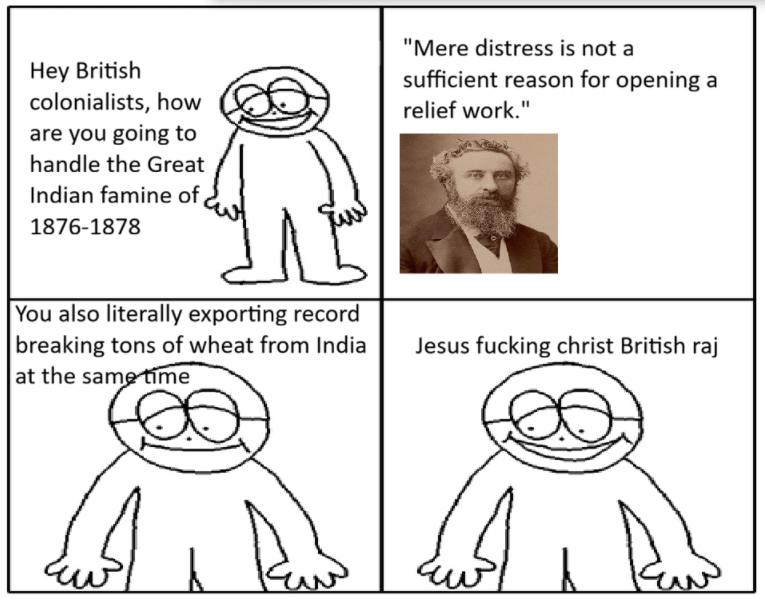
Lord Lytton, the governing British viceroy in India, reacted against calls for relief during the 1877–79 famine, Lytton replied, “**Let the British public foot the bill for its ‘cheap sentiment,’ if it wished to save life at a cost that would bankrupt India,**” substantively ordering “there is to be no interference of any kind on the part of Government with the object of reducing the price of food,” and instructing district officers to “**discourage relief works in every possible way… *Mere distress is not a sufficient reason for opening a relief work.**”
The regular export of grain by the colonial government continued; during the famine, the viceroy, Lord Lytton, oversaw the export to England of a **record 6.4 million hundredweight (320,000 tons) of wheat**.
Lord Lytton’s administration believed that ‘**market forces alone would suffice to feed the starving Indians’**
In January 1877, Temple reduced the wage for a day’s hard work in the relief camps in Madras and Bombay—this ‘Temple wage’ consisted of 450 grams (1 lb) of grain plus one anna for a man, and a slightly reduced amount for a woman or working child, for a “long day of hard labour without shade or rest.” The rationale behind the reduced wage, which was in keeping with a prevailing belief of the time, was that any **excessive payment might create ‘dependency’ among the famine-afflicted population.**
The famine would go on to kill **5.6–9.6 million Indians**
Keeeryu_Kazooma on
Idk why but this part of colonial history is not talked about much.
bjkibz on
British Empire, 1840s: wanna see me starve millions while exporting a shitton of food from the affected area?
British Empire, 1870s: wanna see me do it again?
Apprehensive_Gur_302 on
Churchill: “I support this”
rishin_1765 on
I hate it when people say Britain was the least brutal. We shouldn’t even be having discussions about “least brutality.” Every colonial power viewed its colonial subjects as inferior, and all of them exploited, oppressed, and brutalised the people they ruled.
Of course, this is often justified by claims that colonialism brought “development,” but such arguments ignore the immense human cost and the fact that this so called development primarily served the colonisers

5 Comments
The Great Famine of 1876 to 1878 was precipitated by a systematic failure of crop production over the whole Indian subcontinent.
The famine occurred at a time when the colonial government was attempting to reduce expenses on welfare.
Lord Lytton, the governing British viceroy in India, reacted against calls for relief during the 1877–79 famine, Lytton replied, “**Let the British public foot the bill for its ‘cheap sentiment,’ if it wished to save life at a cost that would bankrupt India,**” substantively ordering “there is to be no interference of any kind on the part of Government with the object of reducing the price of food,” and instructing district officers to “**discourage relief works in every possible way… *Mere distress is not a sufficient reason for opening a relief work.**”
The regular export of grain by the colonial government continued; during the famine, the viceroy, Lord Lytton, oversaw the export to England of a **record 6.4 million hundredweight (320,000 tons) of wheat**.
Lord Lytton’s administration believed that ‘**market forces alone would suffice to feed the starving Indians’**
In January 1877, Temple reduced the wage for a day’s hard work in the relief camps in Madras and Bombay—this ‘Temple wage’ consisted of 450 grams (1 lb) of grain plus one anna for a man, and a slightly reduced amount for a woman or working child, for a “long day of hard labour without shade or rest.” The rationale behind the reduced wage, which was in keeping with a prevailing belief of the time, was that any **excessive payment might create ‘dependency’ among the famine-afflicted population.**
The famine would go on to kill **5.6–9.6 million Indians**
Idk why but this part of colonial history is not talked about much.
British Empire, 1840s: wanna see me starve millions while exporting a shitton of food from the affected area?
British Empire, 1870s: wanna see me do it again?
Churchill: “I support this”
I hate it when people say Britain was the least brutal. We shouldn’t even be having discussions about “least brutality.” Every colonial power viewed its colonial subjects as inferior, and all of them exploited, oppressed, and brutalised the people they ruled.
Of course, this is often justified by claims that colonialism brought “development,” but such arguments ignore the immense human cost and the fact that this so called development primarily served the colonisers