New England was famously settled by religious dissidents like the Puritans who fled persecution at the hands of the Anglican Church. However, despite claiming to be victims of religious persecution, that didn’t stop the Puritans from persecuting those that they viewed as being in opposition to their faith, like Roger Williams.
By 1631 he arrived in the New World to get away from the Church of England, which he considered to be corrupt and false. Almost immediately, he became very unpopular due to disagreements with the local religious and civic leaders, who were essentially one and the same. His greatest criticisms were the lack of a separation between church and state; he saw the colonial officials meddling in church affairs as no different than the magistrates of England and the Crown involving themselves in the Anglican Church. Williams also questioned the validity of colonial charters that did not include legitimate purchase of lands from Native Americans, even going as far as to say that King James and his subjects did not have the right to claim lands without fair payment to the indigenous peoples. Authorities of the Massachusetts Bay Colony were not pleased and summoned him before the General Court numerous times for spreading “diverse, new and dangerous opinions” resulting in his banishment in 1635. Though, as it was winter and Williams was ill, he was allowed to stay until spring, on the condition that he ceased publicly teaching his beliefs of separation of church and state. Williams did not comply and continued to speak out until he was forced to flee the colony during a blizzard. After trekking over 55 miles through deep snow he was offered shelter by members of the local Wampanoag tribe who were aware of his friendly views towards the natives.
In the spring of 1636 Williams and a group of others that had fled Salem to join him crossed the Seekonk River in search of a new place to settle. Williams acquired the land for his new settlement from the Narragansett sachem Canonicus in exchange for trade agreements between the two groups. This settlement was named Providence as he was convinced that divine providence had guided them there and that it would be a haven for those “distressed of conscience” and it quickly attracted families of those who disagreed with the leaders of the Massachusetts Bay Colony. This marked the first time in modern history where citizenship and religion were entirely separate, providing religious tolerance and with majoritarian democracy. Some of his writings about religious tolerance and separation of church and state were influential for philosophers like John Locke, who in turn would inspire the Founding Fathers to push for the separation of church and state in the First Amendment. In 1637 several families were exiled from the Massachusetts Bay Colony and sought to settle near Providence. Williams personally helped negotiate the purchase of Aquidneck Island, which would later be known as Rhode Island.
Williams formed strong friendships and developed deep trust among the Narragansetts and was known by several tribes as an Englishman who kept his word, an extreme rarity at the time. On two occasions he offered himself as a hostage to the Native Americans to ensure the release of a great sachem who was held by other English colonies. When Canonicus died in 1647, his dying wishes included the request that Roger Williams attend his funeral and that he be buried in a cloth that Williams had given him as a gift. He also asked Williams to do all that he could to preserve the peace between his people and the colonists, a promise that Williams would keep for nearly 40 years until the outbreak of King Phillips’s War in 1675.
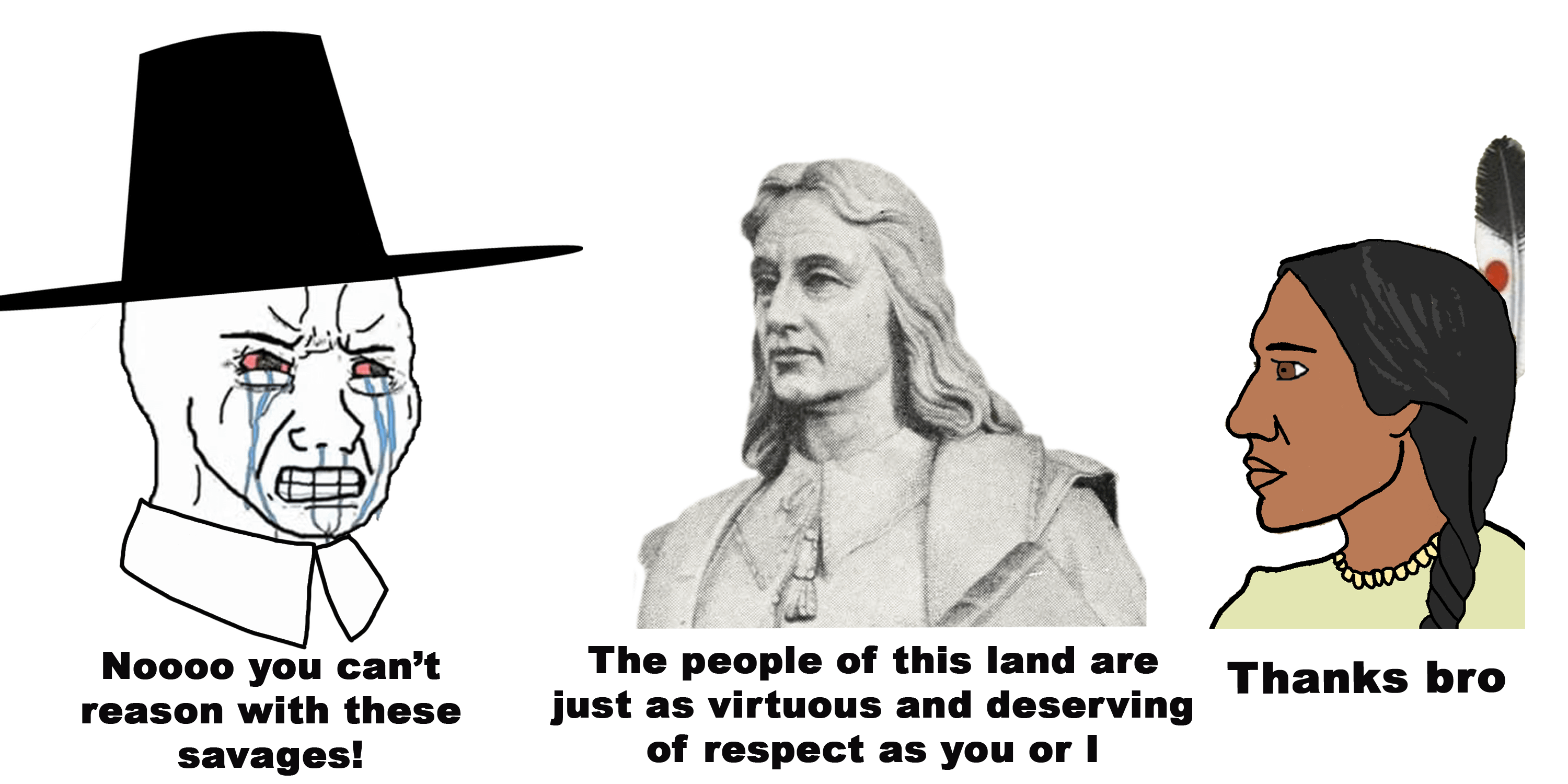
Williams would go on to write *A Key into the Language of America*, the first published study of Native American languages, cultures and beliefs in the English language, in which, he sought to correct the attitudes of superiority displayed by European colonists towards Native Americans:
*”Boast not proud Englishmen, of thy birth & blood; Thy brother Indian is by birth just as Good. Of one blood God made Him, and Thee and All, as wise, as fair, as strong, as personal.”*
Williams died in 1683 and was buried on his own property, though over the years his resting place was forgotten. In 1860, the spot where Williams was believed to have been buried was dug up but all that was found were rusted iron nails, teeth, and a large tree root roughly in the shape of a person that had seemingly consumed Williams’ body. The root is on display in Providence and his remains were interred at the base of a large stone statue in his likeness in Prospect Terrace Park that looks out over the city and state he helped create.

1 Comment
New England was famously settled by religious dissidents like the Puritans who fled persecution at the hands of the Anglican Church. However, despite claiming to be victims of religious persecution, that didn’t stop the Puritans from persecuting those that they viewed as being in opposition to their faith, like Roger Williams.
By 1631 he arrived in the New World to get away from the Church of England, which he considered to be corrupt and false. Almost immediately, he became very unpopular due to disagreements with the local religious and civic leaders, who were essentially one and the same. His greatest criticisms were the lack of a separation between church and state; he saw the colonial officials meddling in church affairs as no different than the magistrates of England and the Crown involving themselves in the Anglican Church. Williams also questioned the validity of colonial charters that did not include legitimate purchase of lands from Native Americans, even going as far as to say that King James and his subjects did not have the right to claim lands without fair payment to the indigenous peoples. Authorities of the Massachusetts Bay Colony were not pleased and summoned him before the General Court numerous times for spreading “diverse, new and dangerous opinions” resulting in his banishment in 1635. Though, as it was winter and Williams was ill, he was allowed to stay until spring, on the condition that he ceased publicly teaching his beliefs of separation of church and state. Williams did not comply and continued to speak out until he was forced to flee the colony during a blizzard. After trekking over 55 miles through deep snow he was offered shelter by members of the local Wampanoag tribe who were aware of his friendly views towards the natives.
In the spring of 1636 Williams and a group of others that had fled Salem to join him crossed the Seekonk River in search of a new place to settle. Williams acquired the land for his new settlement from the Narragansett sachem Canonicus in exchange for trade agreements between the two groups. This settlement was named Providence as he was convinced that divine providence had guided them there and that it would be a haven for those “distressed of conscience” and it quickly attracted families of those who disagreed with the leaders of the Massachusetts Bay Colony. This marked the first time in modern history where citizenship and religion were entirely separate, providing religious tolerance and with majoritarian democracy. Some of his writings about religious tolerance and separation of church and state were influential for philosophers like John Locke, who in turn would inspire the Founding Fathers to push for the separation of church and state in the First Amendment. In 1637 several families were exiled from the Massachusetts Bay Colony and sought to settle near Providence. Williams personally helped negotiate the purchase of Aquidneck Island, which would later be known as Rhode Island.
Williams formed strong friendships and developed deep trust among the Narragansetts and was known by several tribes as an Englishman who kept his word, an extreme rarity at the time. On two occasions he offered himself as a hostage to the Native Americans to ensure the release of a great sachem who was held by other English colonies. When Canonicus died in 1647, his dying wishes included the request that Roger Williams attend his funeral and that he be buried in a cloth that Williams had given him as a gift. He also asked Williams to do all that he could to preserve the peace between his people and the colonists, a promise that Williams would keep for nearly 40 years until the outbreak of King Phillips’s War in 1675.
Williams would go on to write *A Key into the Language of America*, the first published study of Native American languages, cultures and beliefs in the English language, in which, he sought to correct the attitudes of superiority displayed by European colonists towards Native Americans:
*”Boast not proud Englishmen, of thy birth & blood; Thy brother Indian is by birth just as Good. Of one blood God made Him, and Thee and All, as wise, as fair, as strong, as personal.”*
Williams died in 1683 and was buried on his own property, though over the years his resting place was forgotten. In 1860, the spot where Williams was believed to have been buried was dug up but all that was found were rusted iron nails, teeth, and a large tree root roughly in the shape of a person that had seemingly consumed Williams’ body. The root is on display in Providence and his remains were interred at the base of a large stone statue in his likeness in Prospect Terrace Park that looks out over the city and state he helped create.