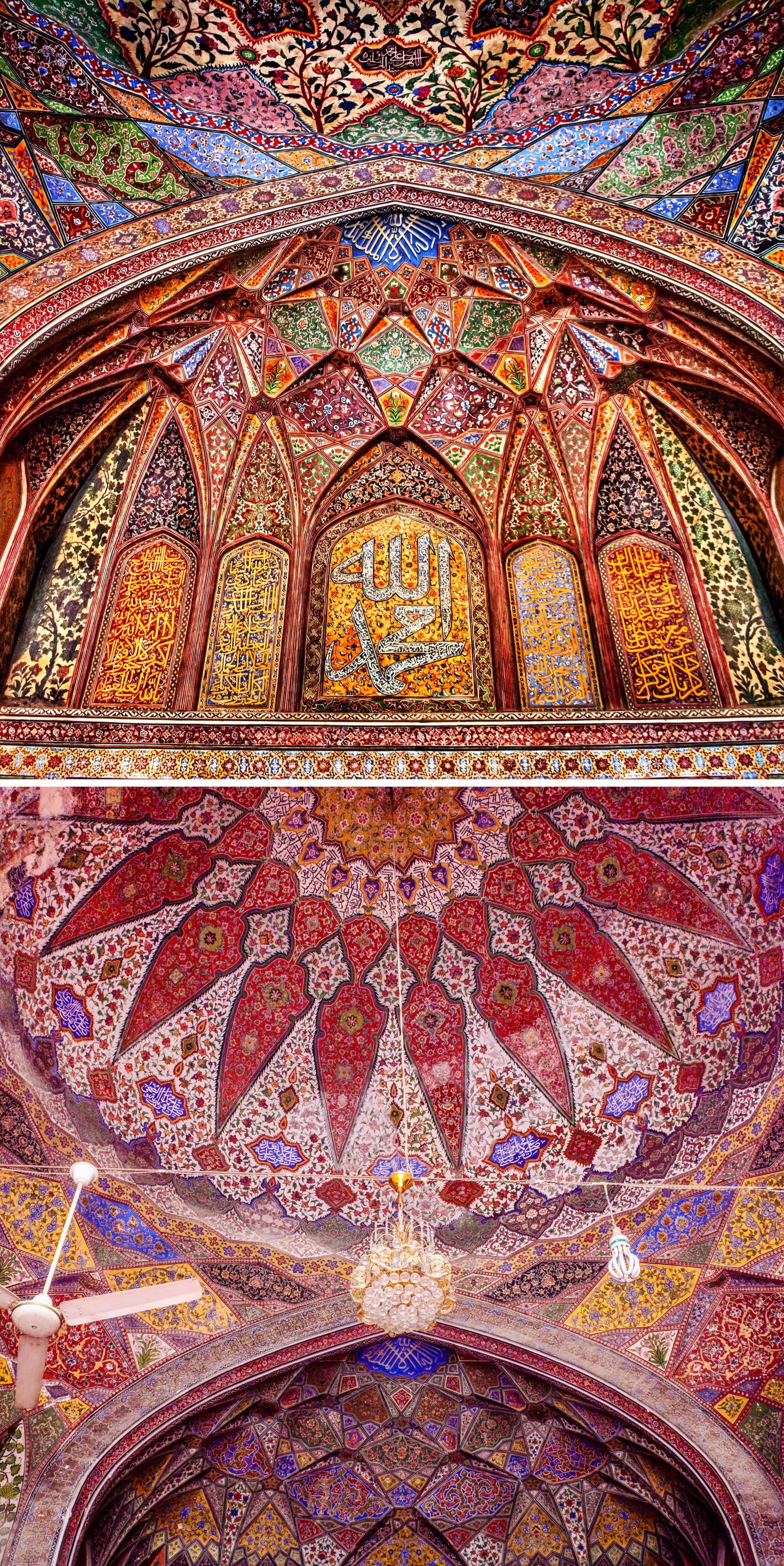
Richly embellished muqarna and the main prayer hall that is decorated with frescoes in The Wazir Khan Mosque, a 17th-century Mughal mosque located in the city of Lahore, Punjab, Pakistan. Construction of the Mosque began in 1634, and was completed in 1641. [2163 x 4320]
by Saint-Veronicas-Veil

2 Comments
The Wazir Khan Mosque is a 17th-century Mughal mosque located in the city of Lahore, Punjab, Pakistan. The mosque was commissioned by the then governor of Punjab, Wazir Khan, during the reign of the Mughal Emperor Shah Jahan as a part of an ensemble of buildings that also included the nearby Shahi Hammam baths. Construction of the Mosque began in 1634, and was completed in 1641.
Considered to be the most ornately decorated Mughal-era mosque, Wazir Khan Mosque is noted for its intricate faience tile work known as kashi-kari, as well as its interior surfaces that are almost entirely embellished with elaborate frescoes. It is on the UNESCO World Heritage Tentative List.
Wazir Khan mosque is known for its elaborate embellishment in a style which draws from the decorative traditions from several regions. While other monuments in Lahore from the Shah Jahan period feature intricate kashi-kari tile work, none match the scale of the Wazir Khan Mosque.
Unlike the contemporary Shah Jahan Mosque in Sindh, the interior walls of Wazir Khan Mosque are plastered and adorned with highly detailed buon frescoes. The interior decorative style is unique for Mughal-era mosques, as it combines imperial Mughal elements with local Punjabi decorative styles. The main prayer hall contains a square pavilion over which the mosque’s largest dome rests — a Persian form known as Char Taq. The underside of the dome feature frescoes depicting trees in pairs, pitchers of wine, and platters of fruit, which are an allusion to the Islamic concept of Paradise.
The arched niche at the mosque’s entrance facing Wazir Khan Chowk is richly decorated with floral motifs, and features one of Lahore’s first examples of a muqarna — an architectural element found at the Alhambra in Spain, as well as on several imperial mosques in Iran. The low domes over the prayer hall reflect the style of the earlier Lodi dynasty, which ruled Lahore prior to the Mughal era.
Wow!! This is so stunning! The embellishments are so intricate and the use of colors are so gorgeous! Would love to see in person.