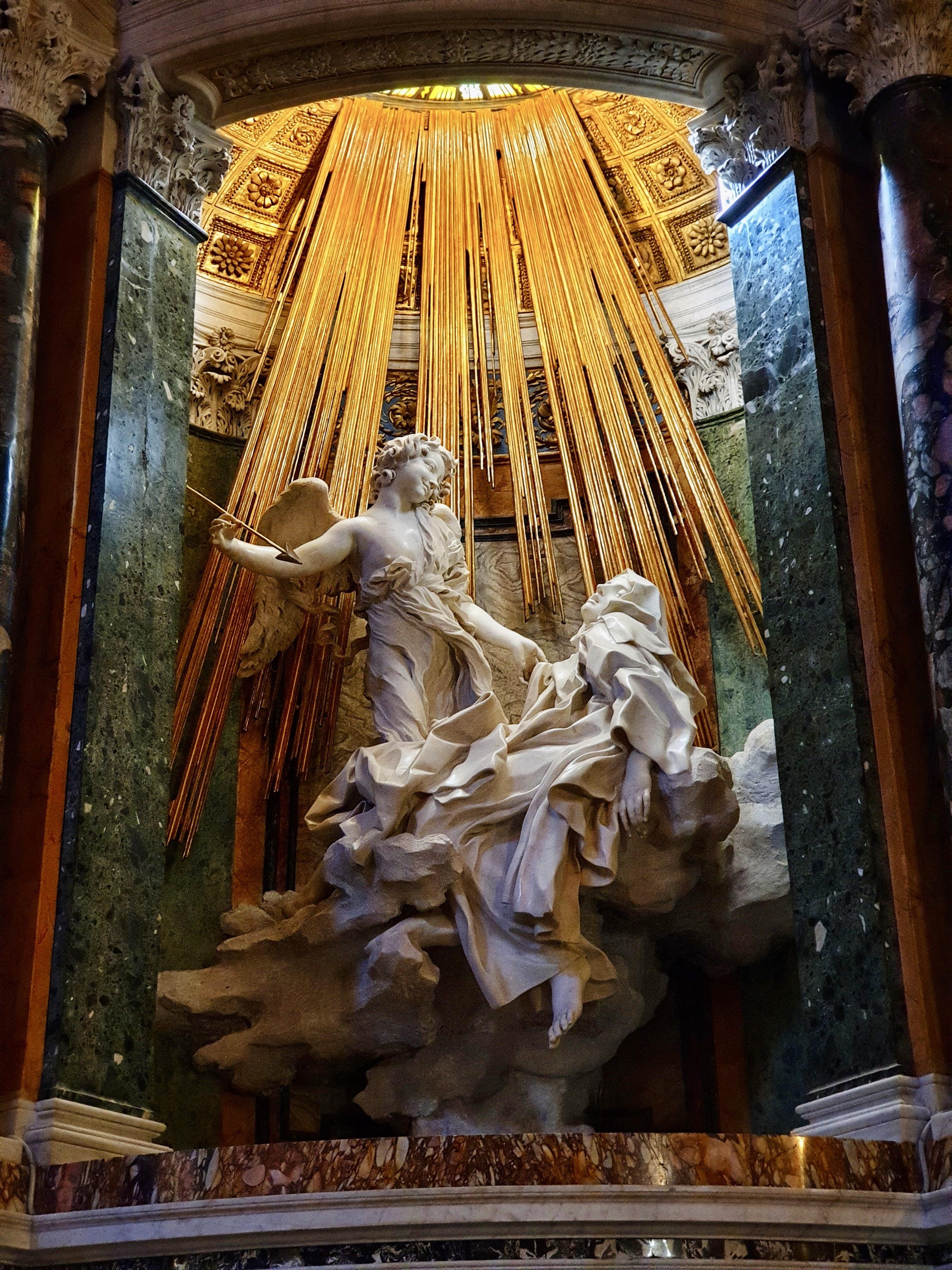
The Ecstasy of Saint Teresa is a sculptural altarpiece in the Cornaro Chapel of the church of Santa Maria della Vittoria in Rome. It was designed and carved by Gian Lorenzo Bernini, the leading sculptor of his day. The commission was completed in 1652. [3024 x 4032]
by Saint-Veronicas-Veil

4 Comments
The Ecstasy of Saint Teresa is a sculptural altarpiece group in white marble set in an elevated aedicule in the Cornaro Chapel of the church of Santa Maria della Vittoria in Rome. It was designed and carved by Gian Lorenzo Bernini, the leading sculptor of his day, who also designed the setting of the chapel in marble, stucco and paint. The commission was completed in 1652.
The ensemble includes at the sides two sets of donor portraits of members of the Cornaro family, who watch the main central group as though in boxes in a theatre. The group is generally considered to be one of the sculptural masterpieces of the High Roman Baroque. The sculpture over the altar shows Saint Teresa of Ávila, a Spanish Carmelite nun (1515–1582), swooning in a state of religious ecstasy, while an angel holding a spear stands over her, following her own account of a vision she had.
The effects are theatrical, the Cornaro family seeming to observe the scene from their boxes, and the chapel illustrates a moment where divinity intrudes on an earthly body. Caroline Babcock speaks of Bernini’s melding of sensual and spiritual pleasure as both intentional and influential on artists and writers of the day. Irving Lavin said “the transverberation becomes a point of contact between earth and heaven, between matter and spirit”. As Bernini biographer Franco Mormando points out, although Bernini’s point of departure for his depiction of Teresa’s mystical experience was her own description, there were many details about the experience that she never specifies (e.g., the position of her body) and that Bernini simply supplied from his own artistic imagination, all with an aim of increasing the nearly transgressively sensual charge of the episode: “Certainly no other artist, in rendering the scene, before or after Bernini, dared as much in transforming the saint’s appearance.”
I miss when the elites at least had the decency of financing the arts with their wealth, not spending it all on yatches and cocaine.
Saint Spaghetti
This one featured in a key scene in the novel Angels and Demons. Maybe the movie too iirc.