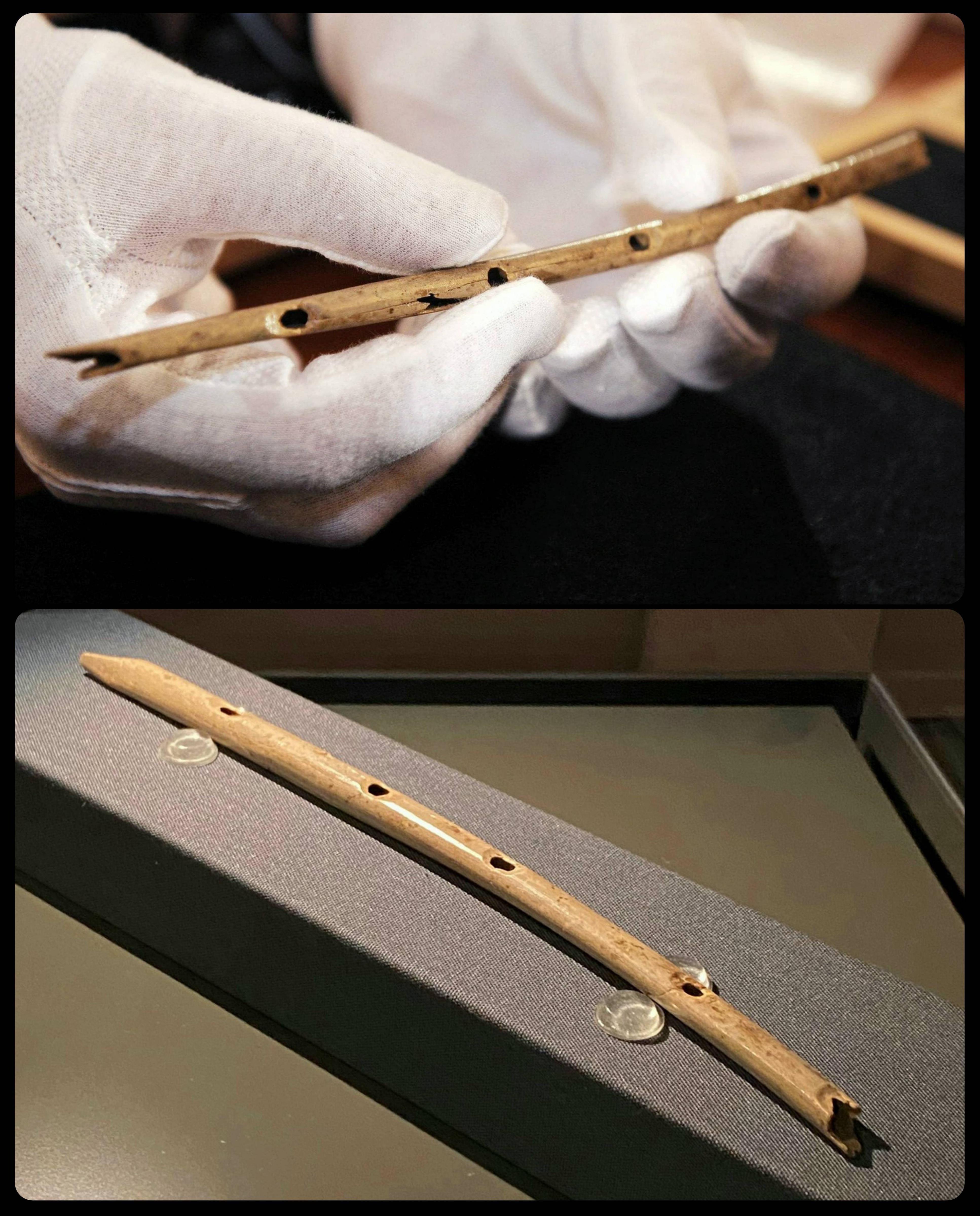
Prehistoric Flute from Germany, c.40,000 BCE: this is one of the oldest musical instruments ever discovered, and it was carved from the wing-bone of a griffon vulture [3867×4798]
Prehistoric Flute from Germany, c.40,000 BCE: this is one of the oldest musical instruments ever discovered, and it was carved from the wing-bone of a griffon vulture [3867×4798]
This flute was discovered during excavations at the Hohle Fels caves in southwestern Germany, where several other flutes dating back to about 41,000-35,000 BCE have also been unearthed. They are the oldest undisputed musical instruments ever discovered.
> With five finger holes and a V-shaped mouthpiece, the almost complete bird-bone flute—made from the naturally hollow wing bone of a griffon vulture—is just 0.3 inch (8 millimeters) wide and was originally about 13 inches (34 centimeters) long.
> … although these are currently the earliest flutes known, it is reasonable to expect that even earlier examples were produced within and outside the region: the instruments from Hohle Fels are too “evolved” in terms of design and manufacture to represent the first flutes.
> The makers and players of the Aurignacian flutes were thus not novices, but had considerable musical knowledge and experience that may have resulted from some form of trans-generational communication.
> Moreover, the earliest musical instruments, such as drums and rattles, were probably made of perishable materials — perhaps wood and hide — that are not routinely preserved in the archaeological record.
> Even so, these flutes from southwestern Germany are of immense importance, as they document a mature musical tradition that was firmly in place thousands of years earlier than previously thought.
> In this rare glimpse into the unfolding of culture itself, we can see that the evolutionary roots of music go deep into our human story. So deep, that many scientists now believe that music played a crucial role in the development of the human mind.
If im not wrong, it is also tuned to a pentatonic scale. Which means, you could play modern day music melodies with it.
DoubleScorpius on
Vultures carried away the spirits of the dead. It’s interesting to think of the way the notes played on a flute made of bird bones would also float away into the sky.

4 Comments
This flute was discovered during excavations at the Hohle Fels caves in southwestern Germany, where several other flutes dating back to about 41,000-35,000 BCE have also been unearthed. They are the oldest undisputed musical instruments ever discovered.
As [this article](https://archive.is/jdfvo) describes:
> With five finger holes and a V-shaped mouthpiece, the almost complete bird-bone flute—made from the naturally hollow wing bone of a griffon vulture—is just 0.3 inch (8 millimeters) wide and was originally about 13 inches (34 centimeters) long.
The [sophistication of the flute’s design](https://www.researchgate.net/publication/26723885_Archaeology_The_earliest_musical_tradition) suggests that it was part of a much older musical tradition that likely predates the colonization of Europe:
> … although these are currently the earliest flutes known, it is reasonable to expect that even earlier examples were produced within and outside the region: the instruments from Hohle Fels are too “evolved” in terms of design and manufacture to represent the first flutes.
> The makers and players of the Aurignacian flutes were thus not novices, but had considerable musical knowledge and experience that may have resulted from some form of trans-generational communication.
> Moreover, the earliest musical instruments, such as drums and rattles, were probably made of perishable materials — perhaps wood and hide — that are not routinely preserved in the archaeological record.
> Even so, these flutes from southwestern Germany are of immense importance, as they document a mature musical tradition that was firmly in place thousands of years earlier than previously thought.
In fact, the development of music [may be as old as humanity itself:](https://kassaflutes.com/articles/fulani-flute-toneholes-tradition)
> In this rare glimpse into the unfolding of culture itself, we can see that the evolutionary roots of music go deep into our human story. So deep, that many scientists now believe that music played a crucial role in the development of the human mind.
#Sources & More Info:
– National Geographic: [Bone Flute is World’s Oldest Musical Instrument, Study Says](https://archive.is/jdfvo)
– PubMed: [The Earliest Known Musical Tradition](https://www.researchgate.net/publication/26723885_Archaeology_The_earliest_musical_tradition)
– The New York Times: [Oldest Musical Instruments are Even Older than First Thought](https://www.nytimes.com/2012/05/29/science/oldest-musical-instruments-are-even-older-than-first-thought.html)
– Kassa Flutes: [Toneholes and Tradition: How a 40,000 Year Old Flute Leveled the Playing Field](https://kassaflutes.com/articles/fulani-flute-toneholes-tradition)
– Nature: [New Flutes Document the Earliest Musical Tradition in Southwestern Germany](https://www.nature.com/articles/nature08169)
Goodness how did it survive unbroken??
If im not wrong, it is also tuned to a pentatonic scale. Which means, you could play modern day music melodies with it.
Vultures carried away the spirits of the dead. It’s interesting to think of the way the notes played on a flute made of bird bones would also float away into the sky.