
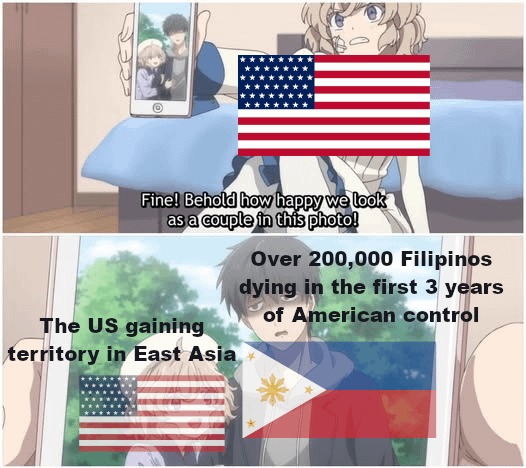
After the Spanish-American War, the US purchased the Philippines from Spain for $20 million. President McKinley spun this as "Benevolent Assimilation," claiming the U.S. was there to tutor and protect their "little brown brothers." But the Filipino people had already declared independence from Spain (with assistance from the US!) and weren't interested in a new manager. The resulting Philippine-American War resulted in the deaths of over 200,000 Filipino civilians (that's the low-end figure), mostly due to famine and disease.
They got past that rough stage after a few years. William Taft was appointed Governor-General, and a number of changes were made. The Philippine Legislature was established, free public schooling was implemented, and the Catholic Church (which had been an instrument of repression under the Spanish) was disestablished and many of their lands redistributed.
Still, the beginning of that relationship was… not good.
by lil_literalist
3 Comments
When your love life turns into a geopolitical strategy
Public schooling was already there during spanish period although not yet widespread since it was only introduced in the 1860’s and implementation is poor.
Those lands were distributed to the local elites to gain their loyalty and not to the common people which is the current form of our land reform problem today.
The relationship was never good all throughout but it was less destructive after the war.
Maybe its me but, if the U.S. didn’t buy the Philippines from Spain, who would have most likely have gotten the Philippines? (assuming that any prospective European powers were interested in the Philippines, or would Japan/China have gotten them?)