You might want to call it an exponential decay. Linear decay of the log a magnitude is the same as rh exponential decay of said magnitude.
kompootor on
You do not cite sources for your data.
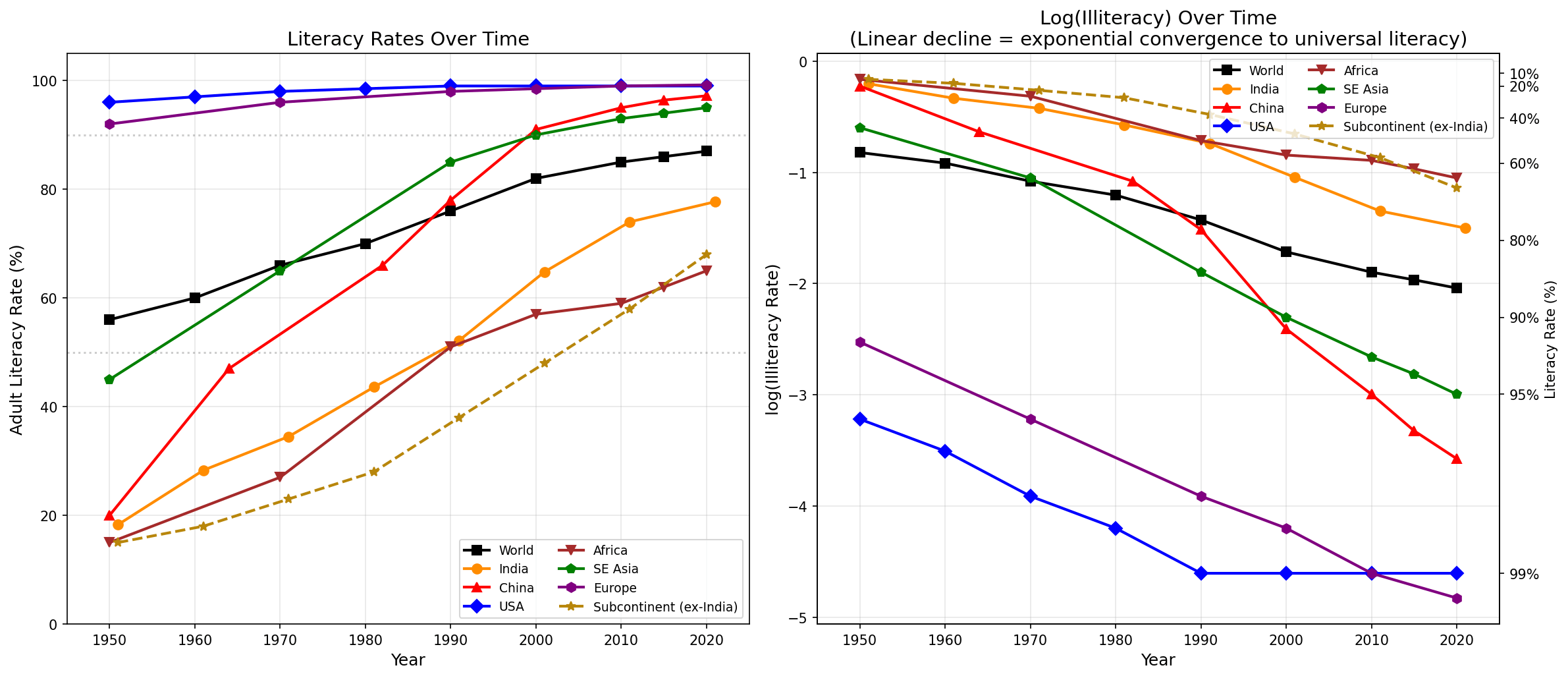
Neither your scale nor your data are suitable to plot “exponential convergence to universal literacy”. As you can see, data for the US appear to have a peak 1% precision, so the literacy rate peaks at 99%. Further precision would be illusory anyway if you go to the source data websites (which you do not cite), because literacy generally has to be measured on a spectrum of competencies. Comparing data across countries/continents in this manner thus is further problematic if you’re not taking this into account.
Compare your left plot to your right plot. Think, given that your data are so sparse, how would you statistically test whether the behavior of the curves is predominantly linear (left) vs exponential (right)? Because these are two assertions, yet both plots have comparable amounts of deviation from straight lines. (This is where plotting percentages in general can potentially get you into trouble too.)

2 Comments
You might want to call it an exponential decay. Linear decay of the log a magnitude is the same as rh exponential decay of said magnitude.
You do not cite sources for your data.
Neither your scale nor your data are suitable to plot “exponential convergence to universal literacy”. As you can see, data for the US appear to have a peak 1% precision, so the literacy rate peaks at 99%. Further precision would be illusory anyway if you go to the source data websites (which you do not cite), because literacy generally has to be measured on a spectrum of competencies. Comparing data across countries/continents in this manner thus is further problematic if you’re not taking this into account.
Compare your left plot to your right plot. Think, given that your data are so sparse, how would you statistically test whether the behavior of the curves is predominantly linear (left) vs exponential (right)? Because these are two assertions, yet both plots have comparable amounts of deviation from straight lines. (This is where plotting percentages in general can potentially get you into trouble too.)