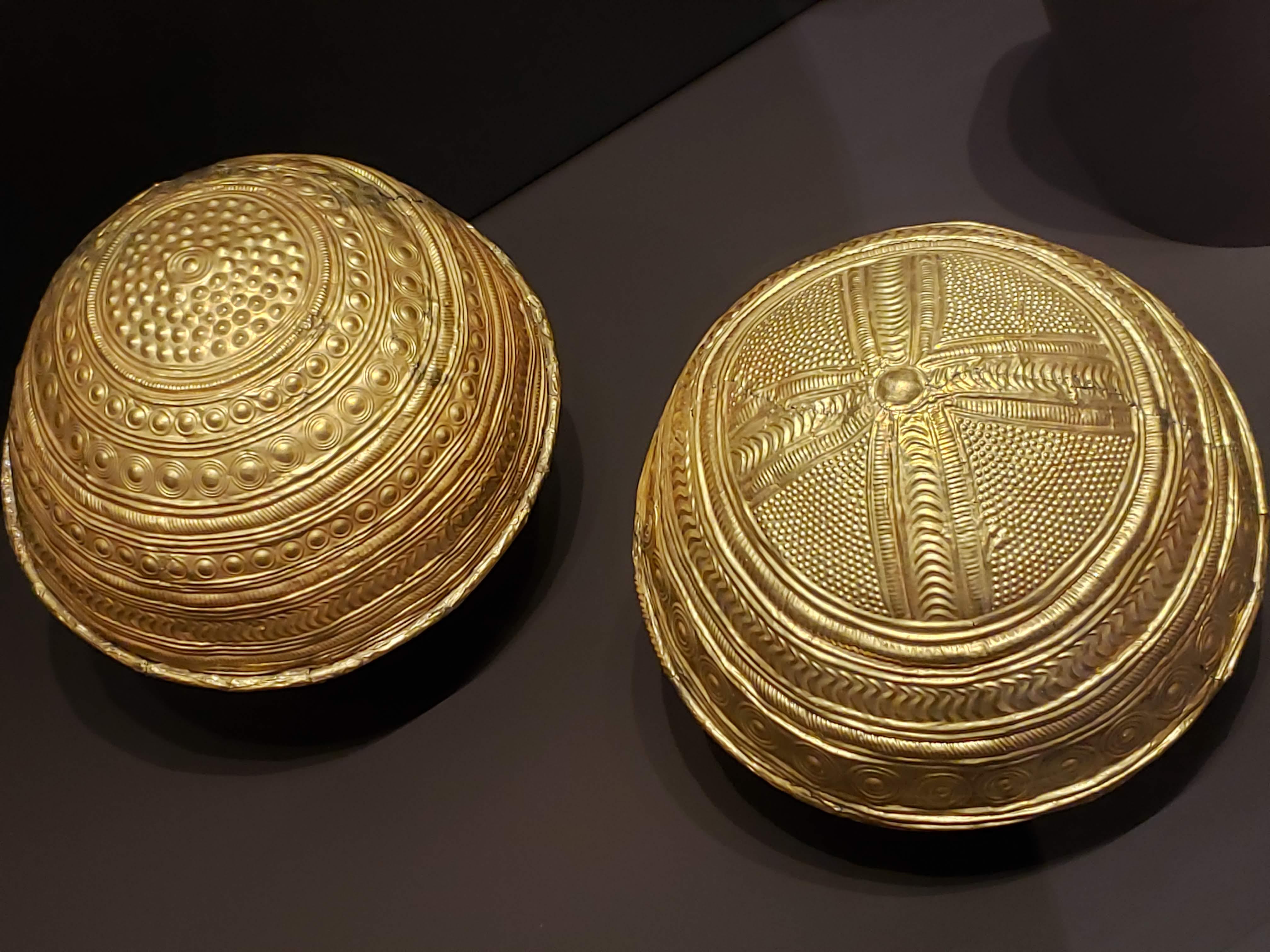
The Axtroki bowls, discovered in 1972 near Eskoriatza, Gipuzkoa, in Spain’s Basque region. Late Bronze Age, ca. 1000-850 BC. Gold. Museo Arqueológico Nacional, Madrid, collection [4032×3024] [OC]
The Axtroki bowls, discovered in 1972 near Eskoriatza, Gipuzkoa, in Spain’s Basque region. Late Bronze Age, ca. 1000-850 BC. Gold. Museo Arqueológico Nacional, Madrid, collection [4032×3024] [OC]
When they were found, one bowl was inside the other. It has recently been suggested that these pieces and the one found in Rianxo, near the Arosa Estuary in Galicia, were probably ceremonial helmets or caps, worn at an act of worship or special ritual of which they are the only remaining legacy. In keeping with this hypothesis, the decorative motifs are thought to be solar symbols.]
Highollow on
Given their location, could those be from a ante-Indoeuropean civilization?
secomano on
I’d have guessed these to be hats instead of bowls.

3 Comments
https://commons.wikimedia.org/wiki/Category:Cuencos_de_Axtroki
[Museo Arqueológico Nacional](https://ceres.mcu.es/pages/Main): 1973/77/1; 1973/77/2
[display description](https://i.ibb.co/rGnfWDBN/20200214-141055.jpg)
[Bowls from Axtroki
Gold
Late Bronze Age
Axtroki (Bolibar, Escoriatza, Guipúzcoa)
When they were found, one bowl was inside the other. It has recently been suggested that these pieces and the one found in Rianxo, near the Arosa Estuary in Galicia, were probably ceremonial helmets or caps, worn at an act of worship or special ritual of which they are the only remaining legacy. In keeping with this hypothesis, the decorative motifs are thought to be solar symbols.]
Given their location, could those be from a ante-Indoeuropean civilization?
I’d have guessed these to be hats instead of bowls.