
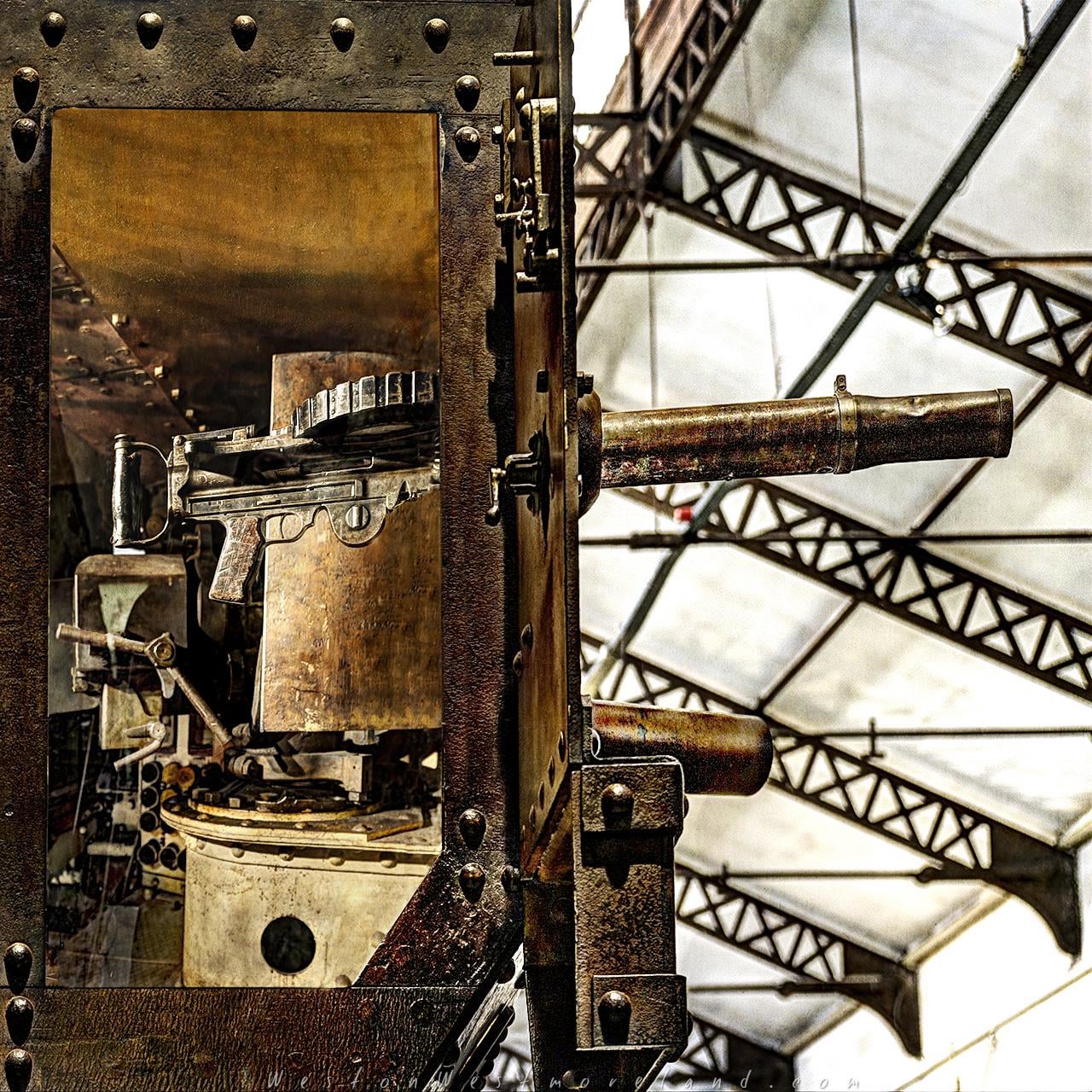
View through the starboard sponson entry hatch of an MK-IV “Male” tank, with a Lewis machine gun in the foreground and a 6-pounder behind, 1917. The Male carried two 6-pound cannons and three Lewis MGs. The Lewis were standardized for Mark IV tanks due to their compact barrels… [1280×1280] [OC]
by WestonWestmoreland
1 Comment
…The Mark IV is the first tank ever to come into battle with practical results and the most iconic one of the Great War.
As the conflict became stagnant and the armies entrenched themselves and turned the battlefield into a hellish labyrinth of mud, bomb craters and barbed wire, the contenders tried to find a way to help their infantry break through the enemy lines. They British idea was an armored and armed vehicle that could advance on mud, over barbed wire and sort the crossing gaps formed by the trenches. They called it a “tank” so that the enemies and the press would think it was some kind of water deposit. The first prototypes were not up to expectations, but proved the British were ion the right path.
A typical Male crew included a captain, lieutenant, driver, and gunners operating guns amid ricocheting bullets that could blind drivers via periscopes. Stalling the engine left them sitting ducks, and poor visibility demanded commanders scout on foot. Despite horrors, tight-knit crews bonded through shared maintenance and drill.
Serving inside a Mark IV Male tank during World War I was grueling, with extreme heat, toxic fumes, deafening noise, and constant danger from enemy fire and mechanical failures. Crews of eight to nine men endured temperatures over 40-50°C (104-122°F), carbon monoxide and cordite fumes that caused unconsciousness or death without fresh air, and such loud engine noise that signals required hammering on the hull.
The cramped interior lacked ventilation or separate engine compartments, leading to choking smoke and frequent radiator boil-overs requiring extra water cans. Crude armor spalled flakes of paint and steel from bullets, forcing crews to wear chain-mail helmets and goggles; post-action recovery often took days due to exhaustion and illness. Fires were common and specialized teams were created to retrieve charred remains.
In one epic 60+ hour action, the Fray Bentos crew (Male tank F41) fought off Germans despite ditching, losing one man and wounding seven, earning the war’s most decorated crew awards. Crews fired rifles through portholes during close assaults and risked exiting under fire for unditching beams.
The Mark IV was first used in large numbers on 7 June 1917, during the British assault on Messines Ridge. Crossing dry but heavily cratered terrain, many of the 60-plus Mark IVs lagged behind the infantry, but several made important contributions to the battle. It benefited from significant improvements. Most of the tanks that took part on the first armored attack broke down or were somehow destroyed, but they effectively broke through the enemy lines and went deep into the German rearguard.
Nearly 460 Mark IV tanks were used during the Battle of Cambrai in November 1917, showing that a large concentration of tanks could quickly overcome even the most sophisticated trench systems.
In the aftermath of the German spring offensive on the Western Front, the first tank-to-tank battle was between Mk IV tanks and German A7Vs in the Second Battle of Villers-Bretonneux in April 1918.
About 40 captured Mark IVs were employed by the Germans as Beutepanzerwagen (the German word Beute means “loot” or “booty”) with a crew of 12. These formed four tank companies from December 1917. Some of these had their six pounders replaced by a German equivalent.
A total of 1,220 Mark IVs were built: 420 “Males”, 595 “Females” a variation of the Male with more MGs instead of cannons) and 205 Tank Tenders (unarmed vehicles used to carry supplies), which made it the most numerous British tank of the war.
War had changed forever, once again.
On a side note, a Lewis MG ,shot from the ground by Australian infantry, is thought to be the one that took the Red Baron down.
My apologies for inaccuracies and mistakes.