
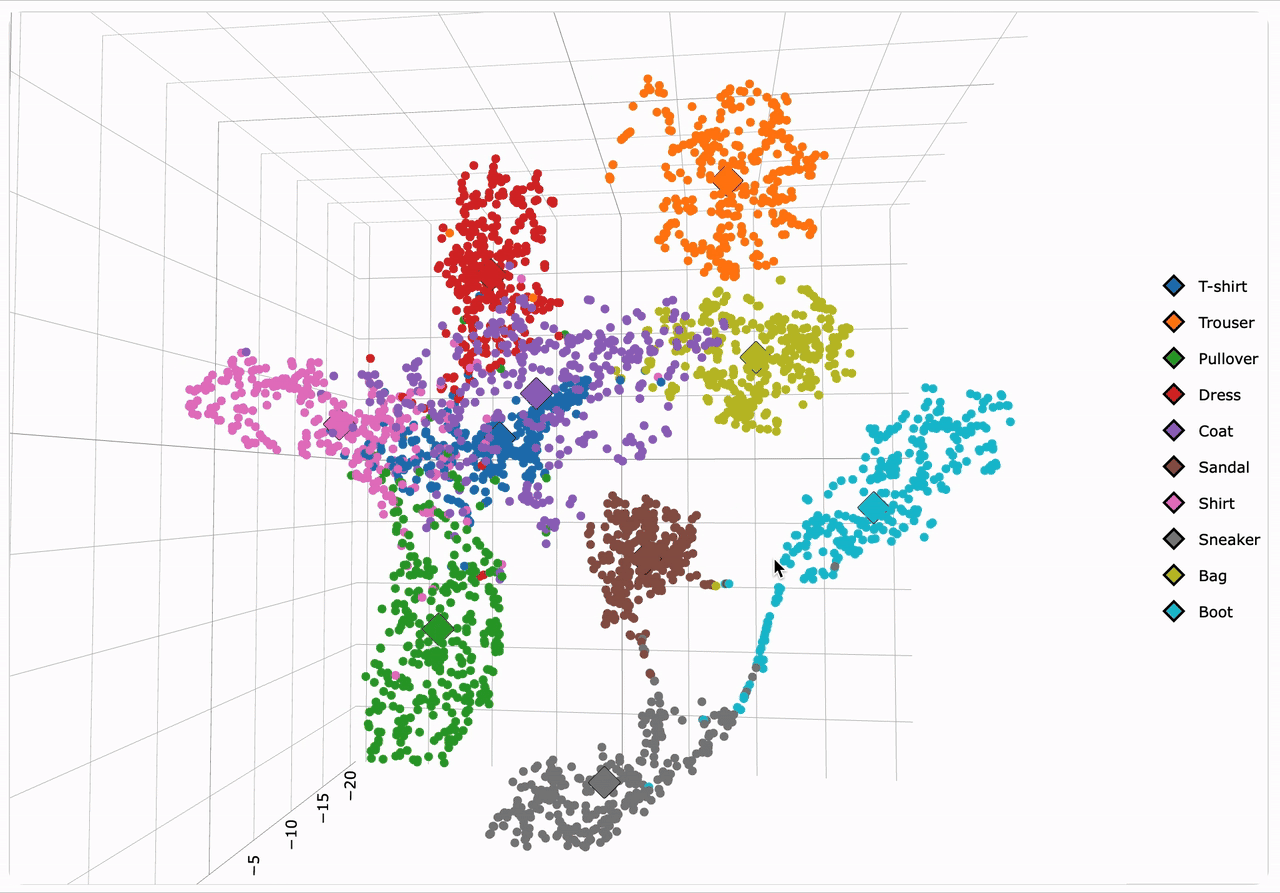
This visualization represents the Fashion-MNIST dataset, which consists of 70,000 grayscale images across 10 distinct clothing categories (T-shirts, trousers, sneakers, etc.).
I trained a Convolutional Neural Network (CNN) to recognize these items. Instead of just looking at the final classification, I extracted the internal 512-dimensional vector produced by the convolution layers. This vector represents the "features" the AI sees.
To visualize this, I used dimensionality reduction algorithms (t-SNE and UMAP) to project those 512 dimensions down into a 3D cloud. The result is that items the AI finds visually similar drift together, creating natural clusters.
It’s interesting to see how the classes corresponding to Shirt, T-shirt, Pullover, and Coat form overlapping clusters in the latent space due to their visual similarity, whereas footwear classes such as Sneaker and Boot form distinct, dense clusters that are well separated. High-cut sneakers and some boots lie between the two clusters, forming a transition zone.
Take a look at it here: bulovic.at/fmnist
by BeginningDept
1 Comment
I thought this was Western Europe at first.