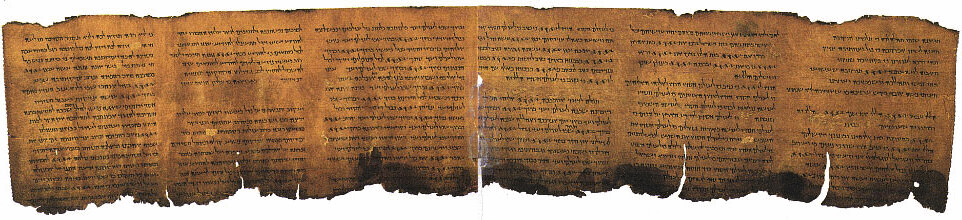
Everyone’s heard of the Dead Sea Scrolls, but most people don’t realize why they’re historically groundbreaking: they’re 1,000 years older than any other Hebrew Bible manuscripts we had, proving the Old Testament was barely changed for millennia
by GermanCCPBot

35 Comments
The Dead Sea Scrolls, discovered between 1947-1956 in caves near Qumran, are one of the most significant archaeological finds in history, but not for the reasons most people think.
Before the Dead Sea Scrolls were found, the oldest complete Hebrew Bible manuscripts we had were from around 900-1000 CE (the Masoretic texts). That meant there was a roughly 1,000-year gap between when the books were supposedly written and our oldest copies . Scholars had no way to know if the text had been altered, corrupted, or rewritten during that millennium.
Then a Bedouin shepherd stumbled into a cave in 1947 and found ancient jars containing scrolls dating to 250 BCE-70 CE, pushing our manuscript evidence back over 1,000 years. When scholars compared these ancient scrolls to the medieval manuscripts, they found something shocking: the text was nearly identical .
This proved that Jewish scribes had preserved the Hebrew Bible with extraordinary accuracy for over a millennium, copying it with almost no changes despite being handwritten by generation after generation . It validated the textual reliability of the Old Testament in a way nothing else could.
There’s also books there that aren’t in the Bible, and not accept as canon, but are still biblical.
old testament in christianity was edited to hell
What they didn’t retcon all the stuff that was no longer considered socially acceptable to make the belief still valid?
[deleted]
In 40k years the 999th edition of Lord Of The Rings will be mostly unchanged too.
Doesn’ t make it reality; the dead sea scroll isn’t anything special other than the scribes was true to the original fairytale.
Archeological significance is something completely else entirely.
I that was your intention, to highlight the archeological significance I apologize my ranting, though not the content thereof.
Also, the small changes compared to the canonized text give an invaluable glimpse into anything from copying mistakes to deep theological differences which existed and were washed out by the process of canonization.
We have older fragments for Old Testament. This is misleading.
And it is the biggest con job of all time
What’s also impressive is how ancient Hebrew in this document is remarkably identical to what is spoken today.
[deleted]
Written by Jackus Kerouacus.
I’m sure the comments here will be civil
My personal favorite is Sapiential Didactic Work A (4Q412)
We have much, much older documents from the old testament now. The Ketef Hinnom Silver Scrolls were found in 1979, and believed to have been written in the 7th century BC. They, too, confirmed the reliability of the text over the years.
millenia – plural of millennium
Define “barely.”
As far as I know, they haven’t been carefully dated using state-of-the-art methods. So there’s no way of knowing just how significant they are.
If you think this is cool check out the Book of Enoch that was also found in the dead sea scrolls but removed from nearly every other version of the Bible
There were like 1,000 documents found, and almost all were either scripture, law, or explaining beliefs. One of them, though, is literally a treasure map.
It was made of copper and tin instead of parchment or papyrus, and engraved rather than written. Had to be cut into strips to be read. It has like 64 locations and says things like “Buried under the steps…” Estimated worth in the billions but no treasure has ever been found.
Iron age folk tales standing the test of time. Remarkable really.
So this is the source of the evil in the world
These scrolls did a little to help Christianity. The book of Isaiah was found in its entirety as part of the Dead Sea Scrolls. For those who don’t know, the book of Isaiah is a prophetic book where it predicts the birth, life, and purpose of Jesus.
Oh great. That means that the book the people use to justify genocide has been around even longer than we originally thought?
If this comment section doesn’t mention the Septuagint and Masoretic texts then it’s missing out on a massive opportunity.
The Dead Sea Scrolls were surprising, but more flabbergasting to me is that the Vedas were basically unchanged despite being an _oral_ tradition. They literally played telephone for over a thousand years before writing it down, and not just the wording but the rhythm and accent are preserved.
The concept of a canon of holy texts was really in its infancy in the 1st C BCE, when the Dead Sea Scrolls were deposited. Apologists love to try to claim that the DSS support the canon as it later developed, but that’s really not the case .
The DSS contain plenty of texts that did not come to be included in the cabin, such as the Book of Giants, the Genesis Apocryphon, the War Scroll, the Community Rules, the Book of Enoch, etc. So already we are looking at a collection of texts that diverges widely from the later accepted canon.
The differences between the canonical books in the DSS and their later “standardized” versions are also not always trivial. Jeremiah, Kings, and Samuel all vary significantly from the later versions. (E.g. 1 Samuel 11 has a weird, abrupt passage about [Nahash, King of Ammon](https://en.wikipedia.org/wiki/Nahash_of_Ammon?wprov=sfla1), and the version of Samuel found in the DSS contains a few additional sentences that were omitted from later copies – likely due to a copying error – that provides essential context to understand the passage).
Here are a few clips by the biblical scholar Dan McClellan discussing the DSS and how they relate to the later canon: [on Isaiah](https://youtu.be/9WIhYZ4cya0?si=kmyWRDmEJ9kFjXwi), [more on Isaiah](https://youtu.be/HL9N-pF5pcU?si=eJPIcc6GqyAIk0_C), [DSS compared to the KJV](https://youtu.be/6cOgozzUYRo?si=8MNgC7wu8845bBhm), and if you want a more in depth discussion, check out episode 45 of his podcast Data Over Dogma, where his interviews Kipp Davis about the DSS.
If you want a rigorous yet accessible introduction to biblical study on these topics, you can’t go wrong with Dan McClellan – he really knows his stuff (and I say that as someone with a doctorate in assyriology, so I have some notion of how complex the study of these topics can be).
Edit: fixed link
About 15 years ago I worked for an Art installation and moving company. We handled lots of very expensive high end stuff. A coworker and I had gotten a job to take the truck to the American Airlines cargo terminal at the airport and then to take the crate to a local university’s seminary program. The crate was large and very well made. We did not know what was inside and the guys at the airport were really curious what was in this large box marked very fragile. We got it all strapped in and drove it safely to where it needed to be. We dropped it off and the lady signed for it and we took it inside. She wouldn’t and couldn’t tell us what was inside at that time. We then drove back to the office. On the way back we saw a billboard that said “Coming soon to University Seminary…the Dead Sea Scrolls”. We both looked at each other, shocked. And yup…that’s what was inside. We just casually drove priceless artifacts across town, unknowingly.
So… The book… Of… Mormon…
Which book was omitted as canon that had weird stories of jesus as a child and the talking dog?
Wild stuff.
Meh, they still made up all the stories.
NOT TRUE. There are many books on the differences. Some small. Some huge! But thousands of differences none the less. Others even interpret as a different origin story.
And they are critical in the human instrumentality project
Gold star for the generational dedication of scribes in a difficult endeavor. Humans are capable of cool things.
Unfortunately the fact that the text hasn’t changed much in 1,000 years is used as ‘evidence’ that all the events contained therein are true, and all the spiritual references are accurate, which is logic that is not applied to any other writings, and is not sound reasoning. Put another way, how long does a writing have to stay accurate through rewritings before it’s considered significant AT ALL?
If Harry Potter is unchanged 1,000 years from now, no one will use that as evidence it was actually 100% factual.