
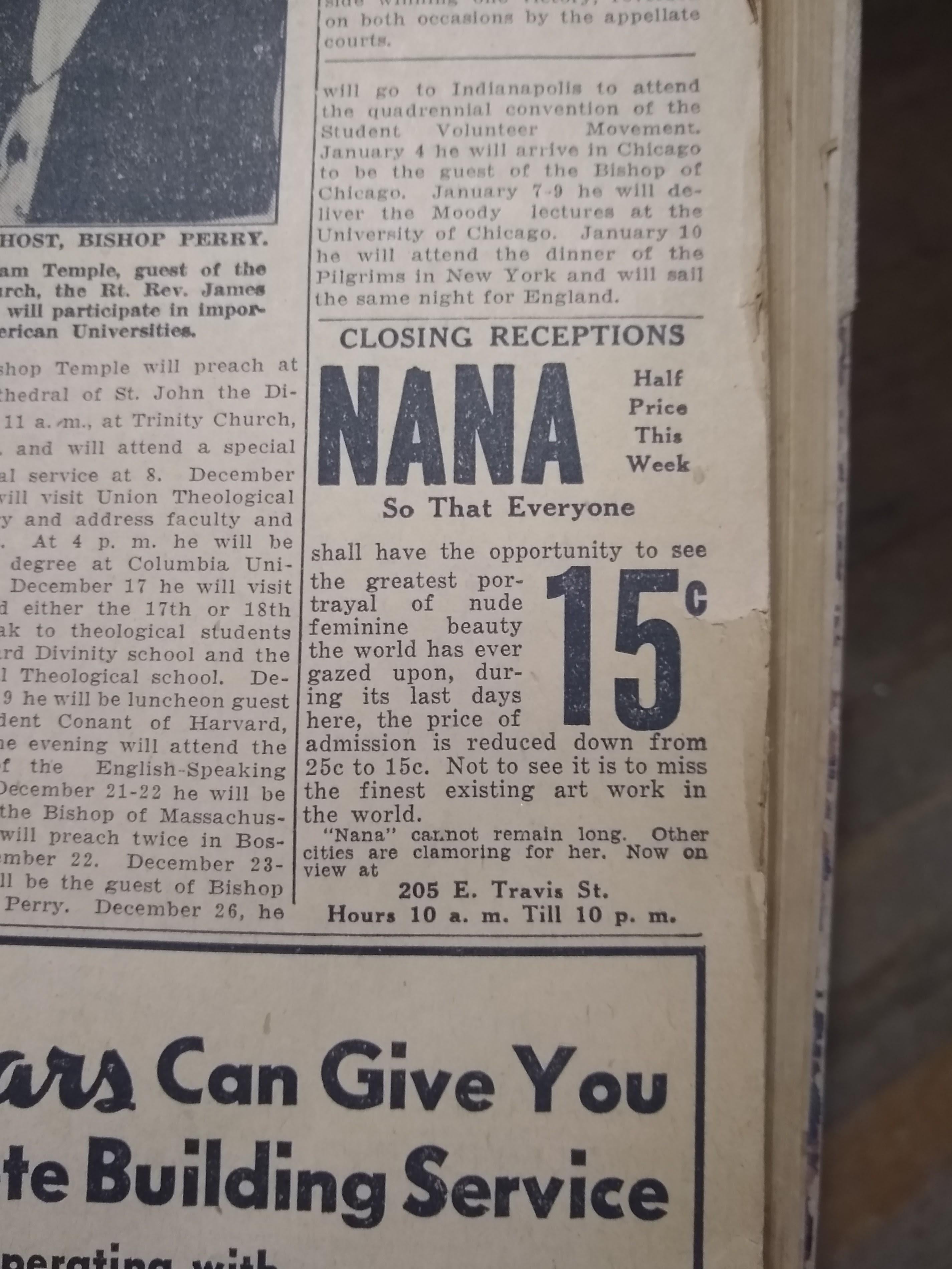
Nana (1881) by Marcel Suchorowsky was exhibited through out the United States and Europe from the 1890's through the 1930's before reappearing in the 1970s and being sold to Texas real estate developer Trammell Crow. Here is a short footnoted history of the painting and its exhibitions. The History of Russian Empire's Most Expensive Painting. A small black and white image of the painting is included in the history. (That small image is the only NSFW aspect of this post.)
After Nana was rejected by the Academic Council, Marcel Suchorowsky decided to make a personal exhibition. This was not new; a lot of famous painters made solo expositions of one painting if it was famous or remarkable in some way. From December 20, 1881, Nana was shown at the exhibition hall of G. I. Hansen’s house (on the corner of Nevsky Prospekt and Malaya Konyushennaya 26/16) daily from 10 a.m. to 10 p.m. (which was possible only with the use of electric lighting, a technical innovation of that time). The entrance ticket price was 30 silver kopecks, quite an expensive price at that time (according to historical data, 1 kg of wheat flour cost 2 kopecks). The success of the exhibition was incredible. Sixteen thousand people came to see Nana during a month and a half. It was more popular than regular salons at the Imperial Academy of Arts and exhibitions of Peredvizhniki. In February 1882, the painting moved to Moscow and was placed in a separate hall on the Petrovsky lines. The entrance fee for the exhibition was raised to 50 kopecks (Severyuhin 2008b, 431).
Nana’s composition is simple (Picture 1). The young courtesan is depicted naked laying in a seductive pose on a sofa, as embodied female’s viciousness and lust. To enhance the effect of his work, Suchorowsky demonstrated it with carefully supplied lighting and elements of the dioramas (or, as it was called back then, “panorama”). The room was decorated with velvet draperies and items common for a stylish boudoir. Pink satin shoes were thrown down on the carpet in front of the painting as if they have fallen from it. Exhibition was often accompanied with music. In a short review of Georgy Ivanov we may also notice that the efforts of Marcel Suchorowsky not only to show the painting but also to create the atmosphere were known and memorable. Thus, he notes, “Part of the “dessu” [underwear] whimsically scattered around the beauty’s bed was drawn, part was the real ones” (Ivanov 1994, 280–281). These attributes were very carefully made; it was not possible to distinguish them even from the first row. All these turned the exhibition into a great show.
by Syllogism19