
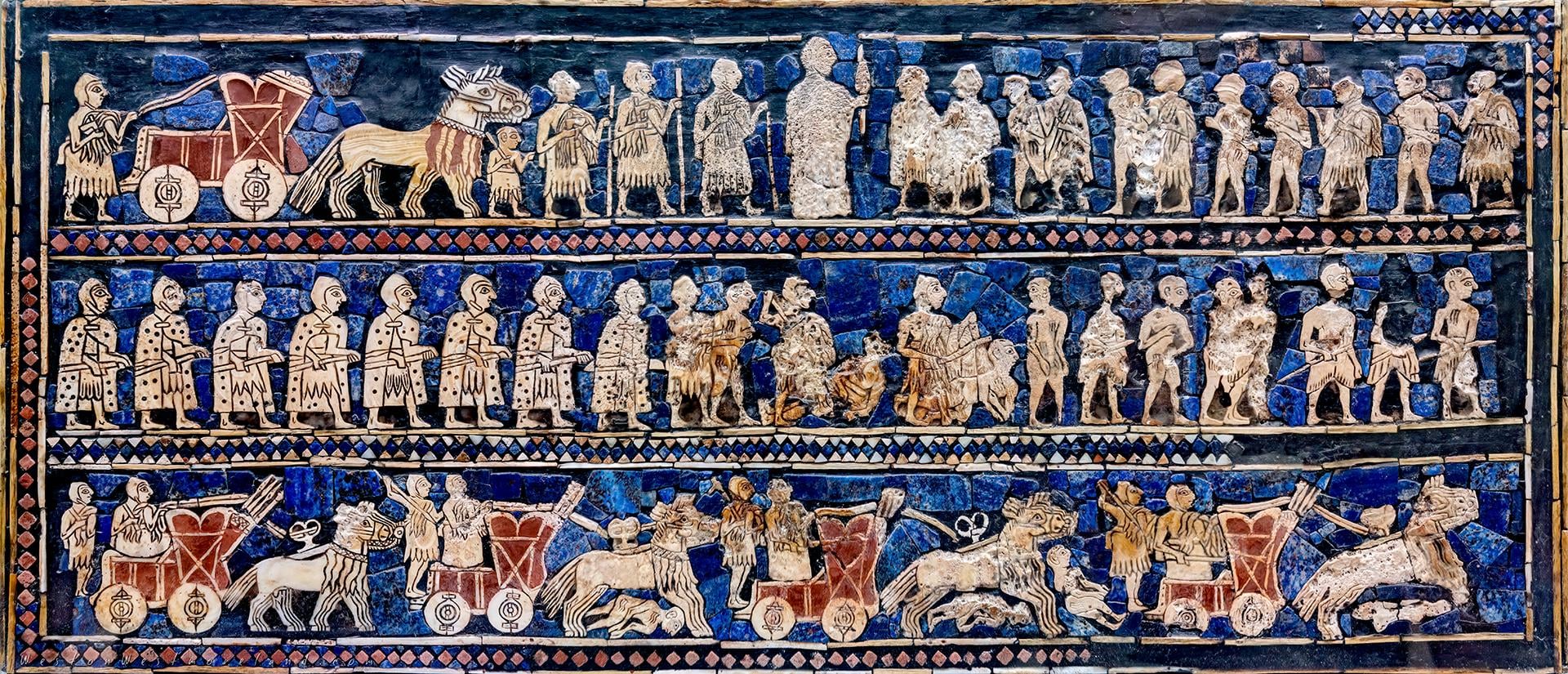
War Panel of the Standard of Ur, Sumerian, c. 2600 BC. One of the two main sides of what most likely formed a box (the other known as Peace), it is one of the earliest representations of a Sumerian army, in what is considered the comic-like narration of a border skirmish… [1920×825] [OC]
by WestonWestmoreland
1 Comment
…and its aftermath, to be read like a comic book from bottom to top.
The bottom tier shows four war wagons, each carrying a driver and a warrior (carrying either a spear or an axe) and drawn by a team of four equids (possibly onagers or domestic asses since horses were only introduced in the 2nd millennium BC after being imported from Central Asia).
The wagons are depicted in considerable detail; each has solid wheels (spoked wheels were not invented until about 1800 BC) and carries spare spears in a container at the front. The arrangement of the equids’ reins is also shown in detail, illustrating how the Sumerians harnessed them without using bits, which were only introduced a millennium later. The wagon scene evolves from left to right in a way that emphasizes motion and action through changes in the depiction of the animals’ gait. The first wagon team is shown walking, the second cantering, the third galloping and the fourth rearing. Trampled enemies are shown lying under the hooves of the latter three groups, symbolizing the potency of a war wagon attack.
In the middle tier, eight virtually identically depicted soldiers give way to a battle scene, followed by a depiction of enemies being captured and led away. The soldiers are shown wearing leather cloaks and helmets; actual examples of the sort of helmet depicted in the mosaic were found in the same tomb. The nudity of the captive and dead enemies was probably not meant to depict literally how they appeared in real life, but was more likely to have been symbolic and associated with a Mesopotamian belief that linked death with nakedness.
The top tier shows the king at the center of the scene, standing taller than any other figure, with his head projecting out of the frame to emphasize his supreme status. He stands in front of his bodyguard and a war wagon. He faces a row of prisoners, all of whom are portrayed as naked, bound and injured with large, bleeding gashes on their chests and thighs – a device indicating defeat and debasement.
The Standard of Ur comprises a hollow wooden box measuring 8.50 in wide by 19.50 in long, inlaid with a mosaic of shell, red limestone and lapis lazuli. It was found in a royal tomb in Ur next to the skeleton of a ritually sacrificed man. It dates to the First Dynasty of Ur during the Early Dynastic period. The standard was probably constructed in the form of a hollow wooden box with scenes of war and peace represented on each side through elaborately inlaid mosaics. Although interpreted as a standard by its discoverer, the original function of the Standard of Ur is not conclusively understood.
The [current form of the artifact](https://upload.wikimedia.org/wikipedia/commons/thumb/3/38/Denis_Bourez_-_British_Museum%2C_London_%288747049029%29_%282%29.jpg/960px-Denis_Bourez_-_British_Museum%2C_London_%288747049029%29_%282%29.jpg) is a reconstruction that presents the best guess of its original appearance. It has been interpreted as a hollow wooden box. The box has an irregular shape with end pieces in the shape of truncated triangles, making it wider at the bottom than at the top.
The artifact was found in one of the largest royal tombs in the Royal Cemetery at Ur, tomb PG 779, associated with Ur-Pabilsag, a king who died around 2550 BC. Excavations in Mesopotamia from 1927–1928 uncovered the artifact in the corner of a chamber, lying close to the shoulder of a man who may have held it on a pole. For this reason, it was interpreted as a standard, giving the object its popular name, although subsequent investigation has failed to confirm this assumption.
The discovery was quite unexpected, as the tomb in which it occurred had been thoroughly plundered by robbers in ancient times. As one corner of the last chamber was being cleared, a workman spotted a piece of shell inlay.
The Standard of Ur survived in only a fragmentary condition. The ravages of time over more than four thousand years caused the decay of the wooden frame and bitumen glue which had cemented the mosaics in place. The soil’s weight had crushed the object, fragmenting it and breaking its end panels.[5] This made excavating the Standard a challenging task. Woolley’s excavators were instructed to look for hollows in the ground created by decayed objects and to fill them with plaster or wax to record the shape of the objects that had once filled them, rather like the famous plaster casts of the victims of Pompeii.[8]
When the remains of the Standard were discovered, the excavators saw that, while their wooden frame had disintegrated, the mosaic pieces had kept their form in the soil. They carefully uncovered small sections measuring about 3 cm2 (0.47 sq in) and covered them with wax, enabling the mosaics to be lifted while maintaining their original designs. The pieces were consolidated with paraffin which caused deterioration. The Standard was completely dismantled and reassembled in 1973, with the inlays on the end panels being adjusted at that time.
My apologies for inaccuracies and mistakes.