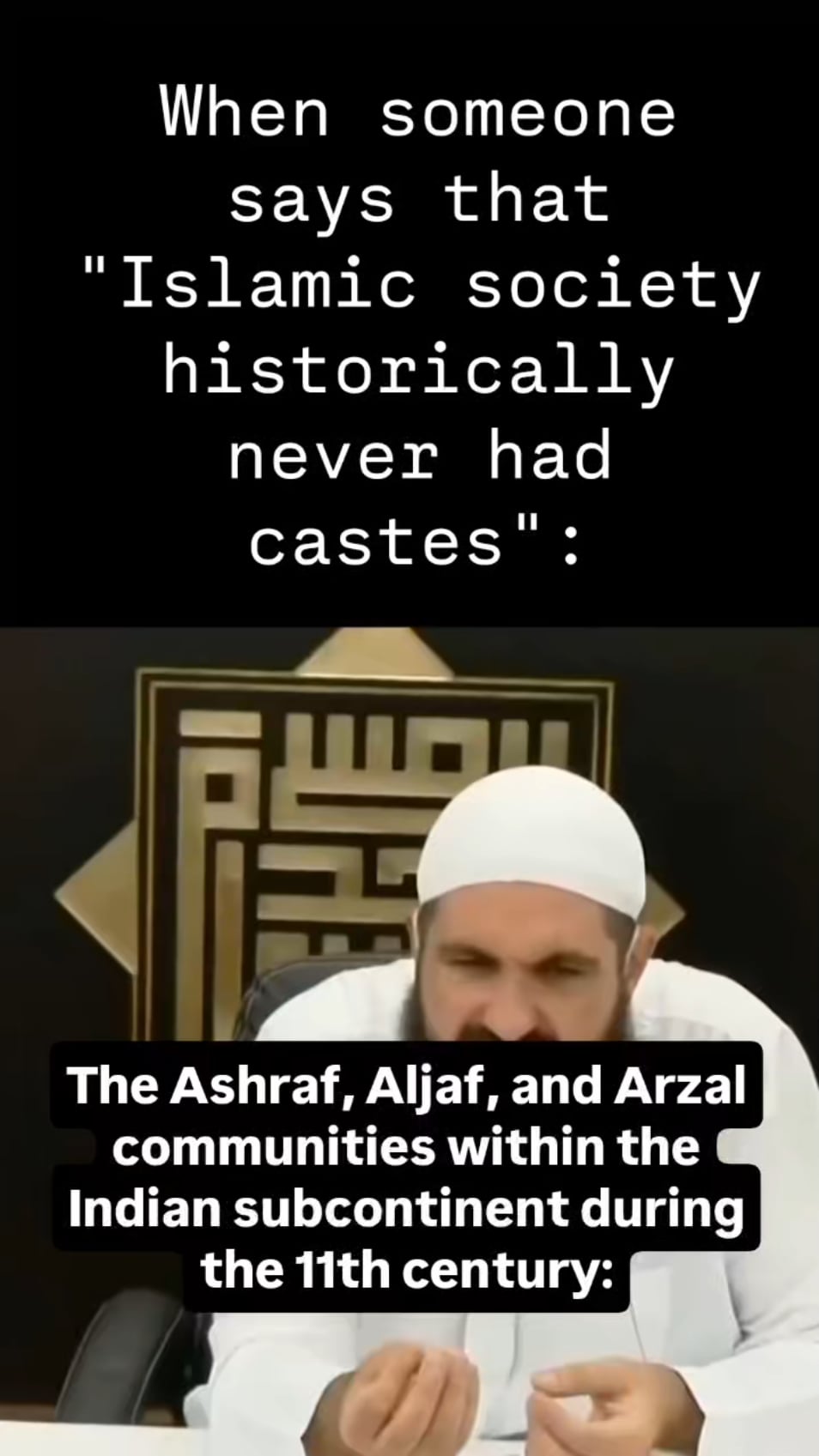
Muslim communities in South Asia have a system of social caste stratification arising from the caste system in India which early Muslim communities encluntered either through trade or invasions of the Indian subcontinent. It developed as a result of relations among foreign conquerors, local upper-caste Hindus convert to Islam (ashraf, also known as tabqa-i ashrafiyya) and local lower-caste converts (ajlaf), as well as the continuation of the Indian caste system by converts.Non-ashrafs are backward-caste converts. The concept of “pasmanda” includes ajlaf and arzal Muslims; ajlaf status is defined by descent from converts to Islam and by Birth (profession).These terms are not part of the sociological vocabulary in regions such as Kashmir and Uttar Pradesh, and say little about the functioning of Muslim society.
The Baradari system is social stratification in Pakistan and, to an extent, India. The South Asian Muslim caste system includes hierarchical classifications of khandan (dynasty, family, or lineage).
Although Islam does not recognize any castes (only socio-economic classes), existing divisions in Persia and India were adopted by local Muslim societies. Evidence of social stratification exists in later Persian works such as Nizam al-Mulk’s 11th-century Siyasatnama, Nasir al-Din al-Tusi’s 13th-century Akhlaq-i Nasiri, and the 17th-century Jam-i-Mufidi.
After Muhammad’s death in the seventh century CE, tribes and families fought a war of succession. After this, a determinant for social stratification in Arab society included being part of Muhammad’s close family (ahl al-bayt).This factor was present in ancient South Asia among Muslims since the eighth century.
This led to a further hierarchical determinant: Arabs versus non-Arabs. Among non-Arabs, further divisions were made between Muslims who were converted in early Islamization campaigns (khadim-al islam) and those who converted more recently (jadid-al islam). South Asian Muslims are divided by classifications that have resulted in Arab-origin higher castes (unch zat) and descendants of lower-caste converts (nich zat). Mughal Empire sultans were high-caste.
The Muslims who came to the subcontinent during the 12th century were already divided into vocation-based social “classes”, including priests, nobles, and others, and racial segregation separated local Muslim converts from foreign-origin Muslims. The foreigners claimed superior status, since they were associated with the conquerors and considered themselves as sharif (“noble”).Indian Muslim society also split in accordance with the Hindu caste system. According to M. N. Srinivas (1986) and R. K. Bhattacharya, Indian Hindu converts to Islam brought their caste system to the region’s Muslim society. Louis Dumont, however, believed that the Islamic conquerors adopted the Hindu caste system “as a compromise which they had to make in a predominantly Hindu environment.”
Ziauddin Barani, a 14th-century Indian political thinker in the Delhi Sultanate, suggested that the “sons of Mohamed” receive a higher social status than the low-born. His most significant contribution to the fatwa was his analysis of castes and Islam. Barani said that castes would be mandated through state laws (zawabi), which would take precedence over sharia in a conflict. According to Barani, every act “contaminated with meanness and based on ignominy, comes elegantly [from the Ajlaf]”. He developed an elaborate system of promotion and demotion of imperial officers (wazirs), primarily based on caste. Barani’s opinions were not followed by his own sultanate. He accused the Tughlaq Sultans of appointing “low-born” people to high office; they included Sultan Muhammad Shah and Sultan Firuz Shah, Barani’s patron in Delhi, who appointed a former slave captured from Telangana and converted as his grand vizier.
Muslims from the julaha (weaver) caste began to identify as “Ansaris”, butchers as “Quereshis”, and the sanitation and bhishti castes as “Sheikh”. The Muslim concept of hereditary kafa’ah, which the ulama use to support endogamy, justifies South Asian Muslim caste practices.
Ashrafization (or sharifization) is the process of lower-caste Muslims adopting upper-caste Muslim practices to climb the social ladder. Some would associate with different titles or claim different ancestry to achieve this.
Some families would claim Sayyid status (a biological descent from the Islamic prophet Muhammad, most oftentimes via his daughter Fatima) with varying degrees of success. The Sayyid dynasty (founded by a Punjabi)and Barha Sayyids (founded by Punjabi peasants who moved to Muzaffarnagar)are examples of families who succeeded in being recognized as Sayyids. However, other families had their claims dismissed. The Nawabs of the Rohilla dynasty (founded by a Jat Hindu convert) failed to provide any reliable proof for their claims and were thus ignored.
Other families would simply claim a general Arab ancestry. The Awans have historically claimed Arab descent, adopting the title of Malik, thus granting them a “high status in the Indian Muslim environment”.The Kalhoros and Daudpotras also attempted to associate with Arabs, adopting the title of Abbasi.The Shaikhs in North India also claim Arab descent.
Some groups, such as the Sambhals of Uttar Pradesh, claim Turkic descent and relation to the Mughal people.
As the Pashtunization of Khyber Pakhtunkhwa took place, local Indo-Aryan tribes would begin to associate with the foreign Pashtuns. Many of the former Dardic speakers of Swat and Indus Kohistan now claim Pashtun ancestry.
Ghaus Ansari (1960) identified the following four categories of Muslim social divisions in India:
1.Ashrafs, who claim foreign-origin descent
Forward-caste converts
2.Converts from other Indian tribes
3. Converts from untouchable castes
Ashraf hierarchy is determined by the degree of nearness to Muhammad and country of origin; Syeds (who trace descent from Fatima, Muhammad’s daughter) have the highest status. Non-Ashrafs are categorized as ajlaf, with untouchable Hindu converts also categorized as arzal (“degraded”).They are relegated to menial professions, such as scavenging and carrying night soil (removing human excreta from medieval latrines)
-Wikipedia
SijilmaasanGoldMan on
Yeah we didn’t really have castles, we had giant, world renowned fucking city metropolis’ instead.
srimaran_srivallabha on
Lmao everyone has caste in India, I was surprised to see Christian brahmins, and Christian kayastha as a caste among Goan catholic christians lmao
frankyfires on
i remember pakistan even rejected the person who got nobel prize from pak cause he was from lower muslim caste

4 Comments
Muslim communities in South Asia have a system of social caste stratification arising from the caste system in India which early Muslim communities encluntered either through trade or invasions of the Indian subcontinent. It developed as a result of relations among foreign conquerors, local upper-caste Hindus convert to Islam (ashraf, also known as tabqa-i ashrafiyya) and local lower-caste converts (ajlaf), as well as the continuation of the Indian caste system by converts.Non-ashrafs are backward-caste converts. The concept of “pasmanda” includes ajlaf and arzal Muslims; ajlaf status is defined by descent from converts to Islam and by Birth (profession).These terms are not part of the sociological vocabulary in regions such as Kashmir and Uttar Pradesh, and say little about the functioning of Muslim society.
The Baradari system is social stratification in Pakistan and, to an extent, India. The South Asian Muslim caste system includes hierarchical classifications of khandan (dynasty, family, or lineage).
Although Islam does not recognize any castes (only socio-economic classes), existing divisions in Persia and India were adopted by local Muslim societies. Evidence of social stratification exists in later Persian works such as Nizam al-Mulk’s 11th-century Siyasatnama, Nasir al-Din al-Tusi’s 13th-century Akhlaq-i Nasiri, and the 17th-century Jam-i-Mufidi.
After Muhammad’s death in the seventh century CE, tribes and families fought a war of succession. After this, a determinant for social stratification in Arab society included being part of Muhammad’s close family (ahl al-bayt).This factor was present in ancient South Asia among Muslims since the eighth century.
This led to a further hierarchical determinant: Arabs versus non-Arabs. Among non-Arabs, further divisions were made between Muslims who were converted in early Islamization campaigns (khadim-al islam) and those who converted more recently (jadid-al islam). South Asian Muslims are divided by classifications that have resulted in Arab-origin higher castes (unch zat) and descendants of lower-caste converts (nich zat). Mughal Empire sultans were high-caste.
The Muslims who came to the subcontinent during the 12th century were already divided into vocation-based social “classes”, including priests, nobles, and others, and racial segregation separated local Muslim converts from foreign-origin Muslims. The foreigners claimed superior status, since they were associated with the conquerors and considered themselves as sharif (“noble”).Indian Muslim society also split in accordance with the Hindu caste system. According to M. N. Srinivas (1986) and R. K. Bhattacharya, Indian Hindu converts to Islam brought their caste system to the region’s Muslim society. Louis Dumont, however, believed that the Islamic conquerors adopted the Hindu caste system “as a compromise which they had to make in a predominantly Hindu environment.”
Ziauddin Barani, a 14th-century Indian political thinker in the Delhi Sultanate, suggested that the “sons of Mohamed” receive a higher social status than the low-born. His most significant contribution to the fatwa was his analysis of castes and Islam. Barani said that castes would be mandated through state laws (zawabi), which would take precedence over sharia in a conflict. According to Barani, every act “contaminated with meanness and based on ignominy, comes elegantly [from the Ajlaf]”. He developed an elaborate system of promotion and demotion of imperial officers (wazirs), primarily based on caste. Barani’s opinions were not followed by his own sultanate. He accused the Tughlaq Sultans of appointing “low-born” people to high office; they included Sultan Muhammad Shah and Sultan Firuz Shah, Barani’s patron in Delhi, who appointed a former slave captured from Telangana and converted as his grand vizier.
Muslims from the julaha (weaver) caste began to identify as “Ansaris”, butchers as “Quereshis”, and the sanitation and bhishti castes as “Sheikh”. The Muslim concept of hereditary kafa’ah, which the ulama use to support endogamy, justifies South Asian Muslim caste practices.
Ashrafization (or sharifization) is the process of lower-caste Muslims adopting upper-caste Muslim practices to climb the social ladder. Some would associate with different titles or claim different ancestry to achieve this.
Some families would claim Sayyid status (a biological descent from the Islamic prophet Muhammad, most oftentimes via his daughter Fatima) with varying degrees of success. The Sayyid dynasty (founded by a Punjabi)and Barha Sayyids (founded by Punjabi peasants who moved to Muzaffarnagar)are examples of families who succeeded in being recognized as Sayyids. However, other families had their claims dismissed. The Nawabs of the Rohilla dynasty (founded by a Jat Hindu convert) failed to provide any reliable proof for their claims and were thus ignored.
Other families would simply claim a general Arab ancestry. The Awans have historically claimed Arab descent, adopting the title of Malik, thus granting them a “high status in the Indian Muslim environment”.The Kalhoros and Daudpotras also attempted to associate with Arabs, adopting the title of Abbasi.The Shaikhs in North India also claim Arab descent.
Some groups, such as the Sambhals of Uttar Pradesh, claim Turkic descent and relation to the Mughal people.
As the Pashtunization of Khyber Pakhtunkhwa took place, local Indo-Aryan tribes would begin to associate with the foreign Pashtuns. Many of the former Dardic speakers of Swat and Indus Kohistan now claim Pashtun ancestry.
Ghaus Ansari (1960) identified the following four categories of Muslim social divisions in India:
1.Ashrafs, who claim foreign-origin descent
Forward-caste converts
2.Converts from other Indian tribes
3. Converts from untouchable castes
Ashraf hierarchy is determined by the degree of nearness to Muhammad and country of origin; Syeds (who trace descent from Fatima, Muhammad’s daughter) have the highest status. Non-Ashrafs are categorized as ajlaf, with untouchable Hindu converts also categorized as arzal (“degraded”).They are relegated to menial professions, such as scavenging and carrying night soil (removing human excreta from medieval latrines)
-Wikipedia
Yeah we didn’t really have castles, we had giant, world renowned fucking city metropolis’ instead.
Lmao everyone has caste in India, I was surprised to see Christian brahmins, and Christian kayastha as a caste among Goan catholic christians lmao
i remember pakistan even rejected the person who got nobel prize from pak cause he was from lower muslim caste